

Russia's blockade could cause mass famine beyond Ukraine – but it’s a crime without a name
- Written by: Alexander Gillespie, Professor of Law, University of Waikato
Trying to gauge the worst aspect of the Russian invasion of Ukraine is difficult. For some, it will be the illegal invasion itself. For others, the war crimes or crimes against humanity committed since.
But measured in terms of pure human suffering, the worst atrocity may well turn out to be famine beyond the immediate warzone. With Russian blockades of Ukrainian ports preventing the export of grain, there are now warnings of mass starvation in other countries.
But while invasions and war crimes are recognised as breaches of international law, causing famine as collateral damage in countries not directly related to the war is not a recognised crime. There is not even a name for this type of atrocity, one that could kill millions.
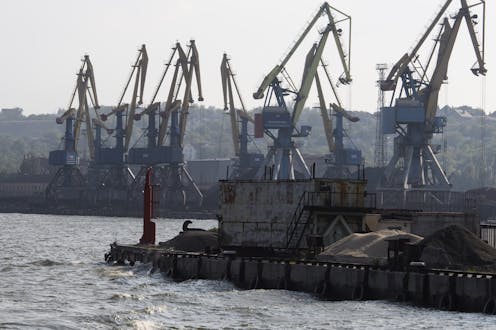
Ukraine is one of the world’s most important breadbaskets and a major cog in the global food economy. There have been direct attacks on Ukrainian grain storage facilities, but Russia knows the most effective economic damage lies in targeting export routes on land and sea. Over 70% of Ukrainian exports, including 99% of its corn, go by ship.
Russia has suspended entry into the strategic Sea of Azov on Ukraine’s south-east coast and effectively blockaded the northern part of the Black Sea, where Nato says the risk of collateral damage or direct attack on merchant ships is high.
Dozens of other vessels are stuck in Ukrainian ports, and soaring shipping prices and rising insurance rates are pushing merchant vessels to safer locations.
Collateral damage beyond the warzone
Using hunger as a weapon of war is not new. And while there were attempts in the 19th century to restrict blockades to weapons and contraband directly related to war efforts, such chivalrous ideas dissolved in the horrors of the first and second world wars.
The subsequent Geneva Conventions prohibited the starvation of civilians as a method of warfare. Ocean blockades designed to deny civilian populations the essentials for survival are also illegal. In 2018, the United Nations Security Council (including Russia) reconfirmed the prohibition of the use of hunger as a weapon of war.
Read more: War in Ukraine is pushing global acute hunger to the highest level in this century
Although Russia has now tried to back away from such humanitarian legal commitments, these rules are considered customary, meaning they apply generally, whether or not specific countries agree. There are also strong legal arguments and broad principles about freedom of transit that apply to ocean trade for peaceful purposes.
But all these laws and rules are directed at protecting civilians within warzones. They were designed to contain the immediate damage of war. They were not designed to prevent collateral damage to distant populations unconnected to a conflict.
So while starvation of an enemy is not new, starvation of vulnerable but distant civilian populations is. It’s partly a symptom of our globalised world, where interconnection, vulnerability and outdated or inadequate rules and restraints are all colliding. And it means the greatest loss of life related to the Ukraine war may occur elsewhere.
War in a hungry world
The threat is exacerbated by the wider problem of famine and malnutrition in a world where 811 million people go to bed hungry every night. The number facing acute food insecurity has more than doubled since 2019, from 135 million to 276 million.
Up to 44 million people in 38 countries are on the edge of famine. Most are just one more economic shock from disaster – such as a potential 37% increase in food prices now forecast by the World Bank.
There can be many causes of food crises, but a combination of climate shocks, rising prices and conflict now sees 60% of the world’s hungry living in areas afflicted by war, violence, debt and poverty.
Read more: With the UN powerless, the greatest danger now may be Russia beginning to lose in Ukraine
It’s not possible to say whether Russia’s threat to global food security is deliberate or coincidental to its war aims, but there are ways catastrophe can be avoided.
Ideally, the Sea of Azov and Black Sea would be demilitarised. A workable compromise would be all sides in the war agreeing to a safe corridor for merchant vessels and food trade, guaranteed by neutral third parties.
Given the seemingly intractable situation now between Russia, Ukraine and the West, this may be a vain hope. But urgent efforts must be made. The lives of millions on the edge of famine and living beyond the warzone may depend on it.
Authors: Alexander Gillespie, Professor of Law, University of Waikato


















