Google AI


Modern Australian

To protect vulnerable Australians from COVID this winter, we need to pick up the pace on third doses

  • Written by: Peter Breadon, Program Director, Health and Aged Care, Grattan Institute
To protect vulnerable Australians from COVID this winter, we need to pick up the pace on third doses

Anthony Albanese campaigned on better pandemic management. Giving the vaccination program a shot in the arm will be his first test.

Not long ago, every shipment of vaccines was a news item and people were queuing around the block to get a jab.

Today, despite rising COVID cases and deaths, Australians seem to have lost interest. The vaccination rate for third doses has almost stalled.

Speeding up third doses will be critical to protecting Australians against Omicron variants as we move into winter. But without a focus on equal access, that protection will remain uneven.

Read more: COVID has killed 5,600 Australians this year and the pandemic isn't over. Ethics can shape our response

Australia is losing the race

After a shaky start, Australia got near the top of the charts for second dose coverage.

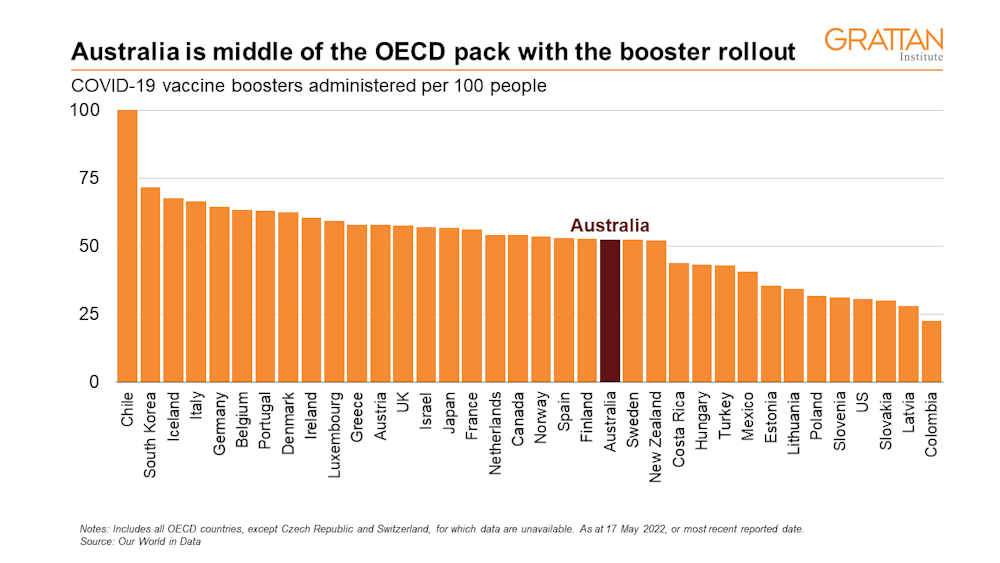
But only about half the population has had a third dose. That puts us back in the middle of the OECD pack, and we’re falling further behind the leaders.

At the current rate, it would take about two years for every Australian who had a second dose to get their third. That’s not nearly fast enough to improve protection before winter. Vaccination still matters Thousands of hospital beds across Australia are occupied by people with COVID. Freeing up those beds is urgent. The flu season is looming, and hospitals are facing a perfect storm heading into winter: emergency departments overflowing, elective surgery wait lists ballooning, and the health workforce stretched to the limit. Read more: Cases are high and winter is coming. We need to stop ignoring COVID Data from the United Kingdom show third doses substantially reduce symptomatic infections and hospitalisations. Against Omicron, protection falls quickly after the second dose, until a third dose boosts it and keeps it higher for longer. That makes high third dose coverage important. It’s also easier than the other steps required for a comprehensive plan to reduce severe illness from COVID, such as national ventilation standards, better access to tests, more antiviral doses, and promoting mask use. Compared to those measures, vaccination is straightforward. We’ve bought the doses, we’ve done it before, and it’s effective and safe. But we’re moving too slowly overall, and parts of the country are being left behind. There are wide gaps in coverage The Department of Health publishes data on the proportion of the eligible population that has received second and third doses in different parts of Australia (the international comparison above uses the share of the whole population). Our analysis shows that the share of eligible Australians without a third dose is three times higher in the least-vaccinated areas compared to the most-vaccinated. This problem isn’t new. By early November in 2021, half of the local areas in Australia had reached 80% second dose coverage. Today, about one in 20 still haven’t made it. It’s not random who misses out. Poor areas are more likely to have low vaccination rates (see chart below), even though they should have the highest. People living in poor areas are more exposed, because more of them have in-person jobs and live in larger households. If they get infected, their chance of severe illness is higher, because they are more likely to have risk factors such as chronic disease. Low vaccination coverage only adds to their risk of harm. Likewise, people living in remote areas have lower vaccination, as do Aboriginal people in many parts of Australia, even though these groups are at greater risk. A key lesson of Victoria’s second wave in 2020, and NSW’s in 2021, is the importance of vaccinating people at higher risk, including those in lower-income areas, to slow the spread of COVID and reduce severe illness. The data show this critical lesson of the pandemic has not been learned. Read more: Australia is failing marginalised people, and it shows in COVID death rates How can we get faster … and fairer? Getting higher – and fairer – vaccination rates will require national and local action. Government advertising and political leadership helped raise the vaccination rate before. The Albanese government should lead the way on third doses, promoting the importance, safety, and impact of vaccination. The government should set ambitious coverage targets for vulnerable groups and areas, and support tailored, local solutions to achieve them. Primary Health Networks (PHNs) are regional bodies responsible for improving primary care, which is health care given outside a hospital, typically without a referral. That includes vaccinations at GP clinics and community pharmacies. Their role includes improving access to care for people at risk of missing out. PHNs should work with local communities to lift third dose rates, with new funding for the PHNs that have the lowest rates in their area, linked to targets they must hit. Local barriers are different from place to place, but there are many proven ways to overcome them. Clinics reaching out to people is effective. Aboriginal-controlled services can play a critical role in their communities. There is experience here and overseas about partnering with community leaders and organisations, countering distrust, and vaccinating in different community settings. Tough vaccine mandates have worked to increase uptake. If other measures fail, and hospitalisations rise, they should be considered again. Without strong leadership, the vaccination rate will remain low and uneven. Getting it right will make a difference now and give us the playbook for the next dose, the next vaccine, and the next pandemic. Authors: Peter Breadon, Program Director, Health and Aged Care, Grattan Institute

Read more https://theconversation.com/to-protect-vulnerable-australians-from-covid-this-winter-we-need-to-pick-up-the-pace-on-third-doses-183609

What to Do When an Older Car Is No Longer Worth Keeping in Melbourne

Ever looked at another repair quote and wondered whether your old car is still worth the trouble? It is a common turning point for Melbourne motoris...

Your Baby's First Year: A Local Guide to Feeding, Sleep, and When to Get Extra Support

Ask ten parents in a Brisbane mothers' group how their baby is feeding or sleeping, and expect ten different answers.  Someone's baby sleeps throug...

Kitchen and Laundry Makeover Ideas That Don't Require a Full Renovation

Full kitchen renos are expensive — and most people don't actually need one.  They need the kitchen to stop looking like it's stuck in 2009, or they...

How Technology Is Reshaping the Modern Australian Commercial Kitchen

The commercial kitchen has always been shaped by technology. Refrigeration changed how ingredients could be stored, modern ventilation transformed k...

The Number on a Roller Blind Fabric That Nobody Explains

Somewhere in the fabric book, next to the colour name, there is a percentage. Three per cent. Five per cent. Ten per cent. Nobody explains it, most c...

What’s Trending in Men’s Jewellery This Father’s Day!

Finding a Father’s Day gift that feels personal, stylish and genuinely wearable is not always easy. While socks and novelty mugs have traditionally ...

Road Signs: Understanding Their Role in Clear and Effective Signage

Effective signage and display hardware can help businesses communicate information, promote products and organise customer or visitor movement. Road...

Bottle Label Printing: Key Factors to Consider Before Your Next Packaging Run

Effective packaging begins with understanding the product, bottle material, artwork and production requirements when planning bottle label printing. H...

Planning a Long-Distance Move With Interstate Movers Melbourne

Moving between states involves more planning than a typical local relocation. Along with packing and transporting household belongings, you need to...

Understanding the Role of an I/O Controller in Industrial Automation

Modern industrial systems depend on accurate communication between sensors, machines and control systems. An I/O controller can help manage this commu...

How the Right Mining Hose Supports Demanding Operations

Mining environments place considerable demands on equipment used for material transfer, water management and processing. Hoses operating in these co...

Simple Ideas for Making Social Gatherings More Memorable

We have all been to those parties where everyone just stands around the kitchen island, staring at their phones, waiting for someone else to make a mo...

Outdoor Wall Lights: Improving Exterior Lighting Around Your Home

Lighting can influence how a room looks, feels and functions, so the right fitting should be selected according to both appearance and practical req...

Commercial Office Cleaning: Combining Routine Office Cleaning With Melbourne Service

Keeping a workplace clean requires a service that can accommodate everyday tasks as well as the particular needs of the business. Professional comme...

Caravan Sales in Queensland: How to Find the Right Caravan for Sale QLD

Caravan ownership is about more than having somewhere to sleep while travelling. For many Queenslanders, it is one of the best ways to explore regio...

What Sir Walter Buffalo Turf Actually Costs in 2026 (And Why Quotes Vary So Much)

Two quotes landed on a Hills District homeowner's kitchen table last spring for the exact same 80-square-metre backyard. One said $12 a metre. The o...

Nearly 1,300 NSW Hospital Beds Are Occupied By People Who Are Ready To Go Home

1,276 people in NSW hospitals have been medically cleared for discharge but remain in hospital because they're still waiting for NDIS or aged care sup...

National Survey Launched to Measure Operational Impacts of Federal NDIS Policy Reforms

The effects of recent NDIS reforms are beginning to move beyond policy papers and into day to day service delivery. A new national survey is asking ...