

When is a COVID mutation a new variant, and when is it a subvariant? And what’s a recombinant?
- Written by: Paul Griffin, Associate Professor, Infectious Diseases and Microbiology, The University of Queensland
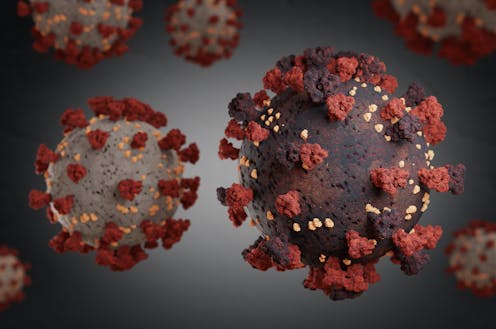
We’ve all become familiar with virus mutations over the course of the pandemic, and can all probably list off the COVID variants including Alpha, Delta and Omicron. But now we’re hearing more and more about subvariants, as Omicron mutates into Omicron BA.2, Omicron BA.4, Omicron XE, and more.
We know the virus is mutating as it spreads, but when is a new mutation a new variant, and when is it a subvariant? And what happens when they combine?
Read more: What's the new Omicron XE variant and should I be worried?
First, what are mutations?
When cells reproduce, they use a set of genetic instructions (made of DNA or RNA) to replicate. But given this is happening at such a rapid rate, sometimes errors can occur.
These errors, or changes in the genetic code, are also called mutations.
In complex organisms such as humans, we are pretty good at finding and fixing these mistakes. But when these finding and fixing processes fail, we see diseases such as cancer arise.
When mistakes happen during the copying of the genetic material in viruses, most of them leave the genetic material too broken to go on replicating, and that virus doesn’t survive.
Occasionally, by random chance, these errors can happen in a section of the code that allows the virus to survive, and in the process, changes occur in the virus.
When it’s in a part of the virus that determines how it behaves, it can change the properties of the virus.
It may change the severity of the disease it causes, our ability to diagnose the virus with our current tests, or even how well treatments work.
Since it was first reported in the Chinese city of Wuhan in December 2019, there have been more than 520 million recorded cases of COVID worldwide (and probably many more unrecorded cases). That’s a lot of virus replication, and a lot of opportunities for these types of changes to occur.

One of the reasons we have heard so much about these types of changes is our access to genomic sequencing, to determine the genetic code of the virus. This has allowed us to find even small changes in the 30,000-letter code of the virus, essentially in real time.
When these changes are found, the new virus can be described in many ways, mostly depending on how different the genetic code and the resulting properties of the virus are from the parent virus from which it arose.
Some terms also essentially mean the same thing and can be used interchangeably, depending on what field someone works in. While there are many agreed terms that are commonly used, there are not simple universal definitions.
What are variants? Are they different to strains?
A variant is where the genetic code has changed due to a mutation, or a number of mutations. A variant, while different genetically, does not necessarily differ in its behaviour from the parent virus.
The virus that causes COVID is a single species of coronavirus named SARS-CoV-2. For many other viruses (and other organisms), there are multiple “strains” where there have been very significant changes not only in the genetic code, but also in the biological properties and behaviour of the virus. Similarly, all dogs are the same species but there are different breeds, which look and act very differently.
Some researchers would say that so far there has not been a type of SARS-CoV-2 found that differs sufficiently to meet this definition, hence, for now, there is only one strain.
Other researchers, however, have suggested the variants that have displayed different behaviours satisfy the definition of being different strains.
Others again say a new variant that becomes dominant in a population earns the right to be called a strain.
 The same species can have different types that behave differently.
Shutterstock
The same species can have different types that behave differently.
Shutterstock
What about variants of ‘interest’ and ‘concern’?
To describe the impact of the genetic changes on the behaviour of the virus, there have been a range of different types of variants described.
In collaboration with expert networks, in late 2020, given the emergence of variants that posed an increased risk, the World Health Organization (WHO) characterised “variants of interest” and “variants of concern”.
According to these WHO definitions, a “variant of interest” is a variant with genetic changes that are known or predicted to affect important virus characteristics. These include transmissibility, disease severity, protection from immune responses, reduced ability to find with diagnostic tests, or reduced effect of treatment.
Read more: Why the COVID-19 variants are so dangerous and how to stop them spreading
To become a variant of concern, a new variant must also have been identified to cause significant transmission and be thought to pose an emerging risk to public health.
Basically, once the potential concerning property that made it a variant of interest has been found to be the case, a variant of interest will then become known as a “variant of concern”.
What are subvariants?
Omicron has been shown to be more infectious than its predecessors, hence has spread swiftly worldwide. Given the resulting abundant opportunities to reproduce, Omicron has had the opportunity to acquire specific mutations of its own.
These have not been deemed significant enough to satisfy the definitions to call them new variants. However, they have had some slightly different properties.
For this reason they have been referred to as “subvariants”. Initially we saw BA.2 arise, which was found to be slightly more infectious than the original Omicron, BA.1
Read more: BA.2 is like Omicron's sister. Here's what we know about it so far
What are recombinants?
There are now a large number of Omicron subvariants, including BA.4, BA.5 and BA.2.12.1. BA.4 was detected in January and is essentially a mixture of BA.1 and BA.3 with some new mutations, making it slightly more infectious than preceding subvariants.
When viruses reproduce inside host cells, they can randomly collect pieces from multiple strains or variants when they reproduce, if the host cell happens to contain both strains or variants.
Given this is basically forming a combination of both virus this process is called recombination. When this happens, the resulting “recombinant” can have properties of either or both viruses.
Authors: Paul Griffin, Associate Professor, Infectious Diseases and Microbiology, The University of Queensland


















