

Modern Australian
Times Advertising

How did ancient moa survive the ice age – and what can they teach us about modern climate change?

  • Written by Nic Rawlence, Senior Lecturer in Ancient DNA, University of Otago
How did ancient moa survive the ice age – and what can they teach us about modern climate change?

One species of iconic moa was almost wiped out during the last ice age, according to recently published research. But a small population survived in a modest patch of forest at the bottom of New Zealand’s South Island, and rapidly spread back up its east coast once the climate began to warm.

What we’re learning about this remarkable survival story has implications for the way we can help living species adapt to climate change, and how we conserve and restore what may be important future habitats.

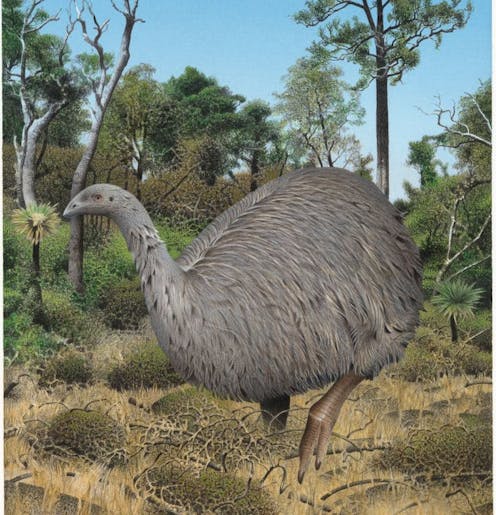
Growing to around 80kg and up to 1.8 metres tall, the eastern moa was one of the smaller of the nine extinct moa species. It got its name because its fossil bones have been found in sand dunes, swamps, caves and middens all along the eastern parts of the South Island – Southland, Otago, Canterbury and Marlborough.

Eastern moa became extinct from over-hunting and habitat destruction by humans, and possibly predation by kurī (dogs) and kiore (rats). But were eastern moa populations thriving when people arrived, or were they already in trouble due to ancient climate change?

Skull of an eastern moa. Genetic information can be obtained from moa bones even after thousands of years. Te Papa CC BY-NC-ND 4.0.

Refuge in the south

Between 29,000 and 19,000 years ago, New Zealand was in the grip of an ice age. Glaciers were much larger and more widespread than they are today, and the distribution of grasslands and forests changed as the climate became colder and drier.

Current climate change threatens the survival of many different species, and the same was true of climate change thousands of years ago. The fossil record hints that the ice age was bad news for eastern moa, as few eastern moa bones from this period have been discovered.

But a lack of fossils doesn’t necessarily mean a species was doing it tough. Perhaps they just avoided the caves and swamps where we might eventually discover their bones.

Read more: How a change in climate wiped out the 'Siberian unicorn'

To find out more, we sequenced DNA from dozens of eastern moa bones to see how their genetic diversity and population size changed over the past 30,000 years.

Large and healthy animal populations tend to have high genetic diversity, while low genetic diversity can be a sign that a population is in decline. We found eastern moa had very low genetic diversity immediately after the last ice age.

So eastern moa didn’t cope well with the ice age climate – but how did they manage to escape extinction? Our study provides a clue: their genetic diversity was highest in the very south of the South Island.

Rimu were prominent in the podocarp forests that eastern moa preferred. The distribution of these forests changed dramatically during the ice age. Katja Schulz/Flickr CC-BY 2.0

Preserving future habitats

During the ice age, grassland replaced wet podocarp forests in many areas. Those forests were the favourite habitat of eastern moa, possibly explaining why they struggled to survive.

Luckily for eastern moa, however, small pockets of forest survived in southern New Zealand during this time. While eastern moa disappeared from most of the country, our study suggests they clung on in remnant forest at the very south of the South Island.

Scientists have a special name for pockets of habitat where species can shelter and endure climate change – “refugia”.

Read more: How the warming world could turn many plants and animals into climate refugees

Once the climate began to return to pre-ice age conditions, eastern moa were able to return to parts of the country they had formerly occupied. They bounced back so well that they were the most common moa in some parts of New Zealand at the time of Polynesian arrival.

Ancient DNA from fossils across the world has shown that refugia play an important role in allowing species to adapt to climate change. The story of eastern moa shows this is equally true in New Zealand.

Importantly, though, the eastern moa was affected differently to other moa, showing not all species are affected by climate change in the same way. Our study emphasises the need to conserve and restore a diverse range of habitats for the future, given the places where species are found today may be unsuitable for them in the very near future.

By ensuring that species can continue to find appropriate refugia, we may reduce the number that become extinct as a result of our global impacts on the climate.

Authors: Nic Rawlence, Senior Lecturer in Ancient DNA, University of Otago

Read more https://theconversation.com/how-did-ancient-moa-survive-the-ice-age-and-what-can-they-teach-us-about-modern-climate-change-183350

Interstate Car Transporter Urges Buyers to Book Early

As the conflict in the Middle East continues to put increasing pressure on local fuel supply, Australian transport companies are experiencing increasi...

Digital Minimalism for Business Owners: Fewer Tools, Better Systems

Be honest. How many apps are open right now? One for scheduling, another for invoices, a third for customer notes, plus a spreadsheet someone email...

The Importance Of Proactive NDIS Renewal Preparation For Sustaining Your Provider Business

Your NDIS renewal notice is not a signal to start preparing. By the time it arrives, preparation should already be well underway. For new providers, s...

Why Fire Extinguisher Testing in Sydney Is Becoming a Records Game, Not Only a Maintenance Job

A fire extinguisher used to feel like one of the simpler parts of building safety. It hung on the wall, wore a service tag, and sat there quietly unle...

The Switchboard Upgrade Question Every Melbourne Renovator Should Ask Before the Walls Close Up

Renovations have a funny way of making people think on surfaces first. Splashback, stone, joinery, tapware, paint. Fair enough too. That is the exciti...

Winter Sanitation Gaps in Parramatta Kitchens: A Hidden Pest Risk

Winter brings a host of changes to our homes, from the chill in the air to the cozy warmth indoors. However, this season also introduces sanitation ch...

When to Seek Advice from Employment Lawyers in Melbourne

Australian employment law is detailed and, at times, complex, with rights and obligations that aren't always obvious to employees or employers witho...

7 Benefits of Professional Gutter Cleaning for Australian Homeowners

Gutters aren't exactly glamorous. They sit up there on the edge of your roof, doing their job quietly - until they stop working. Clogged, overflowing ...

Pipe Floats Strengthening Pipeline Performance In Demanding Environments

Pipelines often travel through environments that are anything but predictable, water currents shift, terrain changes, and materials keep moving unde...

Why Ceiling Fans Are Essential For Comfort, Efficiency, And Modern Living

Creating a comfortable indoor environment is not just about temperature; it is about how air moves, how a room feels, and how efficiently energy is ...

Why Duct Cleaning In Melbourne Is A Smart Investment For Healthier Living Spaces

Behind your walls, ceilings, and vents lies a network quietly working every day to keep your home comfortable. Yet over time, this system can become...

Disability Service Providers Supporting Inclusive And Independent Living

Finding the right support system can feel like assembling a puzzle where every piece must fit just right. For individuals and families navigating di...

A Beginner's Guide to Owning a Caravan in Australia

Owning a caravan opens up a style of travel that's hard to match for freedom and flexibility. However, for those just starting out, the process of c...

Preparing Your Air Conditioner for Summer: What Most Homeowners Overlook

As temperatures rise, many homeowners switch on their air conditioning for the first time in months — only to find it’s not performing the way i...

What Actually Adds Value to Properties in Newcastle

Newcastle has seen steady growth over the past few years, with more buyers looking beyond Sydney for lifestyle, space, and long-term value. As dema...

What is Design and Build in Construction?

Imagine you’re about to start a new construction project, maybe it’s a custom home or a commercial building. You’ve got the idea, the land, an...

Commercial roof leak detection: why early action protects your building

Water ingress is one of the most disruptive and costly issues facing commercial properties. For property managers and facilities teams, even a minor...

Custom Photo Frames: Turning Everyday Moments into Lasting Displays

Photos capture moments, but how you display them determines how they’re experienced every day. A meaningful photograph deserves more than a generi...















