

I make art from the bodily experience of long-distance running
- Written by: Cherine Fahd, Associate Professor, School of Design, University of Technology Sydney
In 1979, the American artist Allan Kaprow wrote Performing Life, an important essay in the history of Western art arguing for the blurring of art and life.
Kaprow suggested we perform art in our everyday living by paying attention to invisible sensations and the details of existence we take for granted.
He wanted us to notice the way air and spit are exchanged when talking with friends; the effects of bodies touching; the rhythm of breathing. Kaprow’s essay has served as an instructive piece for living. As an artist, I see and make art from anything and everything.
Take long-distance running, for example.
When a friend began coaching me to run long distances, I consequently began drawing as well.
Running in the 21st century involves drawing lines. More important than sneakers are GPS devices (like smartphones and watches that sync with exercise apps) to track and analyse every meaningful and meaningless detail of your performance.
Drawing lines
I use the app Strava. It visualises my routes, average pace, heart rate, elevation and calories burned.
Driven by competition, self-improvement and the well-being revolution, it is easy to become fixated on this data. But I am fixated for other reasons as well.
When I run, Strava maps my route with a meandering GPS line. I have become absorbed in this line – literally sensing it when I’m running.
As each foot touches the ground I feel myself drawing the GPS line slowly and incrementally. This embodied connection to my data changes my runs. I spontaneously vary my routes to achieve a particular line.
Run around a pole ten times, burst into a zig-zag, make a circle in the park. I manoeuvre to affect the graphic form to one of my imagining.
Cyclists and runners worldwide have recently discovered the creative possibilities of GPS data. This is called GPS Art or “Strava Art”. Cycling or running routes to visualise a predetermined shape or thing proved popular during the pandemic. Rabbits, Elvis and the middle finger have been plotted, cycled and run. The data version of skywriting.
 ‘I manoeuvre to affect the graphic form to one of my imagining.
Cherine Fahd, Author provided
‘I manoeuvre to affect the graphic form to one of my imagining.
Cherine Fahd, Author provided
As novel as Strava Art is, I am not creating it. Running and drawing are both “body techniques” connected to gesture, touch, feeling, listening, looking and imagining.
While GPS data can visualise every quantifiable detail about my run, it can’t tell me how it felt to run.
Anyone who runs long distances knows that performance is impacted by how you feel on the day, what the run is soothing. Life problems, levels of stress, hormones, depression, happiness, whether you slept well, how much you ate and the weather all impact a run.
Read more: Yearning for touch — a photo essay
Revealing what is hidden
While self-tracking data appears infallible – that is, numerical, scientific and objective – we know it is biased. Data scientists Catherine D'Ignazio and Lauren Klein argue in their book Data Feminism that data science is skewed towards to those who “wield power”, which is “disproportionately elite, straight, white, able-bodied, cisgender men from the Global North.”
Data feminism reveals how systems of counting and classification hide inequalities. The role of data feminism is to use this understanding of what is hidden to visualise alternatives, and they suggest converting qualitative experience into data.
This is where the outmoded art of drawing and the antiquated technologies of charcoal and pencil can extend exercise data and bring new meaning to the personal experience of running.
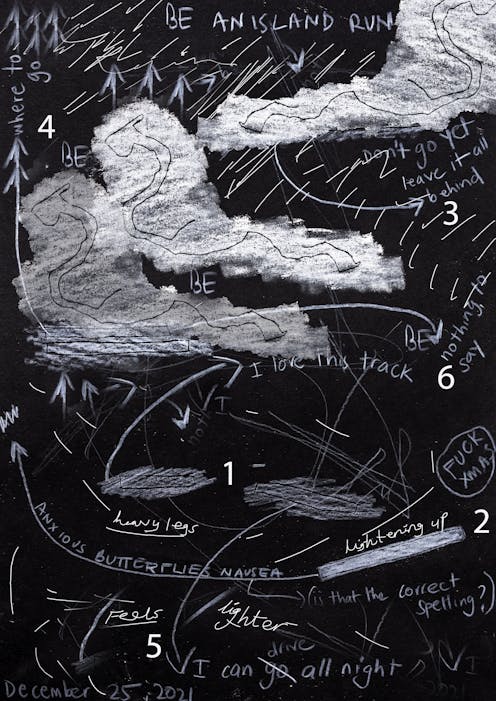
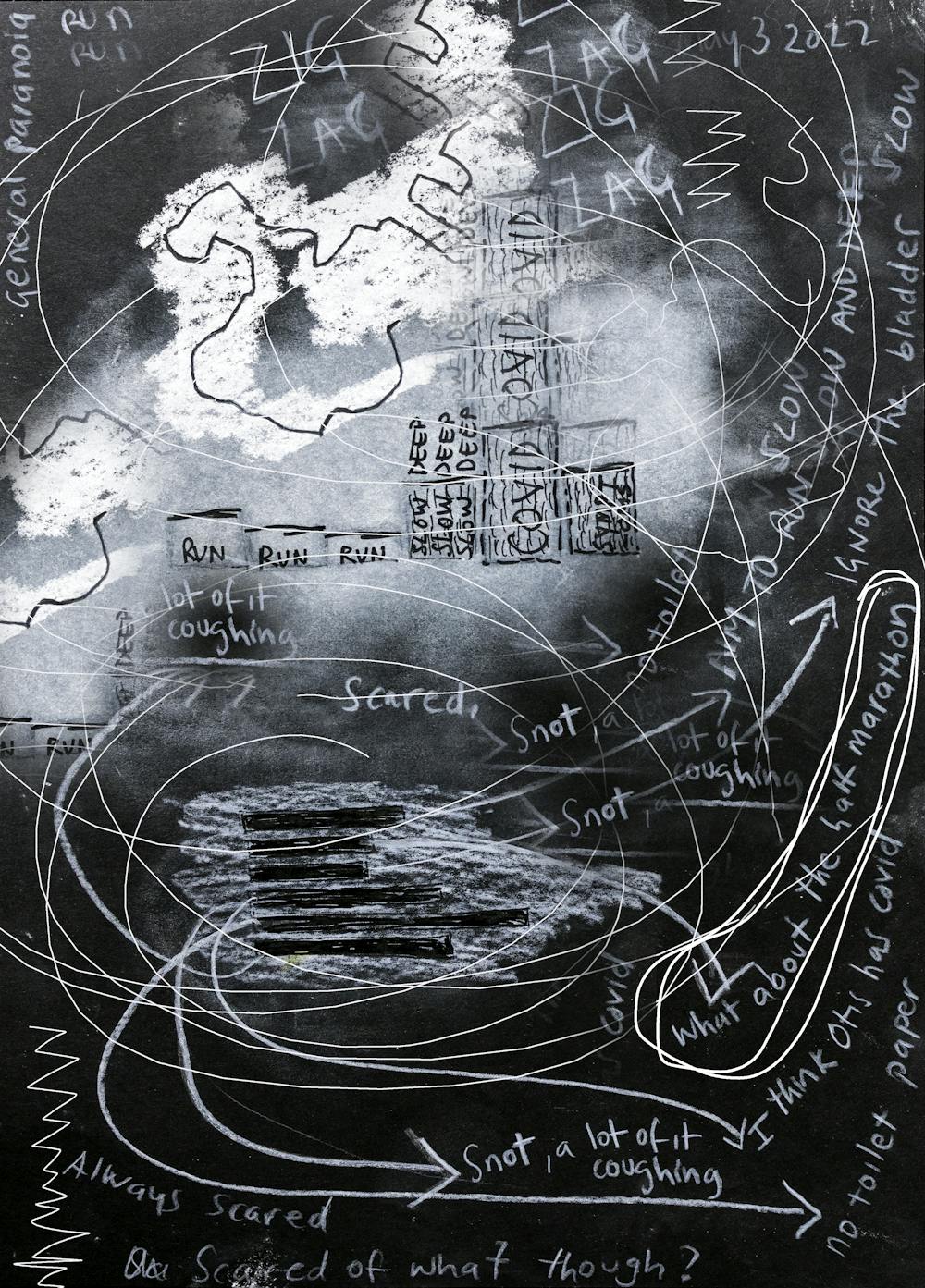
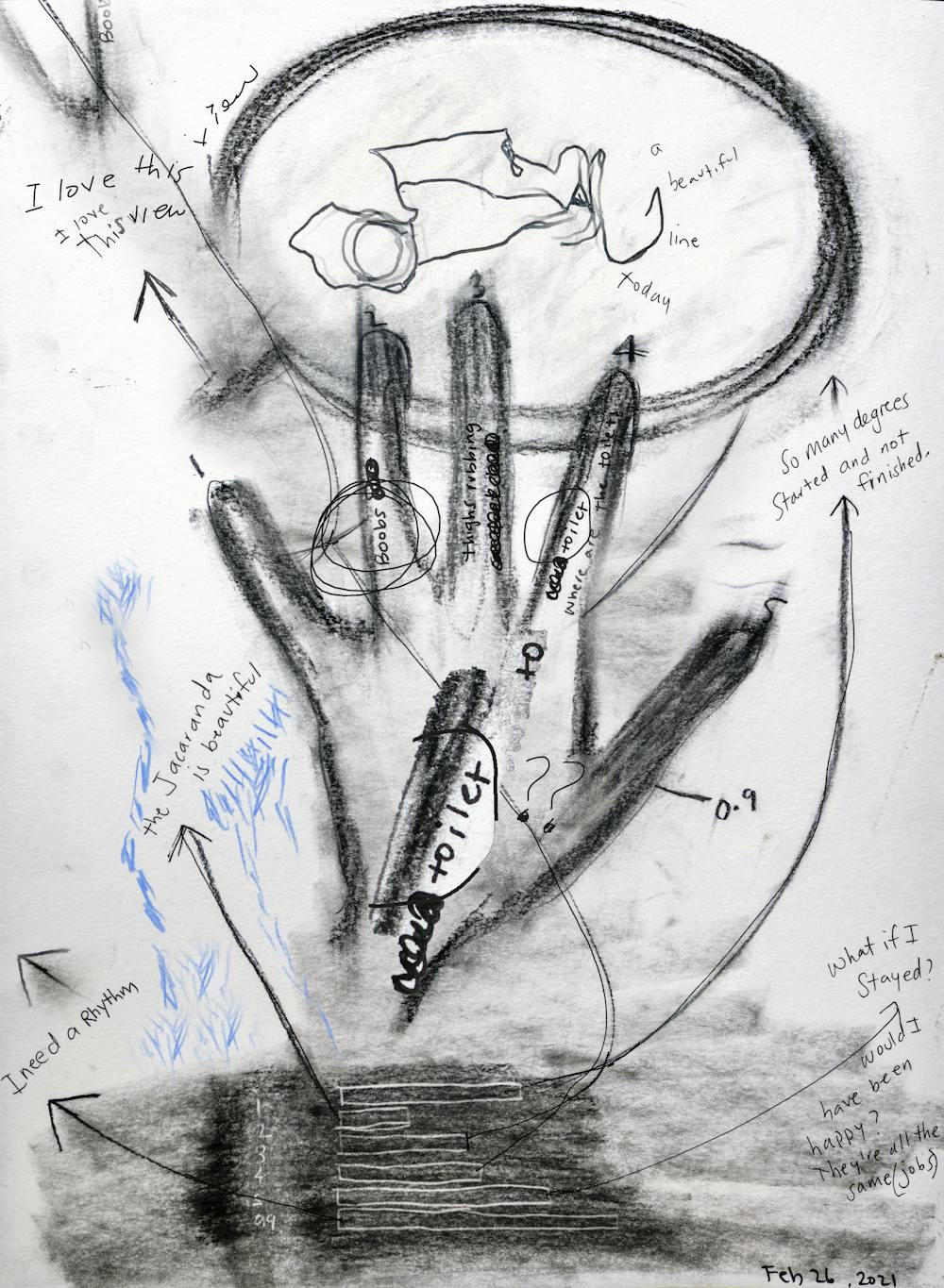
I have been re-drawing my data to make visible what Strava cannot. The unheroic stuff: emotions, persistent thoughts, body sensations like the pressing of my bladder, the location of public toilets, social interactions with strangers, lyrics from the songs I listen to, and the weather.
 ‘The drawings are deliberately messy scribbles, diaristic and fragmented, smudged and imprecise.’
Cherine Fahd, Author provided
‘The drawings are deliberately messy scribbles, diaristic and fragmented, smudged and imprecise.’
Cherine Fahd, Author provided
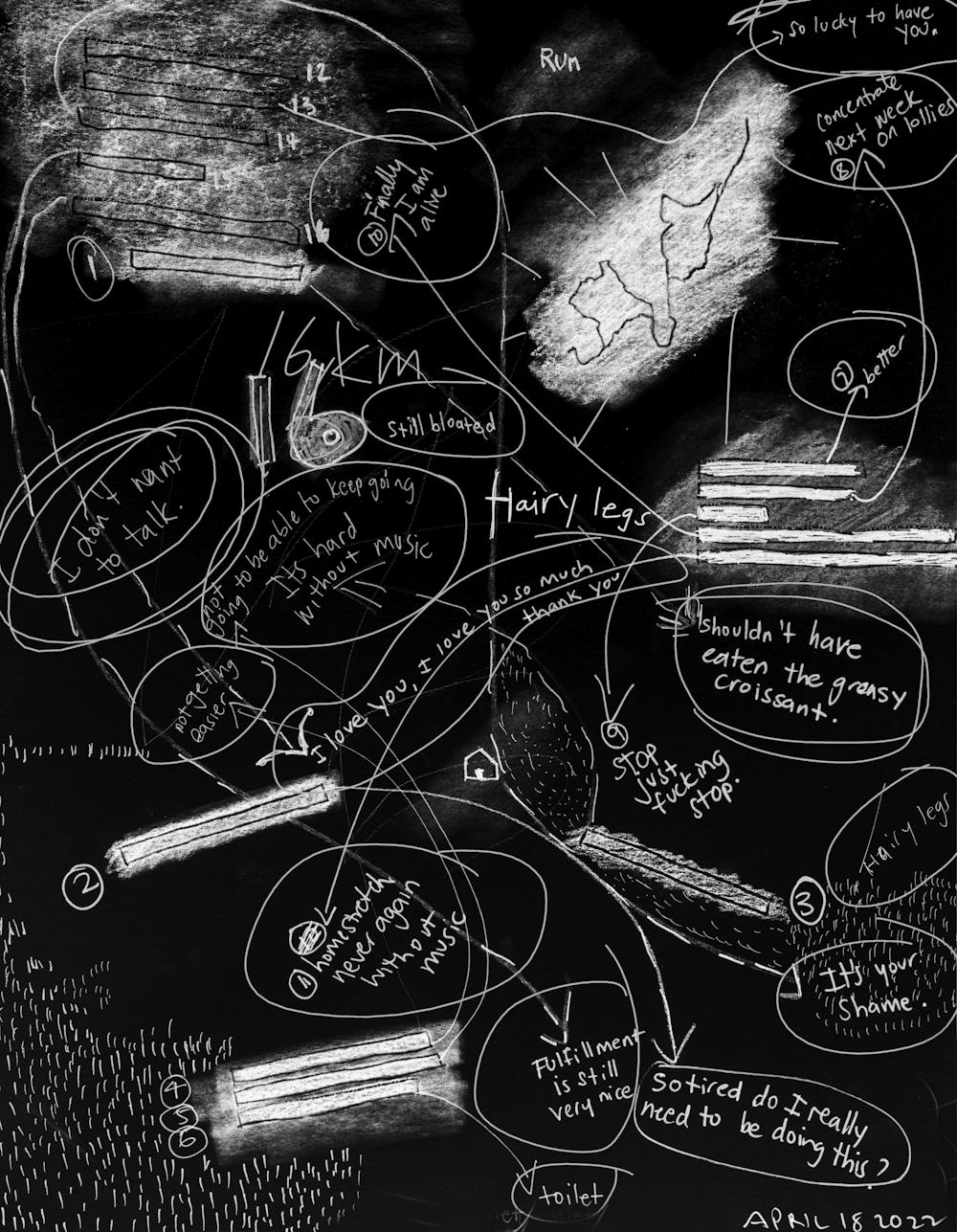
The drawings are deliberately messy scribbles, diaristic and fragmented, smudged and imprecise. They re-label information to reflect what is missing – that I’m a middle-aged woman artist mother who is happy to remain mediocre at running.
Picture a nagging bladder instead of speed; scribble the arrival and departure of joy and anxiety instead of pace; zig-zag through neurotic repetitive thoughts instead of calories burned; trace desires, dreads and dreams instead of personal bests.
That’s not to say I don’t enjoy Strava or that I don’t have running goals. But the drawings offer different data that short circuits the dominance of quantifying every aspect of human experience.
 ‘These drawings offer alternative data not tied to endurance or personal glory.’
Cherine Fahd, Author provided
‘These drawings offer alternative data not tied to endurance or personal glory.’
Cherine Fahd, Author provided
The effects of bringing art and life (or running and drawing) together are confrontational. As Kaprow noted, “anyone who has jogged seriously […] knows that in the beginning, as you confront your body, you face your psyche as well.”
The longer more testing runs produce more data; they also produce more complex encounters with the self and more convoluted drawings.
These drawings offer alternative data not tied to endurance or personal glory. They undo the slick corporate aesthetic of exercise apps and their socially networked metrics, leader boards, badges and medals.
This is a feminist practice that builds on the work of Catriona Menzies-Pike and Sandra Faulkner who give alternative accounts of running from the perspective of women.
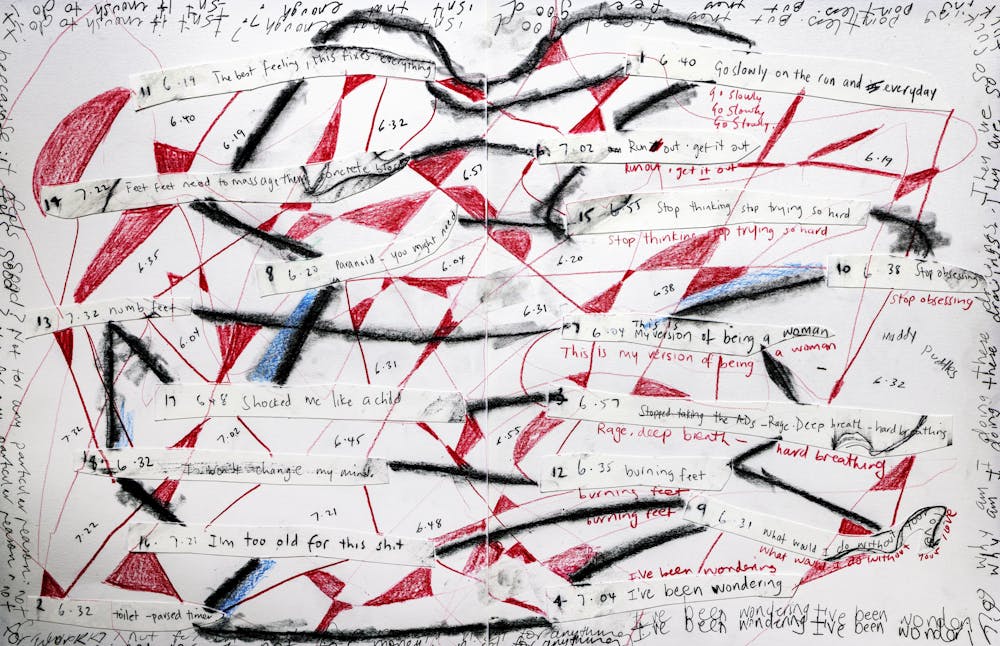 ‘These drawings offer alternative data not tied to endurance or personal glory.’
Cherine Fahd, Author provided
‘These drawings offer alternative data not tied to endurance or personal glory.’
Cherine Fahd, Author provided
Running and drawing can be autotelic activities: activities where the purpose of doing it is doing it. In this highly surveilled, techno-obsessed, capital driven, multi-tasking time, the value of sporting or creative activities delivering no measurable (or financial) results may appear old-fashioned.
But then again, so can running without a self-tracking device. This is something I am willing to try.
Authors: Cherine Fahd, Associate Professor, School of Design, University of Technology Sydney


















