

Google AI


Modern Australian

As women decide Australia's new leaders, what is going on with academic leadership?

  • Written by: Angela Carbone, Professor and Associate Deputy Vice Chancellor Learning Teaching and Quality, RMIT University
As women decide Australia's new leaders, what is going on with academic leadership?

Women’s votes may have swayed the federal election result, but will a change in government move the culture towards one of empowering Australian women? In his victory speech, newly elected Prime Minister Anthony Albanese said: “Together we can make full and equal opportunity for women a national economic and social priority.” Can we? Will we?

Despite the role of the women’s movement in the 2022 election, and the prime minister advocating that the time for change is now, evidence shows there is a lack of systemic mechanisms to empower women to become leaders. It’s clearly a problem in the academic institutions where our future leaders are made, as made clear by a recent special issue of the Journal of University Teaching and Learning Practice, Women and leadership in higher education learning and teaching.

Women like Grace Tame and Brittany Higgins have recently put the women’s movement on the national agenda. But for years we have talked about the actions needed to overcome gender disparities, with no measurable change across industries.

Indeed, Australia has slipped backwards in the World Economic Forum’s Global Gender Gap Index from 15th in 2006 to 50th in 2021. The WEF calculates, at the current rate of progress, it will take 135.6 years to achieve gender parity worldwide.

Read more: Time to gender parity has blown out to 135 years. Here's what women can do to close the gap

Academic leadership has a huge gender gap

At a time of heightened awareness of how women are treated in workplaces across Australia, we need to talk about the gender disparity in the academic leadership of universities.

Writing in The Conversation last year, Marcia Devlin noted that men held 54 of the 74 top jobs (chancellors and vice chancellors) in Australian public universities. Women also continue to be under-represented in senior academic positions. They hold barely a third of positions above the level of senior lecturer.
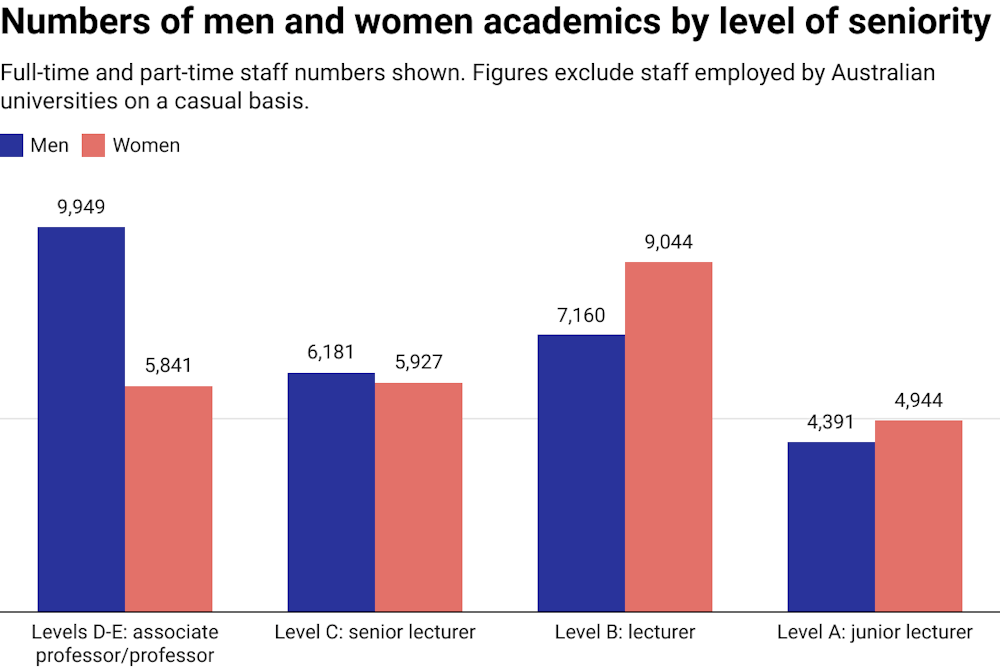
Vertical bar chart comparing numbers of men and women holding academic positions by level of seniority
Chart: The Conversation. Data: 2021 Staff Numbers, Higher Education Statistics, DESE, CC BY Read more: No change at the top for university leaders as men outnumber women 3 to 1 The situation is similar internationally. In the United States, for example, women have earned the majority of PhDs for more than a decade. Yet only 27% of tenured full professors are women. Women’s academic careers have been placed in a holding pattern for too long. While many women juggle many multiple responsibilities, men commonly have a clear run at their career goals. Without awareness of and action on the systemic barriers in higher education, no change will occur to support female leaders of the future. What are the barriers to female leadership? Academia and government are still patriarchal institutions. The patronage of white men grooming and shifting leadership to other elite white men is overlooked as much as the extent of sexual harassment. The nepotism that results in a man being appointed to leadership because of their biological gender persists. And, of course, gender inequity extends beyond leadership appointments in higher education. Rates of casualisation and fixed-term contracts are higher for female academics than for males, both globally and in Australia. We know female academics generally teach large first-year classes, which have excessive administrative duties. While women are left to look after the academic household, men can tend to the garden where things are more likely to grow and bloom (in this analogy, their research and leadership). Women academics have less chance of becoming a professor than men. It takes longer for those who do advance to professorships to get there. Universities still use male definitions of merit criteria, rewarding men’s scholarship over women’s scholarship. It’s known as the “Matilda Effect”. The COVID pandemic added to the barriers female academics must overcome. Increased carer responsibilities and home schooling during lockdowns resulted in lower research outputs and more criticism on student evaluations. As a result, women’s leadership opportunities and promotion prospects were further limited. Read more: Gender bias in student surveys on teaching increased with remote learning. What can unis do to ensure a fair go for female staff? What can be done to develop female leaders? Only 10% of senior leaders in STEM fields are women. However, in organisations where one in ten senior leaders is a woman, nearly 50% of men think women are well represented. This highlights the ongoing unconscious bias in society today. Despite initiatives to attract women into academic careers, professional support to advance their careers is lacking. Early-career female academics have less access to networks, a critical element for career progression, than their male counterparts. There is a lack of structured mentoring opportunities to discuss strategies to overcome the nuanced barriers of the male-dominated environment. Female academics would benefit from sharing strategies for managing challenging situations, designing decision-making processes, applying leadership frameworks, showing resilience and planning for career advancement and leadership growth. Read more: Here's an approach to mentoring that can help close the leadership gender gap The lack of female voice, visibility and advocacy perpetuates the cycle of inadequate time for research activities and higher teaching, service and administrative loads. Systemic mechanisms must be put in place to empower women in higher education to become leaders. This leads us to three key components for the newly elected government and universities to offer full and equal opportunities for academic women in leadership: formalised leadership development programs specifically designed for all women in academia to developing their decision-making capability established leadership mentoring schemes, which make women in leadership positions more visible and support female academics to overcome the individual nuances of the barriers they face increased dialogue among women to create a community where barriers and opportunities can be addressed and explored. Authors: Angela Carbone, Professor and Associate Deputy Vice Chancellor Learning Teaching and Quality, RMIT University

Read more https://theconversation.com/as-women-decide-australias-new-leaders-what-is-going-on-with-academic-leadership-184163

What to Do When an Older Car Is No Longer Worth Keeping in Melbourne

Ever looked at another repair quote and wondered whether your old car is still worth the trouble? It is a common turning point for Melbourne motoris...

Your Baby's First Year: A Local Guide to Feeding, Sleep, and When to Get Extra Support

Ask ten parents in a Brisbane mothers' group how their baby is feeding or sleeping, and expect ten different answers.  Someone's baby sleeps throug...

Kitchen and Laundry Makeover Ideas That Don't Require a Full Renovation

Full kitchen renos are expensive — and most people don't actually need one.  They need the kitchen to stop looking like it's stuck in 2009, or they...

How Technology Is Reshaping the Modern Australian Commercial Kitchen

The commercial kitchen has always been shaped by technology. Refrigeration changed how ingredients could be stored, modern ventilation transformed k...

The Number on a Roller Blind Fabric That Nobody Explains

Somewhere in the fabric book, next to the colour name, there is a percentage. Three per cent. Five per cent. Ten per cent. Nobody explains it, most c...

What’s Trending in Men’s Jewellery This Father’s Day!

Finding a Father’s Day gift that feels personal, stylish and genuinely wearable is not always easy. While socks and novelty mugs have traditionally ...

Road Signs: Understanding Their Role in Clear and Effective Signage

Effective signage and display hardware can help businesses communicate information, promote products and organise customer or visitor movement. Road...

Bottle Label Printing: Key Factors to Consider Before Your Next Packaging Run

Effective packaging begins with understanding the product, bottle material, artwork and production requirements when planning bottle label printing. H...

Planning a Long-Distance Move With Interstate Movers Melbourne

Moving between states involves more planning than a typical local relocation. Along with packing and transporting household belongings, you need to...

Understanding the Role of an I/O Controller in Industrial Automation

Modern industrial systems depend on accurate communication between sensors, machines and control systems. An I/O controller can help manage this commu...

How the Right Mining Hose Supports Demanding Operations

Mining environments place considerable demands on equipment used for material transfer, water management and processing. Hoses operating in these co...

Simple Ideas for Making Social Gatherings More Memorable

We have all been to those parties where everyone just stands around the kitchen island, staring at their phones, waiting for someone else to make a mo...

Outdoor Wall Lights: Improving Exterior Lighting Around Your Home

Lighting can influence how a room looks, feels and functions, so the right fitting should be selected according to both appearance and practical req...

Commercial Office Cleaning: Combining Routine Office Cleaning With Melbourne Service

Keeping a workplace clean requires a service that can accommodate everyday tasks as well as the particular needs of the business. Professional comme...

Caravan Sales in Queensland: How to Find the Right Caravan for Sale QLD

Caravan ownership is about more than having somewhere to sleep while travelling. For many Queenslanders, it is one of the best ways to explore regio...

What Sir Walter Buffalo Turf Actually Costs in 2026 (And Why Quotes Vary So Much)

Two quotes landed on a Hills District homeowner's kitchen table last spring for the exact same 80-square-metre backyard. One said $12 a metre. The o...

Nearly 1,300 NSW Hospital Beds Are Occupied By People Who Are Ready To Go Home

1,276 people in NSW hospitals have been medically cleared for discharge but remain in hospital because they're still waiting for NDIS or aged care sup...

National Survey Launched to Measure Operational Impacts of Federal NDIS Policy Reforms

The effects of recent NDIS reforms are beginning to move beyond policy papers and into day to day service delivery. A new national survey is asking ...
















