

How young Black African Australians use social media to challenge anti-Black narratives and reclaim racial dignity
- Written by: Kathomi Gatwiri, Senior lecturer, Southern Cross University
For Black African young people in Australia, social media can be especially fraught – a place they witness footage of anti-Black violence, contend with an “othering” gaze and encounter racist trolling, posts or comments.
Despite these challenges, social media can offer Black African young people in Australia safe spaces to engage in positive expressions of afro-Blackness, as our new study shows.
Our study, published today in the Australian Journal of Social Issues, was an ethnographic study of the social media activity of 15 young people (16–25) who self-identify as African and live in Australia.
Participants consented to being followed and/or “friended” on social media so as to observe their online practises over a six month period. They were also interviewed about their experiences on social media.
Our study reveals how these young people are using social media to challenge anti-Black narratives and reclaim some of their racial dignity.
Read more: Battlegrounds: highly skilled Black African professionals on racial microaggressions at work
Racial dignity and anti-Black racism
One of us (Gatwiri) has defined racial dignity as:
the immutable, unconditional worth of Blac/k people as human beings. To be racially dignified is to be seen through a humanised lens, and to be afforded basic respect, compassion and recognition in interpersonal and systemic contexts.
Anti-Black racism is a unique form of racism especially directed towards dark skinned Black people.
Research on blackness argues there is something particular and specific about the visibility of Black bodies that triggers the imagination of white Australia. They are “read” as too un-assimilable, too different, too foreign, too dangerous, too visible, too everything.
Zuberi (age 25) also highlighted how anti-Blackness produces hyper-criminalisation of Black people. This results in over-policing by the community and the criminal justice system. He reflected on one example:
We were walking back to the train station, and we were topping up our Myki. And there were two inspectors, standing a few metres from us, on the side. And this was probably about 9pm, a bit late. and they were like “Those people are always up to no good.” And then my cousin’s like, “What? What do you mean?” Like he got very angry and I think in those kinds of moments you kind of question […] you question a lot of stuff.
Real world experiences of anti-Black racism can inform the way young African Australians experience social media and participate in racial discourse online.
Our other journal article from this study reported how Black African Australians used social media to spotlight and engage in positive expression of afro-Blackness. But they were also terrified of making white people uncomfortable, which could invite racial trolling or racial abuse online.
King (age 18) reflected on his attempts to separate himself from the “African gangs” label often attached to young Black African people in Australia. This informed the design of his online avatar and profile photo, curated to evoke a “friendly” persona:
People sometimes they just look at your profile and they think you’re a bad person or a bad influence based on your picture. They’ll assume that you’re like other Black people they’ve seen in their life, they’ll assume you’re the same person.
When confronted with racist content on their newsfeed, most participants made deliberate choices to stay away from the comments section, colloquially considered a “cesspool of hatred”. Zuberi explained:
You do see things on social media but I try to not get involved with it as much […] And for that reason, I choose not to look at the comments.
Creating online boundaries and communities
The young people in our study reported digital spaces were safer than physical, offline settings in the white-majority Australian context.
Many used social media functions – such as block, delete, mute and unfollow – to effectively bypass racism online. They also used the “close friends” and “private stories” features to share their racial experiences.
This allowed people to engage in the kind of self-representation they chose – including posting pictures of themselves or discussing their experiences – within a “safe digital space”.
Social media was also particularly useful in connecting Black African youth who are geographically separated from each other. Many reflected how useful these connections are, often noting they were the “only Black kid” in their school or neighbourhood.
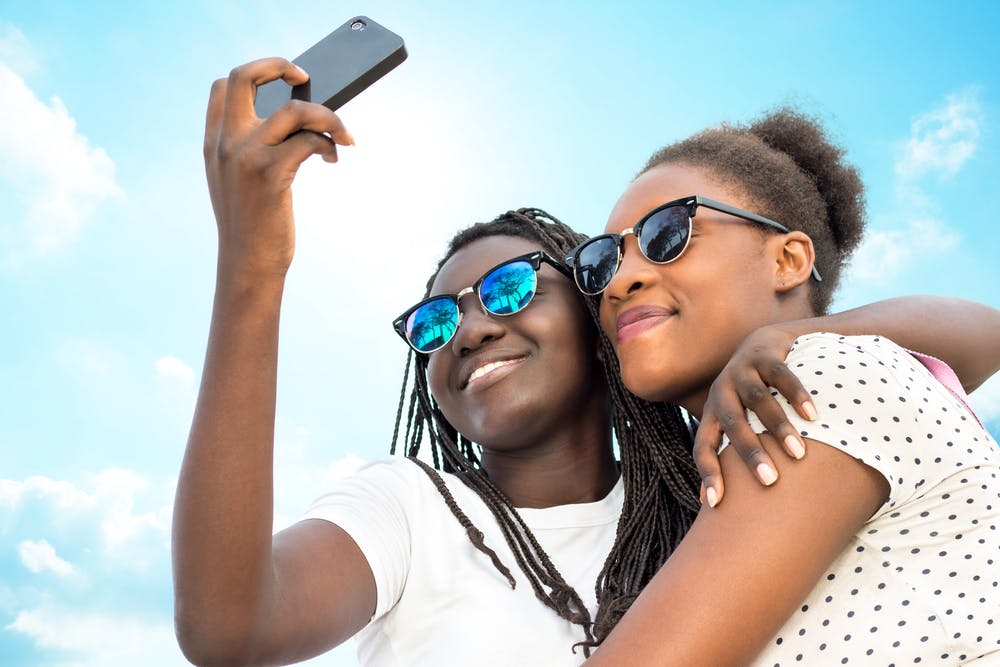 Social media was also particularly useful in connecting Black African youth who are geographically separated from each other.
Shutterstock
Social media was also particularly useful in connecting Black African youth who are geographically separated from each other.
Shutterstock
Social media therefore became a place where participants sought out connections that dignified and validated their experiences.
Nya (age 18) told us these communities helped her to form a positive sense of identity as a young Black woman in Australia:
I’ve created a communal space on every single platform which has made me feel comfortable with myself […] I feel like I belong to the wider Black diaspora […] I actually didn’t grow up with Sudanese people, I grew up in (location removed for privacy) which is very white. So yeah, I created a community and I have connections and I like it.
Fear of racial trolling persists
Human rights lawyer Nyadol Nyuon, has said racial trolling is provoked by the belief that discussions about racism are a lack of gratitude “for the hand that fed you.”
Participants in our study also expressed awareness about the types of content they could and could not post, demonstrating how the fear of offending white people in digital spaces continued to shape their online practices.
As Mark (age 25) said,
I try to be quite careful in digital spaces because anything to do with race, you never know who is going to use that against you.
Using certain social media features allowed our participants to bypass traditional media and instead engage in self-presentations of their own making. This way, they were able to reclaim aspects of their racial dignity by developing positive pro-Black narratives online.
Read more: The power of no: Simone Biles, Naomi Osaka and Black women's resistance
Authors: Kathomi Gatwiri, Senior lecturer, Southern Cross University


















