

How Japanese avant-garde ceramicists have tested the limits of clay
- Written by: Catherine Speck, Emerita Professor, Art History and Curatorship, University of Adelaide
Review: Pure Form, Art Gallery of South Australia.
Japanese art post the second world war is infinitely fascinating. At a time when the country was under Allied occupation and Japan had paid a high price for the war in the Pacific to end, its artists were revelling in new found freedom.
Some of the most interesting work of this era was from avant-garde ceramicists. Their revolution in clay led to them abandoning the Mingei tradition of Japanese folk craft which included making functional vessels such as tea bowls.
In its place, they redefined themselves as artists, placed a premium on individual expression and, as modernists with a Japanese inflection, began producing abstract sculptural ceramics.
Three generations of artists now work in this style, and their stunning work stretching from the late 1940s to 2021 is the subject of the Art Gallery of South Australia’s exhibition Pure Form. The title underscores the shift in ceramics from function to form.
Read more: Kintsugi and the art of ceramic maintenance
A delicate and refined aesthetic
In a time of often unnamed craftsmen producing humble ceramic objects for everyday use integral to the Mingei tradition, five Kyoto-based ceramicists were abreast of international trends in avant-garde modernism. They formed a group called Sōdeisha, meaning “crawling through the mud association” in 1948.
There was initially a gradual shift to pure form, as seen in Yamada Hikaru’s Glazed jar with sgraffito (scratched decoration) (1951-52). Its shape still alludes to a functional vessel while its sgraffito linework – a decorative technique of incising into pale slip to reveal the clay beneath – is steeped in Korean ceramics.
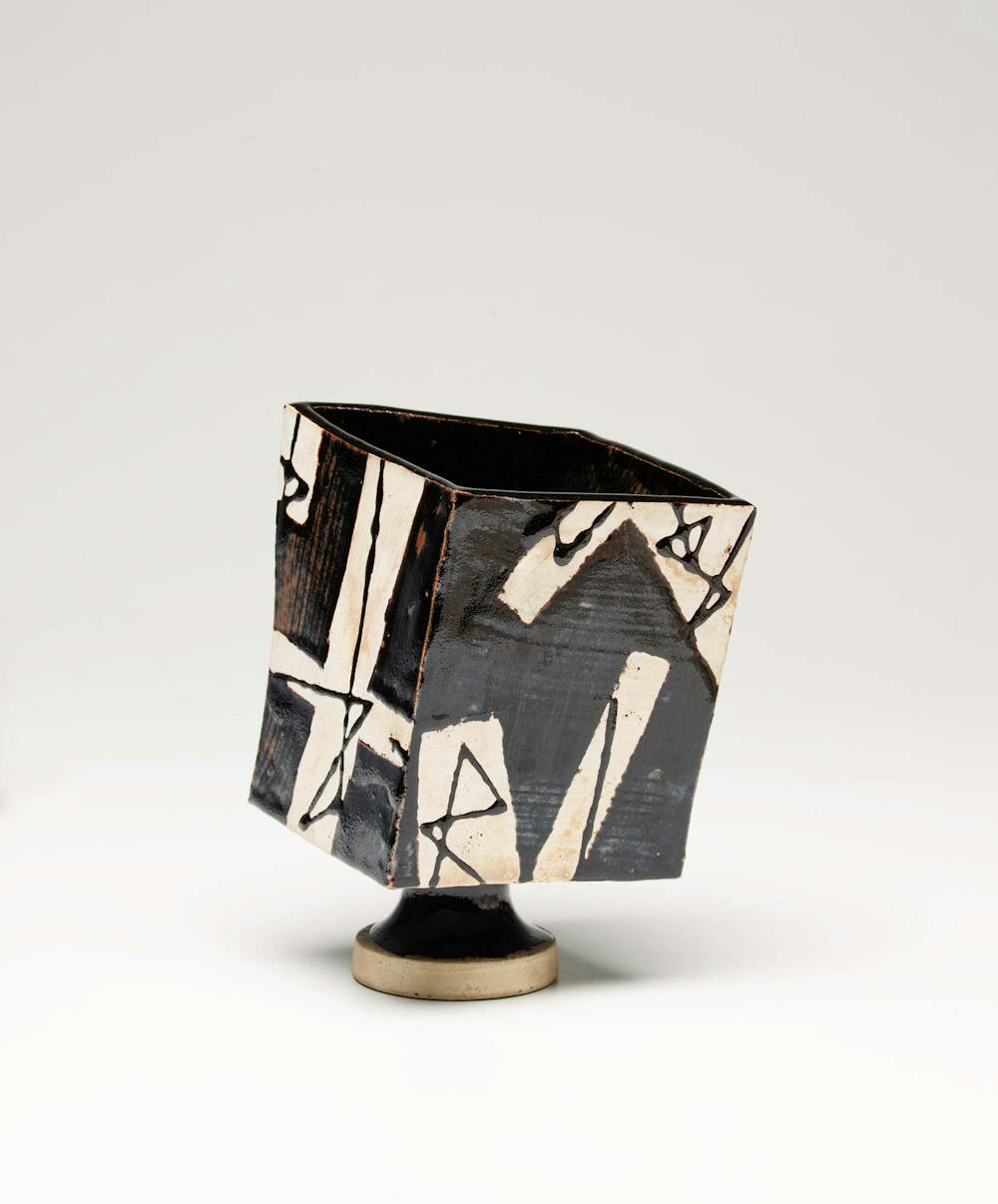
Other works in the exhibition reference surrealism, such as Square vase on pedestal foot (1950-60) by Sōdeisha member Suzuki Osamu. There are vases devoid of openings, elongated forms negating function, or, as with second-generation Sōdeisha artist Hayashi Hideyuki’s Walk (c. 1980), a minimal geometric form referencing the human body.
A delicate and refined aesthetic underpins the work on show, such as that of Matsutani Fumio, a third-generation artist whose ceramics balance innovation with tradition, as in his Yellow (Ou) (2021). This is a flamboyant extension of the architecture of the tea bowl, replete with beautiful line work.
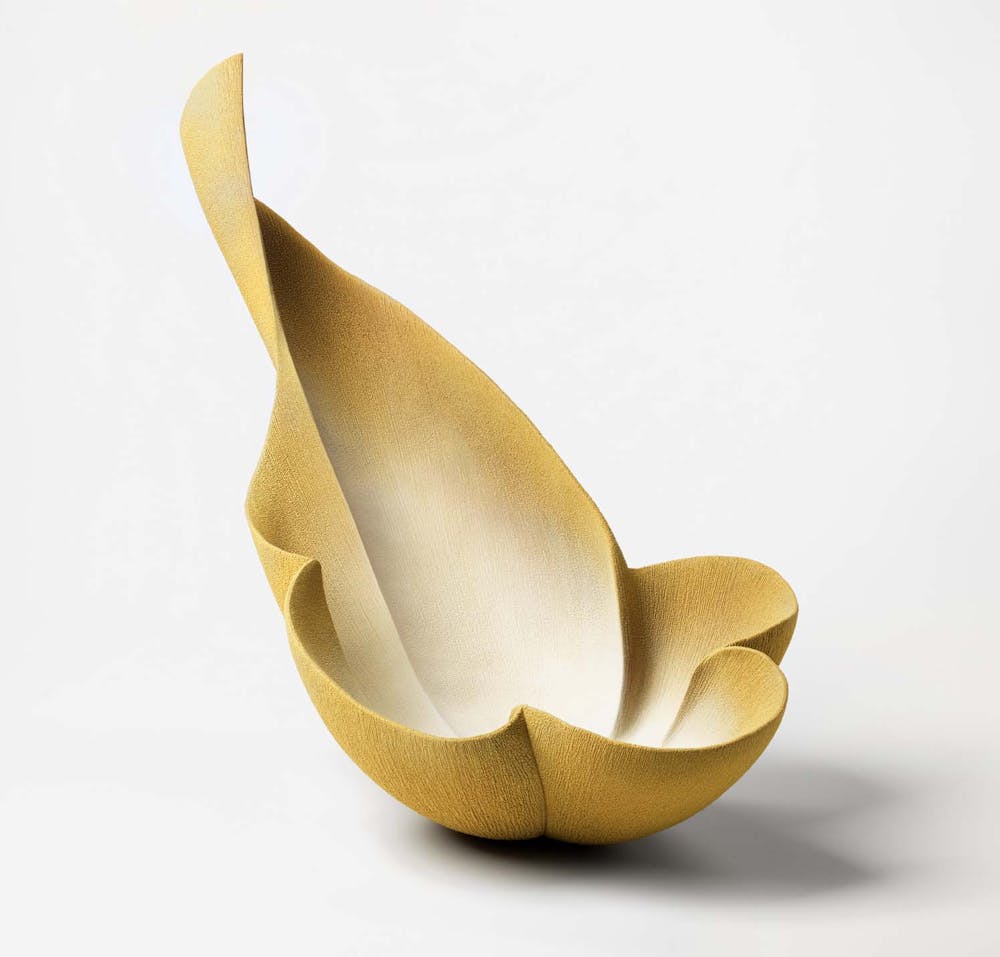 Matsutani Fumio, born Ehime prefecture 1975, Yellow (Ou), 2021, Ehime prefecture, stoneware, 43.2 x 52.3 x 28.2 cm.
Collection of Raphy Star, © Matsutani Fumio, photo: Grant Hancock
Matsutani Fumio, born Ehime prefecture 1975, Yellow (Ou), 2021, Ehime prefecture, stoneware, 43.2 x 52.3 x 28.2 cm.
Collection of Raphy Star, © Matsutani Fumio, photo: Grant Hancock
In terms of drama, Moriyama Kanjiro’s metallic glazed Kai (Turn) (2020) takes the honours for simulating movement. Its tower-like form is constructed from individual pieces assembled and fired to make a stunning swirling sculpture.
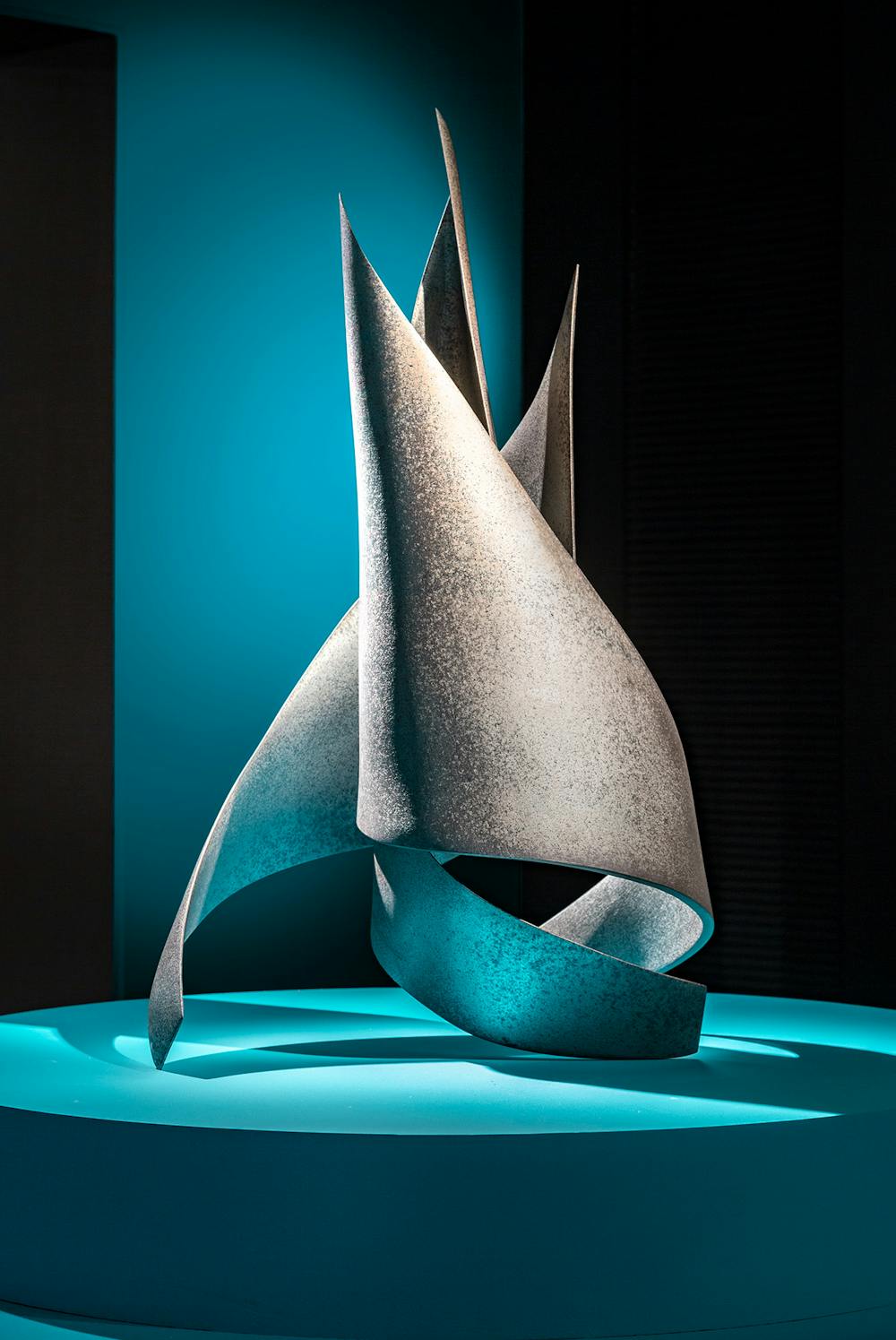 Installation view: Pure Form: Japanese sculptural ceramics, featuring Kai (Turn) VIII.
by Moriyama Kanjiro.
Art Gallery of South Australia, Adelaide; photo: Saul Steed
Installation view: Pure Form: Japanese sculptural ceramics, featuring Kai (Turn) VIII.
by Moriyama Kanjiro.
Art Gallery of South Australia, Adelaide; photo: Saul Steed
Women’s ceramic art and the broader diaspora
One of the many strengths of this exhibition is its focus on women of the calibre of Tsuboi Asuka, who was instrumental in establishing the Women’s Association of Ceramic Art in Kyoto in 1957.
Women’s rights came to the fore during the occupation, along with suffrage, and women ceramicists gained visibility.
Tsuboi’s three panel work Untitled (c. 2005) delicately inserts Japanese textile patterns in clay, each panel taking on the movement of cloth swaying in the wind.
Another is Tanaka Yu, whose clever wrapped bundles in clay imitate reality. Her Yellow sculpture in the shape of a furoshiki (c. 2108), looking like a beautifully wrapped object complete with a knotted tie, is informed by the ancient Japanese art of cloth wrapping.
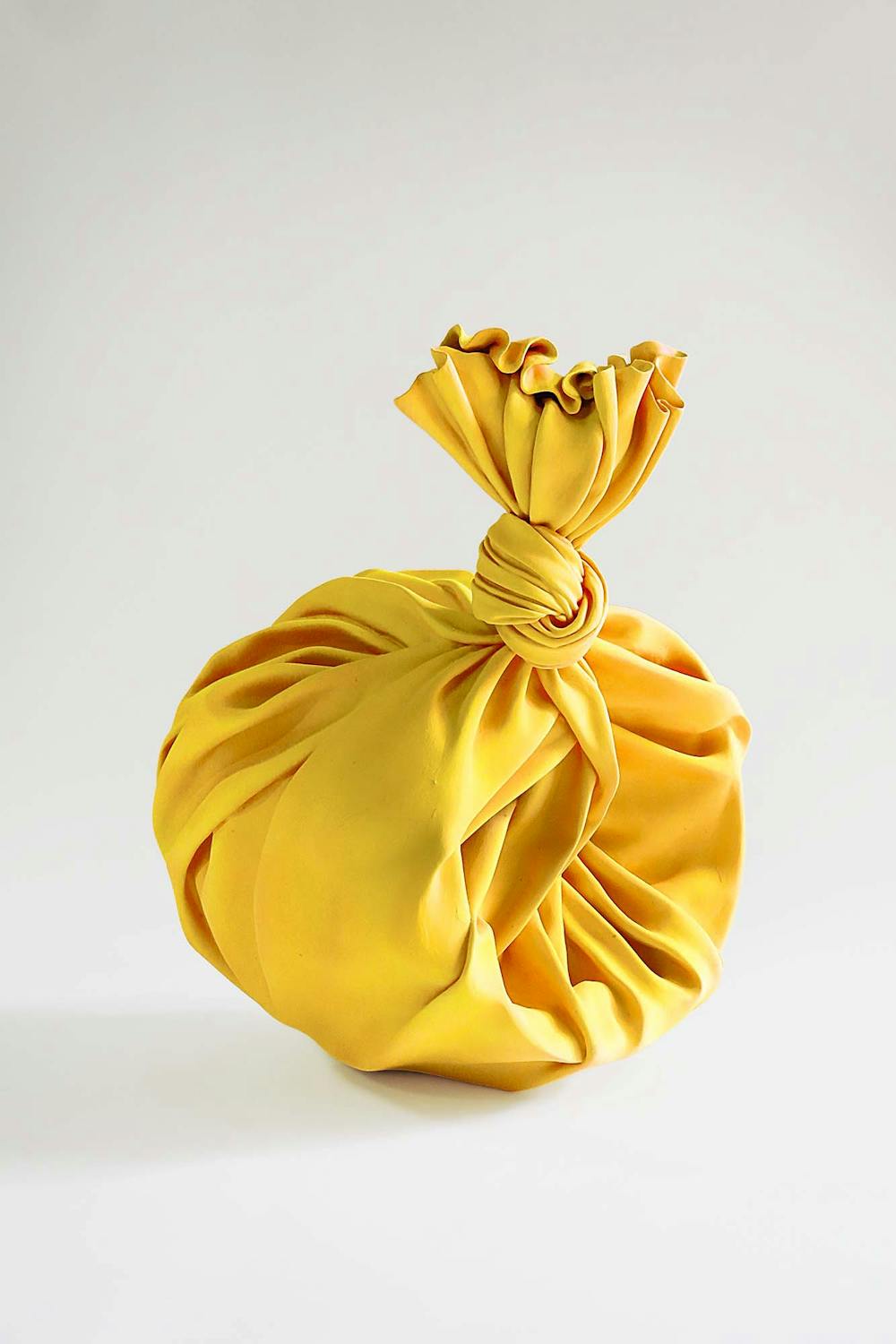 Tanaka Yū, born Ehime prefecture 1989, Yellow sculpture in the shape of a furoshiki, c.2018, Kyoto, stoneware, matte glaze, 46.0 x 54.0 x 38.5 cm.
Collection of Raphy Star, © Tanaka Yū, photo: Hazuki Kani
Tanaka Yū, born Ehime prefecture 1989, Yellow sculpture in the shape of a furoshiki, c.2018, Kyoto, stoneware, matte glaze, 46.0 x 54.0 x 38.5 cm.
Collection of Raphy Star, © Tanaka Yū, photo: Hazuki Kani
Japanese-trained ceramic sculptors now form a diaspora working outside Japan – one is US-based Kaneko Jun in Nebraska, whose large hand-built forms such as Untitled triangle (dango) (2004), employ abstract design features.
Uranishi Kenji is another emigre, based in Brisbane since 2004. His white glazed objects portray the wondrous world of coral in the Great Barrier Reef.
Read more: In Japan, supernatural beliefs connect the spiritual realm with the earthly objects around us
Balancing tradition and the new
The porcelain sculpture on show is superb. Matsuda Yuriko’s erotically charged foot, In her shoes (c. 2007), with its tightly curled back toes suggesting sexual pleasure, is a stunning piece.
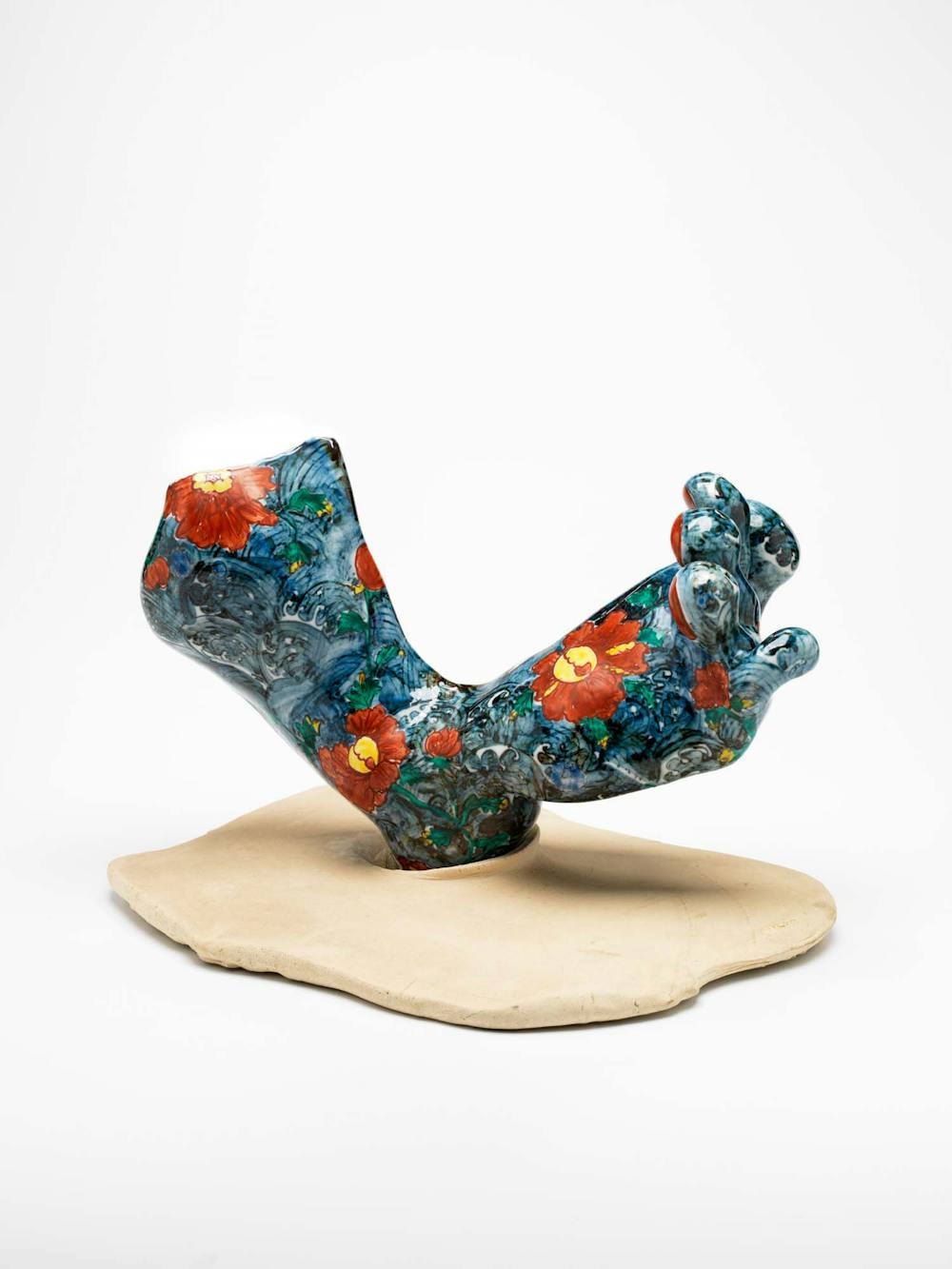 Matsuda Yuriko, born Ashiya, Hyōgō, 1943. In her shoes, c2007, Oshino, Yamanashi prefecture, porcelain, underglaze blue and overglaze enamels, 33.0 x 31.0 x 16.0 cm (foot),2.0 x 41.0 x 33.0 cm (base).
Collection of Raphy Star
Matsuda Yuriko, born Ashiya, Hyōgō, 1943. In her shoes, c2007, Oshino, Yamanashi prefecture, porcelain, underglaze blue and overglaze enamels, 33.0 x 31.0 x 16.0 cm (foot),2.0 x 41.0 x 33.0 cm (base).
Collection of Raphy Star
Her subject is frequently the female body. Here, the decorative surface evokes the patterning of Meiji ceramics while its subject matter sits squarely in the Japanese tradition of shunga, or erotic imagery. Refreshingly, it comes from the perspective of a woman.
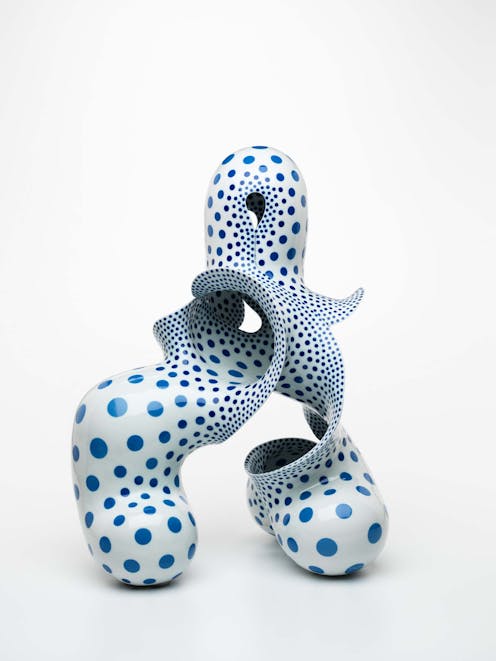
Yet another porcelain piece, Struggling forms (c. 2005) by Nakashima Harumi, looks almost octopus-like, but has only two feet. Its twists echo that of a Möbius strip, it looks disarmingly like an impossible form, but achieves perfect balance. The blue colour of the dot patterning harks back to the Japanese tradition of sometsuke which is underglaze painting in cobalt blue on porcelain or stoneware.
In contrast to referencing tradition, Mishima Kimiyo’s ceramic forms in Box Batter -17 (2017) shows bottles in newspaper wrappings in a roughly opened box, very much of their time. Her interest is the imbalance between the human footprint and nature, seen in the detritus of modern life, newspapers, packaging and soft drink bottles littering the environment.
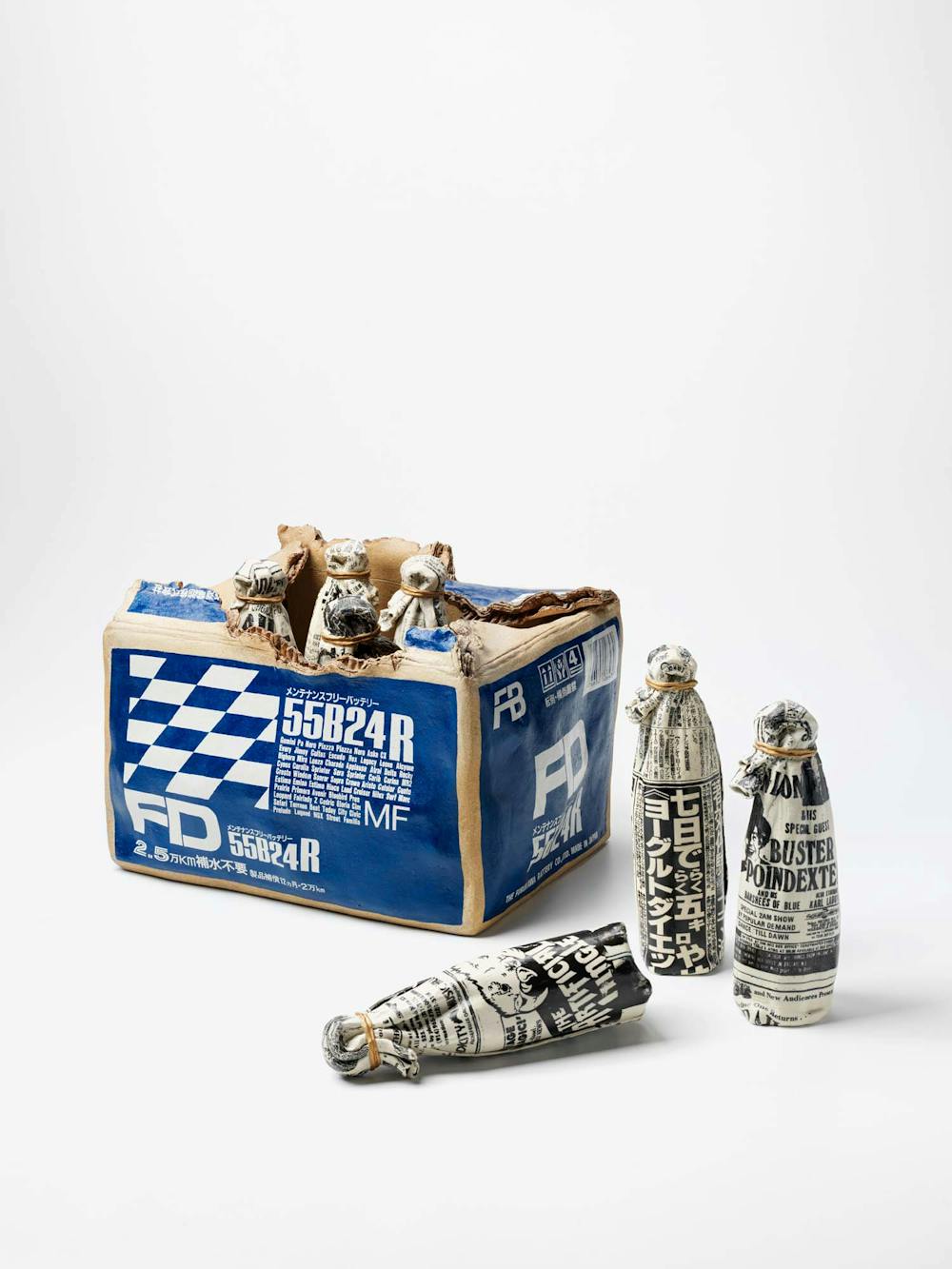 Mishima Kimiyo, born Osaka, Japan,1932, Box Batter -17,2017, Osaka, stoneware, silk screen prints, 22.0 x 31.0 x 25.0 cm (box), 22.5 x 6.5 cm (bottle, each).
Collection of Raphy Star
Mishima Kimiyo, born Osaka, Japan,1932, Box Batter -17,2017, Osaka, stoneware, silk screen prints, 22.0 x 31.0 x 25.0 cm (box), 22.5 x 6.5 cm (bottle, each).
Collection of Raphy Star
The limits of clay
This is a must-see exhibition.
Its 100 plus artworks by 65 ceramicists drawn from public and private collections in Australia and Japan, and spanning modern and contemporary work, are dazzling in innovation, skill and aesthetic.
The sculptural leap to pure form in porcelain in Fukami Sueharu’s To the sky (c. 2013), simulates flight itself and leaves viewers elevated by the experience.
 Fukami Sueharu, born Kyoto, Kyoto prefecture 1947, To the sky, c.2013, Kyoto , slip cast porcelain, celadon glaze (seihakuji), base: walnut , 31.0 x 88.0 x 24.0 cm.
Collection of Raphy Star , © Fukami Sueharu , photo: Grant Hancock
Fukami Sueharu, born Kyoto, Kyoto prefecture 1947, To the sky, c.2013, Kyoto , slip cast porcelain, celadon glaze (seihakuji), base: walnut , 31.0 x 88.0 x 24.0 cm.
Collection of Raphy Star , © Fukami Sueharu , photo: Grant Hancock
While in the exhibition space, I could hear some, including senior artists, puzzling as to how several of the ceramic objects were actually produced. These ceramicists have indeed tested the limits of clay.
Pure Form is at the Art Gallery of South Australia until November 6.
Authors: Catherine Speck, Emerita Professor, Art History and Curatorship, University of Adelaide


















