

Coalition routed in cities and in Western Australia – can they recover in 2025?
- Written by: Adrian Beaumont, Election Analyst (Psephologist), The Conversation
At the May 21 federal election, Labor won 77 of the 151 House of Representatives seats (up eight since 2019 when adjusted for redistributions), the Coalition won 58 seats (down 18), the Greens four (up three) and all Others 12 (up seven). This was a Labor majority of three.
The 2019 election result was Coalition 77 seats and Labor 68, but the ABC adjusted for Labor gaining a seat from the Coalition from redistributions. Craig Kelly’s defection from the Coalition to the UAP was not factored in, so Hughes was not a gain for the Coalition.
Primary votes were 35.7% Coalition (down 5.7%), 32.6% Labor (down 0.8%), 12.2% Greens (up 1.8%), 5.0% One Nation (up 1.9%), 4.1% UAP (up 0.7%), 5.3% independents (up 1.9%) and 5.1% others (up 0.2%).
Despite losing the primary vote by 3.1%, Labor won the national two party count by a 52.1-47.9 margin, a 3.7% swing to Labor. This is obtained by recounting all seats that did not finish as Labor vs Coalition contests between those parties to ascertain the preference between Labor and Coalition of all of Australia’s voters.
With the combined major party primary votes down to just over 68%, and 16 seats won by crossbenchers, some would argue that the two party vote is not relevant anymore. I think it is still relevant as a basic measure of whether more Australians preferred a Labor government or a Coalition one, and of how left or right-leaning seats and states were at the election.
The tables below show the number of seats for each state and nationally, the number of Labor seats, the percentage of Labor seats, the number of net Labor gains, the Labor two party percentage, the two party swing to Labor, the number of Other seats (this includes Greens), the number of Other gains and the number of Coalition seats.
The two party swing to Labor in Western Australia was a massive 10.6%, far larger than in any other state.
Seat changes occurred in cities
All Labor, Greens and independent gains occurred in Australia’s five mainland capital cities, and the large majority were in inner city seats. In regional seats, there were swings to the Coalition in Lyons, Gilmore and Lingiari, which made these seats close holds for Labor.
The Australian Electoral Commission (AEC) has a table of two party swings by seat demographic. Negative swings are to Labor, positive to the Coalition. This table has a 5.6% two party swing to Labor in inner metro seats, 3.6% in outer metro, 2.5% in provincial and 2.3% in rural seats.
In Queensland, there was a particularly marked difference between inner metro (an 8.7% two party swing to Labor) and other seat categories (between a 3.1% and 4.4% swing).
Analyst Ben Raue has charts of the difference between each seat demographic and the national two party vote since 1993. He says the inner metro difference in Labor’s favour is the highest ever in these charts, while the difference between rural seats and nationally is the highest in the Coalition’s favour.
Before the election, I anticipated that the best swings to Labor would occur in the cities. Australian cities with over 100,000 population have 68% of our overall population. Winning rural seats isn’t good enough for the Coalition in Australia.
Read more: Will a continuing education divide eventually favour Labor electorally due to our big cities?
People with a higher level of educational attainment tend to live in inner metro seats, and they have swung towards the left in recent elections in Australia, the US and the UK. Concerns about climate change and social issues were likely important factors in inner metro seats.
State result summaries
In NSW, Labor gained Robertson, Bennelong and Reid from the Liberals, but lost Fowler to an independent. Independents also gained Wentworth, North Sydney and Mackellar from the Liberals. The regional seat of Gilmore was held by Labor by just a 0.2% margin against the Liberals.
In Victoria, Labor gained Chisholm and Higgins from the Liberals, and independents gained Goldstein and Kooyong. The Liberals held Deakin by just a 0.2% margin and Menzies by 0.7% against Labor.
In Queensland, the Greens gained Griffith from Labor and Ryan and Brisbane from the LNP. Outside Brisbane, Labor had swings in its favour, but did not gain any seats. While Labor recovered ground from 2019’s shellacking in regional Queensland, it wasn’t enough to gain seats.
In WA, Labor gained Swan, Pearce, Hasluck and Tangney from the Liberals and an independent gained Curtin. The Liberals held Moore by 0.7% against Labor. Labor has WA to thank for its House majority.
The WA Senate result was crucial in giving Labor a friendly Senate, with Labor winning three of the six up for election, to two Liberals and one Green, a gain for Labor from the Liberals.
Read more: Final Senate results: Labor, the Greens and David Pocock will have a majority of senators
In SA, Labor gained Boothby from the Liberals, with the Liberals holding Sturt by 0.5% against Labor.
Tasmania was the only state to record a two party swing to the Coalition. The Liberals had swings in their favour in the regional seats of Bass, Braddon and Lyons, easily retaining the first two after gaining them in 2019, and coming close to gaining Lyons, which Labor held by 0.9%.
In the ACT, Labor easily retained its three seats, while independent David Pocock defeated Liberal Zed Seselja in the Senate. Pocock was helped by Labor’s 67.0-33.0 two party win in the ACT, a 5.3% swing to Labor.
Read more: ACT Senate result: Pocock defeats Liberals in first time Liberals have not won one ACT Senate seat
In the NT, Labor easily retained the Darwin-based Solomon with a swing in its favour, but came close to losing the regional Lingiari, holding by 1.0% against the Country Liberals.
Two party seat margins and swings
The AEC has a sortable table of two party results for each seat. Ignoring crossbenchers, Labor won the two party count in 84 of the 151 seats, to 67 for the Coalition. Labor won this measure in its own 77 seats, the four Greens seats, Clark, Fowler and Mayo.
None of the seats gained by teal independents at this election flipped from a Coalition win to a Labor win on two party votes. Labor gained a two party majority in Brisbane, Ryan and Mayo; the first two were gained by the Greens and the last is held by Centre Alliance’s Rebekha Sharkie.
Labor’s best seats against the Coalition were the six seats that were Labor vs Greens contests: Cooper, Wills, Melbourne, Sydney, Grayndler and Canberra.
When Greens and other votes in these seats were counted between Labor and the Coalition, these six seats gave Labor between 72 and 79% against the Coalition. The best two party share in a traditional Labor vs Coalition contest for Labor was in Newcastle (68.0%).
With WA recording a much bigger swing to Labor than any other state, it’s not surprising that WA seats made up the top seven two party swings to Labor.
Greens leader Adam Bandt’s seat of Melbourne was the top non-WA swing to Labor at 10.1%. In 2019, Labor’s Melbourne candidate was disendorsed after nominations closed, and this affected Greens preference flows.
The largest swing to the Coalition was in Fowler (8.3% swing). This was the seat Kristina Keneally lost to an independent. Other western Sydney seats, such as Blaxland, Chifley, McMahon and Watson, swung slightly to Labor, so this was a candidate effect against Keneally.
There were six other seats which swung more than 4% to the Coalition: in ascending order, they are Lyons, Gorton, Lingiari, Braddon, Scullin and Calwell. Gorton, Scullin and Calwell are safe Labor seats in Melbourne, and it appears there was a backlash from the Victorian Labor government’s COVID lockdowns.
The other three are regional seats in Tasmania and the NT. In my election maps article before the election, I said Labor could struggle to regain the Tasmanian seats of Braddon and Bass.
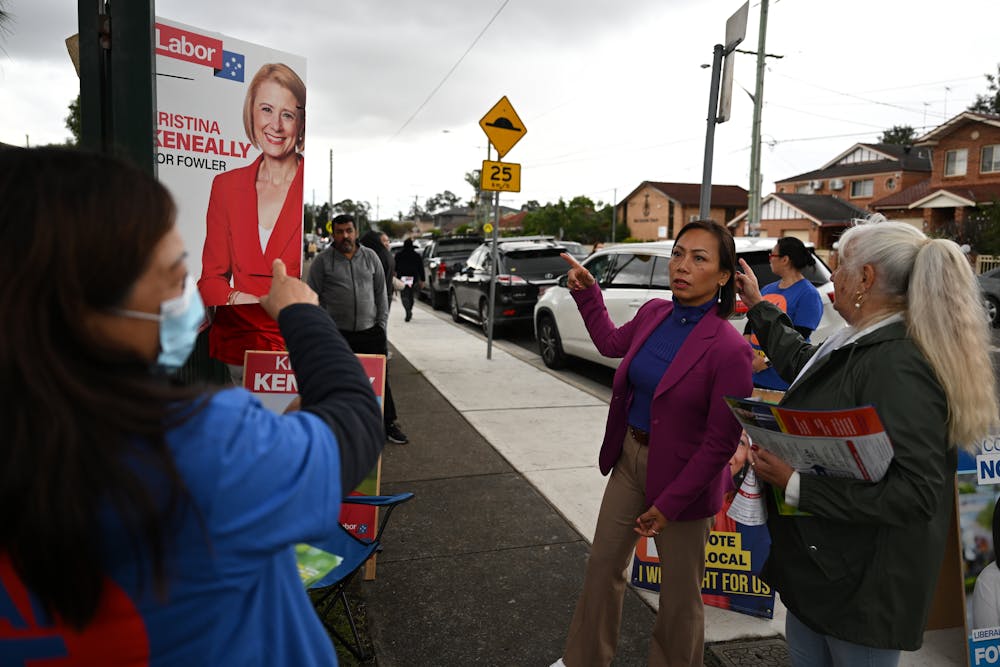 The largest swing to the Coalition was in Fowler (8.3% swing). This was the seat Kristina Keneally lost to independent Dai Le.
AAP Image/Dean Lewins
The largest swing to the Coalition was in Fowler (8.3% swing). This was the seat Kristina Keneally lost to independent Dai Le.
AAP Image/Dean Lewins
Read more: Where are the most marginal seats, and who might win them?
Can the Coalition recover at the next election?
Once elected, independents and other parties who win seats in Australia are difficult to dislodge. For example, independent Andrew Wilkie won Clark (then named Denison) from third on primary votes in 2010, but has retained it easily at subsequent elections.
Furthermore, while the Coalition won the two party count in all the seats won by teal independents, these seats all swung to Labor by between 1% and 10%. The lowest two party swing to Labor in a teal seat was Warringah, where Tony Abbott had deflated the Liberal vote in 2019. If the trend to the left in inner cities continues, it will be difficult for the Coalition to regain these seats.
While the Coalition came close to gaining three regional seats from Labor – Gilmore, Lyons and Lingiari – there are not enough regional seats in Australia for the Coalition to compensate for the losses of city seats.
If the Coalition is to win the next election, they will probably need to regain support in outer metro seats. I believe that in these seats the economy is of paramount importance. At this election, people in outer metro seats probably swung to Labor owing to concerns about inflation.
Economic conditions at the next federal election are likely to be crucial in determining how outer metro seats vote. So if the economy is lousy in three years, the Coalition will probably return to power.
With the massive swing to Labor in WA at this election, the Liberals will be hoping it returns to its normal place as a strongly pro-Coalition state at the next election. But while the WA swing was enhanced by COVID factors, Perth has around 80% of WA’s overall population.
If the Liberals continue to struggle in cities, WA is likely to be more difficult than it may first appear for the Liberals to win back. Tasmania’s three northern seats are likely to be easier for the Liberals to win and hold, but Tasmania only has five seats while WA has 15.
With declining vote share for the major parties, it is becoming more difficult for one of them to win a majority even with our single-member system for the House. Labor has angered both House and Senate crossbenchers with its proposals to cut the number of parliamentary staff each crossbencher is entitled to from four to one.
While Labor does not need the crossbench for a House majority in this term, they could easily need more support in the future, And Labor needs at least one non-Greens crossbencher in the Senate to pass legislation opposed by the Coalition in this term. The proposed reduction is stupid politics.
Authors: Adrian Beaumont, Election Analyst (Psephologist), The Conversation


















