Sky-high mortgages, 7.1% inflation, and a 20% chance of recession. How the Conversation's panel sees the year ahead
- Written by: Peter Martin, Visiting Fellow, Crawford School of Public Policy, Australian National University
Homeowners will face mortgage rates near 5.5% in a little over a year, according to a survey of 22 leading Australian economists.
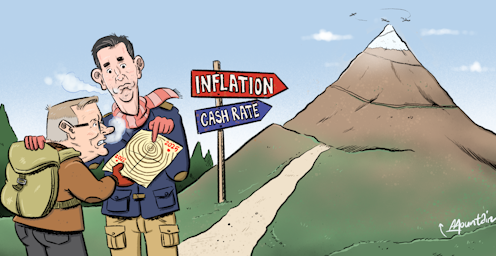
The Conversation’s 2022-23 forecasting survey predicts an increase in the Reserve Bank’s cash rate from its present 0.85% to a peak of 3.1% by next August.
If fully passed on, the series of rate hikes would lift the cost of payments on a variable $500,000 mortgage by about $600 per month and the cost of payments on a $800,000 mortgage by about $1,000 per month.
Sydney and Melbourne home prices would slide 6-7%.
The panel believes the Reserve Bank will push its cash rate to its highest point since the 2010-2012 resources boom in an effort to contain inflation, which it expects to jump from its present 5.1% to a peak of 7.1% before the end of the year.
Panel members put the risk of an overreaction by authorities bringing on a recession at a 40% chance in the United States, and a lower 20% probability in Australia.
Now in its fourth year, The Conversation’s survey draws on the expertise of leading forecasters in 20 Australian universities and financial institutions, among them economic modellers, former Treasury, International Monetary Fund and Reserve Bank officials, and a former member of the Reserve Bank board.
Inflation
The panel expects the next inflation figure to be released later this month to show prices climbed 6.7% in the year to June – the most since the early 1990s.
Panelist Saul Eslake says it hard to be confident about when inflation will peak without being confident about when and how the conflict in Ukraine will end, although he says it is difficult to see energy prices climbing higher, and there is some evidence COVID-related supply disruptions are beginning to ease.
On balance the panel expects inflation to peak at 7.1% towards the end of this year before declining next year.
Interest rate rises
The panel expects the equivalent of five 0.25 point increases in the Reserve Bank’s cash rate in the next six months, and just short of another two 0.25 point increases in the six months that follow.
On balance, the panel expects the cash rate to stop climbing when it gets to 3.1% next August, but some members expect much steeper increases.
Warwick Mckibbin, a former member of the Reserve Bank board, expects a cash rate of 4.5% (implying mortgage rates of 6.75%) by March, and he says that is less than required.
He says the cash rate needs to climb above the 3.5% that would normally be thought of as neutral, and stay there for a sustained period to bring inflation back to the Reserve Bank’s target.
Read more: RBA Governor Philip Lowe is hiking interest rates. It'll add hundreds per month to mortgage payments
Former Commonwealth Treasury and financial markets economist Warren Hogan sees rates climbing for as many as five years, although his forecast is for four.
RBC Capital Markets head of economics Su-Lin Ong believes that won’t be needed to cool the economy, as the expiry of the ultra-cheap three-year fixed rate mortgages taken out during COVID will deliver a “market-induced tightening”.
Recession risk in the US and Australia
The panel believes the United States is at a much greater risk than Australia of a miscalculation in which rates are pushed so high to contain inflation that they bring on a recession.
The US economy has already turned down in the first three months of this year, and the panel expects it to finish the year just 2.2% larger than when the year began. The panel expects unusually low economic growth of 2.6% in China.
In the United States, the task of defining the start and end of recessions is assigned to the National Bureau of Economic Research’s business cycle dating committee.
The panel believes there is a 40% chance it will call a recession in the next two years, with the most likely start being March 2023.
The panel assigns a lower 20% probability to a recession in Australia (commonly defined as two consecutive quarters of negative economic growth) and believes the most likely start date is August 2023.
Economic growth
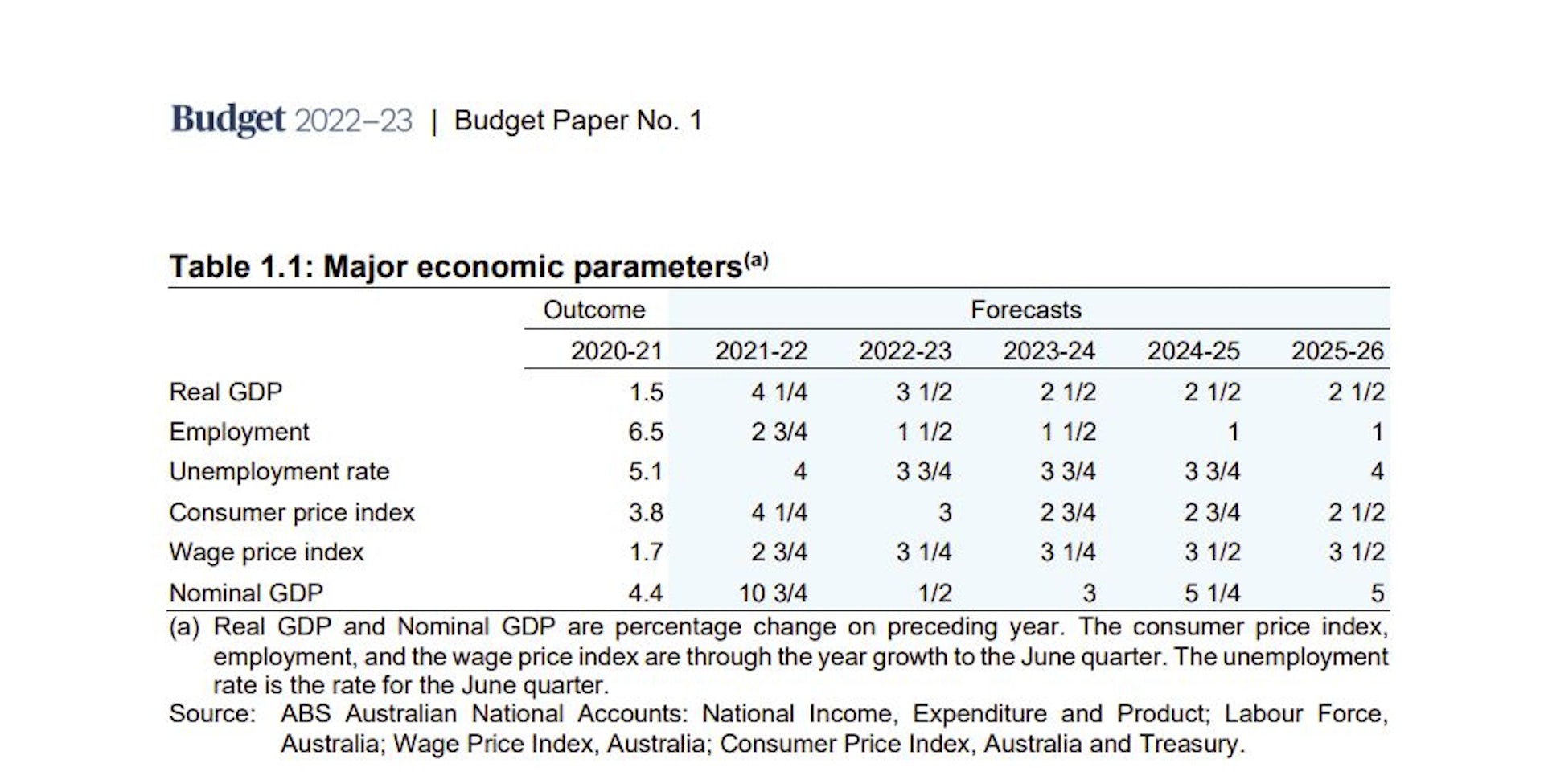
Absent recession, the panel expects economic growth to decline in line with forecasts in the March budget from year-on-year growth of 4.25% in 2021-22 to 2.5% over the coming five years.
Living standards
The substantial increase in wage growth the panel expects from 2.4% in the year to March to 3.6% by June next year will be nowhere near enough to prevent real wages sliding.
Even with inflation down to 4.8% by then as forecast, real wages would go backwards by a further 1.2%.
Weighing on further increases in wages growth will be a forecast nudge up in the rate of unemployment, from 3.9% to 4.2%.
ANZ chief economist Richard Yetsenga says while reopening Australia to skilled migrants, temporary visa holders, students and backpackers will add to the supply of workers, it should also boost already very strong consumer spending, limiting any increase in unemployment.
The panel expects outsized real growth in household spending of 4.5% in 2022-23 boosted by what Barrenjoey Capital’s chief economist Jo Masters describes as elevated household savings, combined with continuing fixed rate mortgages and the low and middle income tax offset payments due to hit accounts from July.
The broadest measure of living standards, real net disposable income per capita, should continue to advance, although modestly.
Home prices
The panel expects mortgage rate driven falls in home prices to reach 6-7% in Sydney and Melbourne over the coming year.
Julie Toth of Swinburne University and Nous Group expects the biggest impact in low and medium income suburbs, where buyers are more vulnerable to mortgage increases.
Markets
The panel nonetheless expects solid growth in non-mining business investment of 6.4% (and mining investment of 7.6%), and an iron ore price above US$100 an ounce but sliding down from its present US$130 to US$108.
It expects the Australian share market to end the financial year 2% lower.
After a year in which the 10-year bond rate that determines the government’s cost of borrowing soared from 1.5% to 3.7%, panelists expect only a small further increase in 2022-23, to 3.9%.
After sliding from 75 US cents to 69 US cents, they expect the Australian dollar to climb modestly to 72 cents during 2022-23, putting some downward pressure on inflation.
The Conversation Economic Panel
Click on economist to see full profile.
Authors: Peter Martin, Visiting Fellow, Crawford School of Public Policy, Australian National University