

Thousands of giant crabs amass off Australia's coast. Scientists need your help to understand it
- Written by: Elodie Camprasse, Research fellow in spider crab ecology, Deakin University
Am I not pretty enough? This article is part of The Conversation’s series introducing you to little-known Australian animals that need our help.
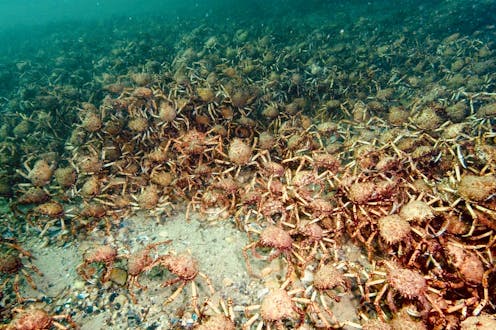
Every winter in shallow waters off Australia’s southern coast, armies of native spider crabs appear in their thousands. They form huge underwater piles, some as tall as a person. These fascinating crustaceans are on a risky mission – to get bigger.
Crabs cannot simply grow like humans and other soft-bodied creatures. They must break free from their shells, expand their soft flesh and harden a new shell – all while dodging hungry predators on the hunt for a soft, easy meal.
This moulting process leaves crabs clumsy and uncoordinated, making any escape tricky. That’s thought to be one reason they clump together in such big numbers – to keep each other safe.
The spectacular gatherings attract tourists from interstate and overseas and have even been featured in a BBC documentary. But despite all this attention, scientists know very little about these quirky creatures. We need your help to investigate.
Safety in numbers
Southern Australia’s spider crabs (Leptomithrax gaimardii) are usually orange to red-brown. They can reach 16cm across their shell and 40cm across their legs, and are commonly known as great spider crabs.
Spider crabs are believed to be widely dispersed in deeper waters. But they’re most visible to humans when they congregate near shore in winter, and occasionally at other times of year.
Once together, spider crabs shed their old shells in a synchronised act thought to take about an hour. The crabs stay together until their new hard shells form, which probably takes a few days.
The aggregation can last a few weeks. Soft crabs are thought to take refuge in the middle of the piles, protected by crabs yet to moult.
Afterwards, spider crabs return to deeper waters and their solitary lives, leaving the seafloor littered with discarded shells.
Read more: A tiny wasp could save Christmas Island's spectacular red crabs from crazy ants
Plenty of mysteries to solve
Spider crab aggregations have been officially reported along the Victorian and Tasmanian coasts. Historically, most winter sightings have been reported on the Mornington Peninsula – particularly near the Rye and Blairgowrie piers.
Anecdotal evidence suggests the gatherings can also happen elsewhere. For instance, an aggregation was reported this year on the western side of Port Phillip Bay.
But there’s still so much we don’t know about spider crabs, such as:
- how many spider crabs are out there?
- how many gather en masse?
- how long do the crabs stay?
- what signals do crabs use to know it’s time to come together?
- why do the crabs aggregate at one location in several consecutive years then not return?
Most spider crab gatherings seem to occur in winter, but they’re known to come together at other times. For example, aggregations in late spring, midsummer and early autumn have been reported in parts of Port Phillip Bay and elsewhere Victoria and Tasmania.
Those aggregations don’t seem related to moulting – in fact, we have no idea why they occur!
Source: Elodie Camprasse.We need your help
To better understand spider crab aggregations, a citizen science project called Spider Crab Watch has been launched.
We’re inviting everyone – including divers, fishermen, swimmers and boaters – to report where they see spider crabs, alone or in groups. We’d also love to hear from people who come across discarded spider crab shells on the beach, because that indicates an aggregation occurred nearby.
The reports will help us determine the habitats and conditions suitable for spider crab aggregations. We welcome sightings from Port Phillip Bay and across the Great Southern Reef, where spider crabs live. The reef spans the southern part of Australia from New South Wales to Western Australia and Tasmania.
Read more: From counting birds to speaking out: how citizen science leads us to ask crucial questions
Logging a sighting is a quick process. Just report the date, time and location of the spider crabs, and answer a few questions. Photos are not essential but always welcome.
We’re also using traditional research to solve these mysteries. This includes underwater surveys, spider crab tagging and the use of timelapse cameras to capture images of spider crabs and their predators at sites where aggregations are expected.
After the aggregations, the images captured will be uploaded to a web portal. Interested people from around the country (and the world) can then analyse the images to help us count spider crabs and identify their predators.
If that interests you, sign up for Spider Crab Watch updates.
This program and the broader research is supported by funding from the Victorian government.
Understanding our oceans
The aims of this research go far beyond spider crabs. Scientists also want to know if spider crab gatherings help predators maintain healthy populations.
Huge stingrays, seals, seabirds and some sharks are often spotted near aggregation sites. But we need more information to understand how crab aggregations affect animals at the top of the food chain.
Spider crabs have captured the imagination of ocean lovers for decades – yet we know so little about their lives.
This project will help us gather information on this amazing natural spectacle and the role it plays in the marine environment.
Read more: Octopus, crabs and lobsters feel pain – this is how we found out
Authors: Elodie Camprasse, Research fellow in spider crab ecology, Deakin University


















