

Modern Australian
The Times

what we now know about the meteor that lit up the daytime sky above New Zealand

  • Written by James Scott, Associate Professor in Geology, University of Otago
what we now know about the meteor that lit up the daytime sky above New Zealand

Meteorites hit New Zealand three or four times a year, but the fireball that shot across the sky above Cook Strait last week was unusual.

It had the explosive power of 1,800 tonnes of TNT and was captured from space by US satellites. It set off a sonic boom heard throughout the southern parts of the North Island.

Witnesses described a “giant bright orange fireball” and a flash that left a “trail of smoke that hung around for a few minutes”.

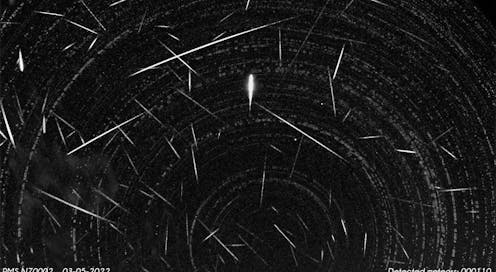
The fireball was most likely caused by a small meteor, up to a few metres in diameter, traversing Earth’s atmosphere. It was one of only five impacts of greater than a thousand tonnes of energy globally in the past year. Most meteors are tiny, creating “shooting stars” that only briefly skim the atmosphere.

The fragmentation of the meteor produced a shock wave strong enough to be picked up by GeoNet, a network of earthquake seismometers, with a flash bright enough to be recorded by a global lightning-tracking satellite. The Metservice’s Wellington radar picked up the leftover smoke trail south of the tip of the North Island.

But what is the chance of finding any of the its fragments, or meteorites, that dropped to Earth?

As part of Fireballs Aotearoa, a recently established collaboration between the universities of Otago and Canterbury and the astronomy community to track down freshly fallen meteorites, we are deploying specialised night-sky meteor cameras across New Zealand.

Fireballs Aotearoa’s meteor cameras only operate at night, but the compiled witness reports reveal the July 7 fireball travelled from northwest to southeast and most likely fragmented over the ocean. Unfortunately, any meteorites are therefore probably inaccessible.

Meteorites on Earth

Earth mainly gets meteorites from the asteroid belt, the Moon and Mars. They range from those only visible with a microscope to gigantic ones, such as the roughly 10km-wide meteorite that triggered the extinction of dinosaurs 65 million years ago.

Meteorites are scientific goldmines. Some contain material from before the Sun formed. Others tell us about the history of the young Sun’s planet-forming disk, when dust circulating around it began to clump into larger rocks and, eventually, planets.

Read more: As the Perseverance rover lands on Mars, there's a lot we already know about the red planet from meteorites found on Earth

Lunar meteorites show the Moon originated from the collision of a small planet with Earth. Martian meteorites tell us about the surface and interior of our closest planet. We don’t even need to send a spaceship.

If a meteor is recorded by several night-sky cameras, then its trajectory can be calculated and any resulting meteorites potentially located. The trajectory also tells us the meteor’s pre-impact orbit, allowing us to estimate where in the Solar System it originated.

How to help find a meteorite

New Zealand has nine known meteorites. Although the fireball wasn’t seen, the most recent was the Auckland meteorite that crashed through an Ellerslie roof in 2003. Our analysis shows this rock belongs to the ordinary chondrite group and therefore was part of a small asteroid only slightly younger than the Sun.

Last year, the British citizen-led fireball network UKFall captured footage of an enormous fireball over southern England. The debris was located on a driveway in Winchcombe, Gloucestershire – where the owner initially assumed someone had emptied their barbecue.

Now on display in the Natural History Museum in London, the Winchcombe meteorite turned out to be a type incredibly rare on Earth.

It is similar to the 5g of material returned in 2020 from asteroid Ryugu by the Hayabusa 2 spacecraft, except the meteorite gave scientists a hundred times as much to work with.

Read more: What are asteroids made of? A sample returned to Earth reveals the Solar System's building blocks

Although the Wellington fireball on July 7 probably didn’t drop a meteorite on land, the next one might. And you can join the meteorite hunt by reporting any sightings to Fireballs Aotearoa.

We would like to acknowledge Jim Rowe and Jeremy Taylor, our colleagues at Fireballs Aotearoa, for help with compiling this article.

Authors: James Scott, Associate Professor in Geology, University of Otago

Read more https://theconversation.com/equivalent-to-1-800-tonnes-of-tnt-what-we-now-know-about-the-meteor-that-lit-up-the-daytime-sky-above-new-zealand-186636

Chatswood Tutoring And Its Role In Academic Achievement

Academic success often requires more than classroom attendance alone. Students face increasing expectations as they progress through school, particu...

Why Laser Hair Removal Treatments Continue Growing In Popularity

Managing unwanted hair can become time-consuming and frustrating for many people, especially when shaving, waxing, and other temporary methods requi...

Choosing the Right Devices for a Flexible Workplace

For IT leaders managing large fleets, the device layer is where workforce productivity and security policy meet. The shift towards flexible and hybrid...

How Business Advisory Services Help Companies Achieve Sustainable Growth

Every business owner aims to build a profitable and sustainable organisation. While dedication, innovation, and hard work are important, achieving l...

Why Body Contouring Has Become A Popular Cosmetic Treatment

Many people maintain healthy lifestyles through regular exercise and balanced eating habits but still struggle with stubborn areas of fat that are d...

How to Choose the Right POS Hardware for Your Business in Australia

A lot of Australian business owners spend weeks researching POS software but buy hardware almost as an afterthought. That's a mistake. The wrong har...

Why Material Handling Hose Is Critical for Industrial Efficiency

A high-performance material handling hose is an essential component in industries that transport abrasive, dry, or bulk materials on a daily basis...

How to Choose the Right Lawyer in Melbourne for Your Situation

Choosing legal support can feel difficult, especially when the stakes are personal or business-related. The right lawyer in Melbourne should underst...

Hoteliers Look to Clever Value Adds to Increase Revenue

The Australian hospitality industry is still in recovery mode after a notoriously rough patch in recent years. While there has been a post-COVID tra...

Moving to Queensland? Here’s How to Prep Your Car for the Big Move North

There’s no sign of the northern migration slowing down, with thousands of southerners fleeing from chaotic lifestyles and cooler climates for a brig...

Diesel Shortage to Impact Trades and Contractors

Strait of Hormuz blockage affecting all major parts of trades and construction Trades and construction across residential, commercial and industria...

Why Holiday Home Owners Turn to Rental Management Agents

The Allure — and the Reality — of Renting Out Your Property Owning a holiday home is a dream for many Australians. Whether it's a beachside sha...

Why Finding Reliable Doctors In Bundoora Is Important For Long-Term Health

Access to quality healthcare plays an important role in maintaining overall wellbeing and managing health concerns early. Trusted Doctors in Bundoor...

Understanding the Different Types of Car Services: Minor vs Major

When it comes to car maintenance, one of the most important things every vehicle owner should understand is the difference between a minor and a maj...

How Superannuation and TPD Insurance Work Together

Superannuation is an essential part of financial planning in Australia. It is designed to provide individuals with income during retirement, helping...

Tiny Towns funding granted for Mt Hotham and Mt Buller upgrades

Alpine Resorts Victoria (ARV) has welcomed funding support from the Victorian Government’s  Tiny Towns Fund, with both Mt Hotham and Mt Buller se...

Locksmith Services: Why Professional Security Solutions Matter More Than Ever

Security is a critical concern for homeowners, businesses, and vehicle owners alike. Whether it involves protecting a property, replacing damaged lo...

Why Tooth Fillings Are Important For Protecting Damaged Teeth

Cavities and minor tooth damage are common dental problems that can worsen if left untreated. Professional tooth fillings help restore damaged teeth, ...
















