

high-tech tool promises scientists an edge over the cane toad scourge
- Written by: Arman Pili, PhD candidate, Monash University
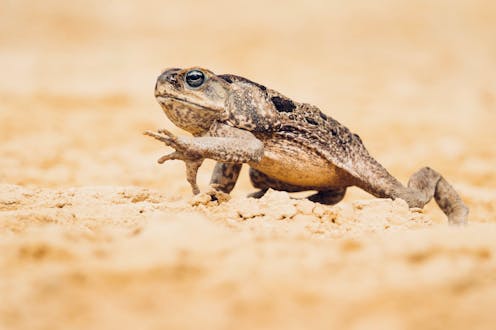
Cane toads are invasive frogs that threaten the survival of several Australian wildlife species. Scientists and conservation managers have long grappled with how to stop the toad’s march across the continent.
That’s where our new research comes in. A paper just published describes a computer simulation program we developed to help test cane toad management in the virtual world before strategies are rolled out in real life.
The program, structured like a video game, answers questions such as: should toads be hand-caught or trapped? When is the best point in a toad’s lifecycle to eradicate it? And how best to balance effort and cost versus reward?
We hope the program will help guide scientists and conservation managers to get an edge over their poisonous amphibian foe.
A video narrated by the author explaining how virToad works.The cane toad disaster
The cane toad is the ultimate invader, spreading up to 50 kilometres a year and breeding explosively.
What makes the cane toad truly devastating is its weapons of environmental destruction — poison packed in specialised skin glands on its shoulders. This weapon can quickly kill native predators that take a bite, such as goannas, quolls, snakes and even crocodiles.
The cane toad was brought to Australia from Hawaii in 1935 to control beetles that were damaging sugar cane plantations. While the toads had little impact on the beetles, they thrived in the wild.
Cane toads are now found across Australia’s north and they’re fast creeping southwest. Within a few years, cane toads are expected to reach the Kimberley-Pilbara corridor.
There, man-made waterbodies for livestock grazing are likely to provide cane toads with safe passage through arid landscapes and into the Pilbara region – an important refuge for many native species.
Managing cane toad invasions
The Kimberley-Pilbara corridor is now a crucial battleground between cane toads and conservation managers. But cane toads must also be suppressed in landscapes where the species is already established. And preventing the toads from invading Australia’s offshore islands, or eradicating them once there, is also imperative.
Achieving all this with limited resources is a struggle. We developed virToad to guide scientists and conservation managers in their decisions. virToad is a free and open-source program that builds on existing literature and models.
Unlike previous models, virToad simulates the vulnerabilities of cane toads at various stages of their lifecycle, and the management strategies that can exploit them. These nuances make virToad’s predictions more useful than previous models.
For example, cane toads need water to breed and rehydrate, so virToad simulates management strategies along freshwater shorelines. These include traps that lure tadpoles, juveniles and adults, by releasing chemical cues, mimicking toad calls or attracting insects (a food source) with UV lights.
virToad also simulates a promising new strategy of releasing chemical pheromones to suppress tadpole development.
virToad players can trial various management strategies, in any Australian landscape and over timescales of days to years. Each can be carried out in isolation or in combination:
By playing around with different strategies, and understanding the effort needed to implement them, virToad allows conservation managers to calculate whether they have the people and budget to deploy a plan on the ground.
Read more: What is a waterless barrier and how could it slow cane toads?
So what worked best?
Our simulations showed some actions worked better than others in managing cane toad invasions.
In the Northern Territory tropics, for example, hand-collecting and trapping juveniles and adults made the most significant and lasting difference. In fact, a daily effort over a year eradicated toads. But this strategy is expensive and labour-intensive.
The simulation showed similar results could be obtained when adults and juveniles were hand-captured or trapped once a week, for a year – that’s 85% less cost and effort than the daily strategy.
Unfortunately, hand-collecting toads for one day a year – as happens with community-led toad-busting activities – had no noticeable impact.
Likewise, fencing waterbodies and trapping or chemically suppressing tadpoles had no lasting impact in the NT tropics simulation. But these strategies may be more effective in other environments. For example, fencing waterbodies may be effective in the arid Kimberley-Pilbara corridor, where other water sources are scarce.
In perhaps our most significant finding, small-scale interventions had negligible long-term benefits. Our simulations showed local toad populations re-established a year after any localised strategy was implemented, regardless of its initial success or the effort expended.
This clearly indicates a landscape-scale approach is needed to manage cane toad invasions. And virToad is uniquely well-suited to guide managers on this undertaking.
Of course, our findings are only virtual. While we took steps to validate the realism of our model, real-world data on the impact of various management strategies is needed to confirm our simulated findings.
Read more: How indigenous expertise improves science: the curious case of shy lizards and deadly cane toads
A new arsenal
We hope virToad gives scientists and conservation managers a new arsenal in the fight against cane toads, by helping ensure their decisions are both science-based and cost-effective.
While the design is based on Australian conditions, it can potentially be used in other parts of the world. And as the biodiversity crisis worsens globally, we hope virToad will inspire research into ways of managing other damaging invasive species.
We also plan to further develop virToad into a computer simulation “game” that the general public can play. Through this, we hope to spread the word that effectively fighting cane toads is vital to saving threatened wildlife.
Read more: Pest plants and animals cost Australia around $25 billion a year – and it will get worse
Authors: Arman Pili, PhD candidate, Monash University


















