

Artificial light at night can change the behaviour of all animals, not just humans
- Written by: Therésa Jones, Associate Professor in Evolution and Behaviour, The University of Melbourne
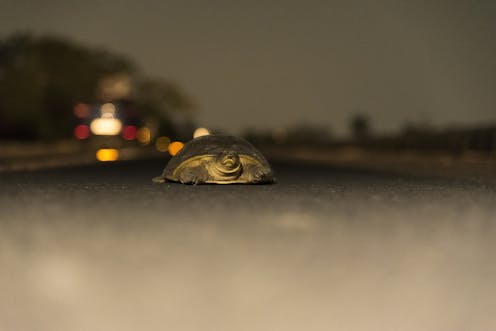
As the Moon rises on a warm evening in early summer, thousands of baby turtles emerge and begin their precarious journey towards the ocean, while millions of moths and fireflies take to the air to begin the complex process of finding a mate.
These nocturnal behaviours, and many others like it, evolved to take advantage of the darkness of night. Yet today, they are under a increasing threat from the presence of artificial lighting.
At its core, artificial light at night (such as from street lights) masks natural light cycles. Its presence blurs the transition from day to night and can dampen the natural cycle of the Moon. Increasingly, we are realising this has dramatic physiological and behavioural consequences, including altering hormones associated with day-night cycles of some species and their seasonal reproduction, and changing the timing of daily activities such as sleeping, foraging or mating.
The increasing intensity and spread of artificial light at night (estimates suggest 2-6% per year) makes it one of the fastest-growing global pollutants. Its presence has been linked to changes in the structure of animal communities and declines in biodiversity.
Read more: We attached tracking devices to West Africa's green turtles. This is what we learnt
How animals are affected by artificial lighting
Light at night can both attract and repel. Animals living alongside urban environments are often attracted to artificial lights. Turtles can turn away from the safety of the oceans and head inland, where they may be run over by a vehicle or drown in a swimming pool. Thousands of moths and other invertebrates become trapped and disoriented around urban lights until they drop to the ground or die without ever finding a mate. Female fireflies produce bioluminescent signals to attract a mate, but this light can’t compete with street lighting, so they too may fail to reproduce.
Each year it is estimated millions of birds are harmed or killed because they are trapped in the beams of bright urban lights. They are disoriented and slam into brightly lit structures, or are drawn away from their natural migration pathways into urban environments with limited resources and food, and more predators.
Other animals, such as bats and small mammals, shy away from lights or may avoid them altogether. This effectively reduces the habitats and resources available for them to live and reproduce. For these species, street lighting is a form of habitat destruction, where a light rather than a road (or perhaps both) cuts through the darkness required for their natural habitat. Unlike humans, who can return to their home and block out the lights, wildlife may have no option but to leave.
For some species, light at night does provide some benefits. Species that are typically only active during the day can extend their foraging time. Nocturnal spiders and geckos frequent areas around lights because they can feast on the multitude of insects they attract. However, while these species may gain on the surface, this doesn’t mean there are no hidden costs. Research with insects and spiders suggests exposure to light at night can affect immune function and health and alter their growth, development and number of offspring.
Read more: Sex on the beach might be fun for people – but it's bad for dunes and wildlife
How can we fix this?
There are some real-world examples of effective mitigation strategies. In Florida, many urban beaches use amber-coloured lights (which are less attractive to turtles) and turn off street lights during the turtle nesting season. On Philip Island, Victoria, home to more than a million short-tailed shearwaters, many new street lights are also amber and are turned off along known migration pathways during the fledging period to reduce deaths.
In New York, the Tribute in Light (which consists of 88 vertical searchlights that can be seen nearly 100km away) is turned off for 20-minute periods to allow disoriented birds (and bats) to escape and to reduce the attraction of the structure to migrating animals.
In all cases, these strategies have reduced the ecological impact of night lighting and saved the lives of countless animals.
However, while these targeted measures are effective, they do not solve what might be yet another global biodiversity crisis. Many countries have outdoor lighting standards, and several independent guidelines have been written but these are not always enforceable and often open to interpretation.
As an individual there are things you can do to help, such as:
default to darkness: only light areas for a specific purpose
embrace technology: use sensors and dimmers to manage lighting frequency and intensity
location, location, location: keep lights close to the ground, shield at the rear, and direct light below the horizontal
respect the spectrum: choose low-intensity lights that limit the blue, violet and ultraviolet wavelengths. Wildlife is less sensitive to red, orange and amber light
all that glitters: choose non-reflective finishes for your home. This reduces the scattered light that contributes to sky glow.
In one sense, light pollution is relatively easy to fix – we can simply not turn on the lights and allow the night to be illuminated naturally by moonlight.
Logistically, this is mostly not feasible as lights are deployed for the benefit of humans who are often reluctant to give them up. However, while artificial light allows humans to exploit the night for work, leisure and play, in doing so we catastrophically change the environment for many other species.
In the absence of turning off the lights, there are other management approaches we can take to mitigate their impact. We can limit their number; reduce their intensity and the time they are on; and, potentially change their colour. Animal species differ in their sensitivity to different colours of light and research suggests some colours (ambers and reds) may be less harmful than the blue-rich white lights becoming commonplace around the world.
Authors: Therésa Jones, Associate Professor in Evolution and Behaviour, The University of Melbourne


















