

why keeping warming under 1.5℃ is a life-or-death matter for tidal marshes
- Written by: Neil Saintilan, Professor, School of Natural Sciences, Macquarie University
It may not always be clear why global temperature rise must be kept below 1.5℃, compared to 2℃ or 3℃. Research published today in the journal Science shows this apparently small distinction will make all the difference for the world’s tidal marshes.
Tidal marshes fringe most of the world’s coastlines. These coastal wetlands are flooded and drained by salt water brought by tides. They provide valuable habitat for animals, support fisheries that feed millions of people and take carbon dioxide from the atmosphere, storing it in their roots.
New roots build up the marsh soil, while stems trap sediment. Both processes help tidal marshes keep pace with sea-level rise. Indeed, tidal marshes increase the amount of carbon they store as the rate of sea-level rise increases.
This feedback has led scientists to question whether tidal marshes might survive future sea-level rise. Unfortunately, our research shows that’s unlikely if warming exceeds 1.5℃.
Read more: Rising seas allow coastal wetlands to store more carbon
A 20-year experiment provides the answer
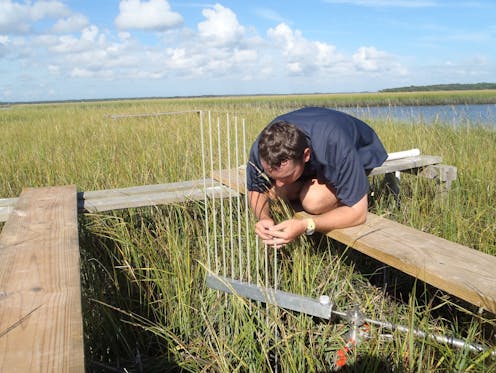
I am part of an international team of scientists who embarked on an experiment nearly 20 years ago to test whether tidal marshes were keeping pace with sea-level rise. Nearly 500 devices called “surface elevation tables” were installed in tidal marshes in countries including Australia, the United States, Canada, Belgium, Italy, the United Kingdom and South Africa.
These devices measured the amount of sediment and root material accumulating in the marshes. They also measured changes in the marsh’s surface elevation. Nearby tide gauges measured the rate of sea-level rise. This rate varied across the network.
Some coastlines such as Australia’s have a stable land mass – so the rate of sea-level rise reflects the rise in ocean volume driven by global warming.
On other coastlines, including much of North America, the land may still be sinking or rising after the removal of massive ice sheets at the end of the last ice age. What’s more, extracting oil and water resources from underground can cause local subsidence, increasing “relative” sea-level rise.
The data we gathered provide insights into what might happen to tidal marshes as sea-level rise accelerates.
Read more: Sea levels are rising fastest in big cities – here's why
What do the findings tell us?
One set of findings was encouraging. These data showed the rate at which material accumulates in tidal marshes around the world corresponds closely to the varying rates of sea-level rise.
Even the marshes experiencing sea-level rise of 7-10mm per year – the rate anticipated globally under high-emissions scenarios – were accumulating sediment and organic matter at a comparable rate.
However, measuring changes in elevation produced a very different picture. Even though marshes under higher rates of sea-level rise were accumulating more sediment, this did not translate into more elevation gain.
The new research suggests a simple explanation for this.
The additional sediment and water accumulating on the surface weigh the marsh down, compressing the sediment below. This is particularly apparent in marshes with high organic content: precisely the type that develops under high rates of sea-level rise.
This insight accords with observations emerging from the paleo record, which also suggest tidal marshes are highly vulnerable to rapidly rising sea levels.
A story of good news and bad
To protect our tidal marshes, we must try to reduce global carbon emissions that cause global warming and sea-level rise.
Sea level rise has averaged about 3.7mm per year since 2006. Our research shows tidal marshes are capable of keeping up with this on most of the world’s coastlines.
But global sea-level rise is set to increase. Modelling by the Intergovernmental Panel on Climate Change projects it will reach 7mm per year if warming reaches between 2℃ and 3℃.
Current global commitments put Earth on a trajectory for this level of warming. And once we reach tipping points for sea-level rise, they are locked in for centuries, regardless of subsequent cuts in emissions.
The best hope for preserving the world’s existing tidal marshes is to meet the Paris Agreement goal of limiting global warming below 2℃ – and if possible 1.5℃.
But we should even now be considering how we might allow for these important ecosystems to shift landwards. This has been their natural adaptation to episodes of high sea-level rise in the past. Countries with large expanses of undeveloped coastal floodplain, such as Australia, are well placed to provide areas to preserve shifting tidal marshes in a warmer future.
Authors: Neil Saintilan, Professor, School of Natural Sciences, Macquarie University


















