

Albanese wants to change the way politics is done. This means the way politics is reported will have to change too
- Written by: Denis Muller, Senior Research Fellow, Centre for Advancing Journalism, The University of Melbourne
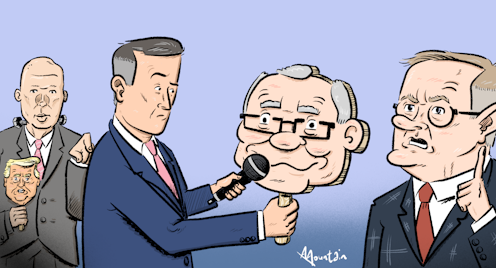
If politics really is to be done differently, as Prime Minister Anthony Albanese has promised, then the way politics is reported will need to be done differently too.
This is because the media’s power to portray will determine how the electorate perceives whether change is happening.
It is a reciprocating process. The way politicians perform influences the media’s portrayal of them, and how the media portray politicians in turn influences political practice.
One benchmark for helping us assess whether the promised change materialises is provided by academic Judith Brett’s characterisation of the Morrison administration:
The blame shifting, the careless inattention, the failure to prepare, the blatant favouring of Coalition and marginal seats with government largesse, the focus on announcements with little follow-up, the absence of serious concern about corruption and integrity […]
But that benchmark takes into account only the performance of the politicians. What about the media?
The media do appear to be in the early stages of changing the way they report federal politics. But this change is tentative, patchy and uncertain.
For instance, the coverage of the government’s actions on foreign policy has on the whole been straightforward and informative. That was until someone in the media pack travelling with Albanese in Europe asked why the prime minister’s visit to Ukraine was not equivalent to Morrison’s holiday to Hawaii during the 2019 bushfires. Albanese slapped down the comparison as “offensive”.
The on-the-road media pack had a bad election campaign disfigured by exactly this kind of juvenile “gotcha” reporting. Clearly in some parts of the media, the atmosphere of anticipated change has not penetrated.
In other parts of the media it clearly has, but there is an undercurrent of tentativeness, understandably so. Politics done differently suggests politics with fewer culture wars, fewer scandals, more policy focus, more incrementalism.
Moreover, a good deal of ideological steam has gone out of the political discourse as issues such as religious freedom, Safe Schools and transgender discrimination have faded from view. Climate change is now accepted by enough mainstream politicians, and media, to make the remainder look like cranks.
There has also been a dramatic structural change in the composition of the parliament, with the crossbench now representing a powerful third force. How will the media adjust from two-horse politics, so the crossbench gets a voice commensurate with its level of representation?
Read more: How the 'reality-distorting machinery' of the federal election campaign delivered sub-par journalism
All this implies the need for a shift in the priority given by the media to the various news values that turn content into news. Two of the most powerful news values, negativity and conflict, have been in plentiful supply since the collapse of the Rudd prime ministership in 2010.
Politics done differently, with a focus on policy formulation and implementation, makes the news values of impact and significance more salient. But this is not the stuff of clickbait, eyeballs, social media agitation and tabloid headlines.
This is a challenge at a time when every click and eyeball counts for a media industry still trying to recoup some of the devastating financial losses inflicted by the internet.
Will editors and news directors – and media proprietors – be up for the challenge? It is too soon to say. Conflict or negativity can always be manufactured, so there is no guarantee a more civilised and constructive political conversation will be reflected in more civilised and constructive coverage.
However, there are a few early signs of recognition in the media that change is in the air.
Author and freelance journalist Julie Szego seems to be onto it. In a column for The Age, she made the sardonic observation that Australian politics was suddenly boring. Once upon a time, she wrote, it was like the Danish TV drama Borgen, a world of cheap publicity stunts, the selling out of cherished principles, and morally bankrupt spin where a prime minister “creepily” washed a woman’s hair for a photo op. “But now it is all one big yawn.” Yet this was worth celebrating, she said, because it had produced a “background hum of steady-as-she-goes, the not un-genuine bid for consensus, the incremental steps toward something better”.
Covering the first sitting day of the 47th parliament, The Australian on its front page tried kicking life into the issue of construction union thuggery, based on a parliamentary question from a Liberal backbencher. But its editor-at-large, Paul Kelly, wrote reflectively on the need for competence in government and for Albanese to break the cycle of first-term failure.
Katharine Murphy, writing in The Guardian Australia, described the first day of the new parliament as conveying “a sense of a corner being turned”.
She noted that Scott Morrison was absent, preferring to attend a conference of conservative politicians in Tokyo. This was perhaps for the best, she added, since the style of politics he indulged in had been “repudiated in myriad ways”.
Whether this change in atmospherics illustrated by these examples of the newspaper coverage percolates into television news is an open question.
However, if change is to occur in how politics is portrayed to the public, the performance of television is crucial. This is because television news is still the most general source for Australian news consumers, with 66% saying they watch TV news and 42% saying it is their main source of news.
Read more: How much do mainstream media matter in an election campaign? (Spoiler: more than you might think)
Television news is also the most formulaic of all professional mass media: tight scripts allied to footage that may or may not assist the viewer’s understanding, and grabs of people speaking, all compressed into short packages. There is little scope for reflecting anything except the most superficial elements of a story.
Even so, the wording of scripts, the way they are read, and the choice and juxtaposing of grabs do allow for change to be reflected.
Regardless of the medium, absorbing and implementing change like this takes effort, and the difficulty of breaking old habits should not be underestimated. Journalists and audiences alike are accustomed to established ways of telling stories, just as medieval minstrels and their audiences were. No departure from the established script is easily tolerated.
But if it turns out that tomorrow’s politics are indeed done differently, it would be a serious disservice to the public if the media overlaid on them the news template of yesterday.
Authors: Denis Muller, Senior Research Fellow, Centre for Advancing Journalism, The University of Melbourne


















