

5 tips for building kids' resilience after bumps, scrapes and other minor injuries
- Written by: Sarah Wallwork, Post-doctoral Researcher, University of South Australia
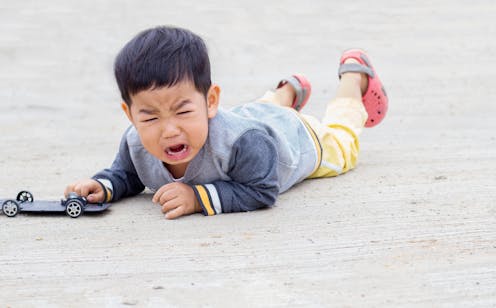
Bang! A child trips and grazes their knee. Your toddler bumps his head on the table. Your niece stubs her toe. The tears flood in.
Do you: (a) tell them to “brush-it-off”, (b) make a fuss and laboriously check for grazes, or (c) give them a cuddle, quick check, and encourage them to keep playing?
I am a physiotherapist and clinical pain neuroscientist from the University of South Australia. Recently, my colleagues and I published research investigating strategies to promote recovery and resilience in young children after injury.
While a parent or caregiver’s response to a child’s bumps or scrapes will depend on the child, the situation and the injury, generally, my research suggests a response like option c: comfort and reassurance (a cuddle), first-aid scan (quick check for grazes), and encourage them to manage their pain using distraction (return to activity).
Learning how to respond to pain
Everyday pain and injuries – such as minor bumps, cuts, grazes – are critical learning experiences for young children, and can influence how they interpret and respond to pain or injury experiences in the future.
This is important because one in five adolescents and adults will experience persistent or chronic pain problems, such as back pain, headaches or abdominal pain.
Read more: Parents' reactions can lessen or worsen pain for injured kids
We don’t (yet) know how to prevent children from developing persistent pain problems. But teaching people with persistent pain about how pain works helps reduce their pain.
We all learn about pain and injury through our own life experiences. When we get an injury, pain follows. Therefore pain must mean injury, right?
Actually, it’s not that simple. One of the difficulties health practitioners face in teaching people about pain is that they are often challenging long-held beliefs about how pain and recovery works.
Instead of trying to challenge these life-long developed beliefs, we can work “bottom-up” and start educating children about pain and injury from early on.
Investigating helpful pain behaviours
With a vested interest in this myself (I have two young children), my colleagues and I wanted to find out what parents and caregivers can do to teach children about pain that might promote “helpful” pain behaviours. That is, behaviours that are likely to lead to recovery, and build resilience for the future (and hopefully prevent future pain problems).
To address this, we investigated “everyday” pains – mostly because they are common in young children, but also because experience through learning can be very powerful.
So, we conducted a study asking eighteen international experts from child health, psychology, development, resilience, as well as parents and educators, what parents and caregivers could do to promote recovery and resilience after minor pains and or injury.
While recognising that all children and experiences will be unique, here are five key tips from the experts:
1. Teach children about the meaning of pain
Teach children that pain is our body’s alarm system: it’s there to protect us from danger.
It’s also important to note that pain and injury don’t always align. How we’re feeling on the inside, for instance, can influence how much pain we are in. If children are hungry or tired, the pain might seem worse.
2. Validate children’s pain and injury
This could involve getting down to the child’s level, acknowledging their pain and or injury, and how they’re feeling.
Ensure children feel safe, heard, and protected.
But don’t make a big fuss of it. Every child and event will be different, so use your judgement to strike a balance.
3. Reassure them
Let them know that their body is amazing and will heal and recover; and the pain will pass.
4. Support children’s emotional development
Role-model empathy, allow children to express their emotions, and encourage them to connect to their body’s warning signs.
This might include helping them talk about or show their feelings. Be mindful to not let your own reactions and emotions intervene. A fearful and shocked reaction to an injury may instil fear in that child.
This doesn’t mean letting the child wail and carry on. Rather, let them express themselves and then encourage them to regulate their emotions. This could involve encouraging deep breathing and connect to what it is they are feeling on the inside.
5. Involve children in managing their own pain and injury
Encourage children to make decisions and attend to their pain and injury, in an age-appropriate way. This might involve getting a band-aid, wet cloth, rubbing the area, or distraction.
Discuss first-aid and healing processes. Pop on a band-aid, tell them their “ouchie” is protected, and that it’s safe to move and play.
Be mindful of your language – demonstrate that they are the healers, rather than “getting fixed”. For example, you could talk about when we eat good food and get lots of good sleep, we are setting up our bodies to have lots of energy to heal and get better. This encourages active involvement in the healing process.
In everyday life, children will be exposed to lessons about pain and injury in many other social, cultural and educational contexts. Pain is commonly shown in children’s movies and TV shows in unhelpful ways, with low levels of empathy and gender stereotypes, where boy characters sustain more injuries than girls, but observers are more responsive to girls.
Therefore, how parents and caregivers communicate with children about pain and injury is important, and can build resilience after injury.
Read more: Is your child frightened of needles? Here's how to prepare them for their COVID vaccine
Authors: Sarah Wallwork, Post-doctoral Researcher, University of South Australia


















