

Capturing the shadow of Saturn's moon Titan from right here on Earth
- Written by: David Coward, Associate professor, University of Western Australia
Titan is Saturn’s largest moon, and it is more like a planet than a moon in many respects.
It has a thick atmosphere as well as wind, rivers, lakes made of hydrocarbons such as methane, and a liquid water ocean. Understanding its atmosphere may help us in the search for life on other planets.
Hence the excitement this July when a rare opportunity was available to further study Titan, from right here on Earth. On July 18 at 11:05pm (WAST, Western Australian time) Titan passed in front of a faint star, as seen by observers across most of Australia.
Read more: The secrets of Titan: Cassini searched for the building blocks of life on Saturn's largest moon
This event, known as an occultation, lasted only a few minutes and about 2% of the star’s light was blocked by Titan’s atmosphere.
The effect was so small it required large telescopes and a special camera to record it. But the data gathered should have profound implications for our understanding of an atmosphere on another world.
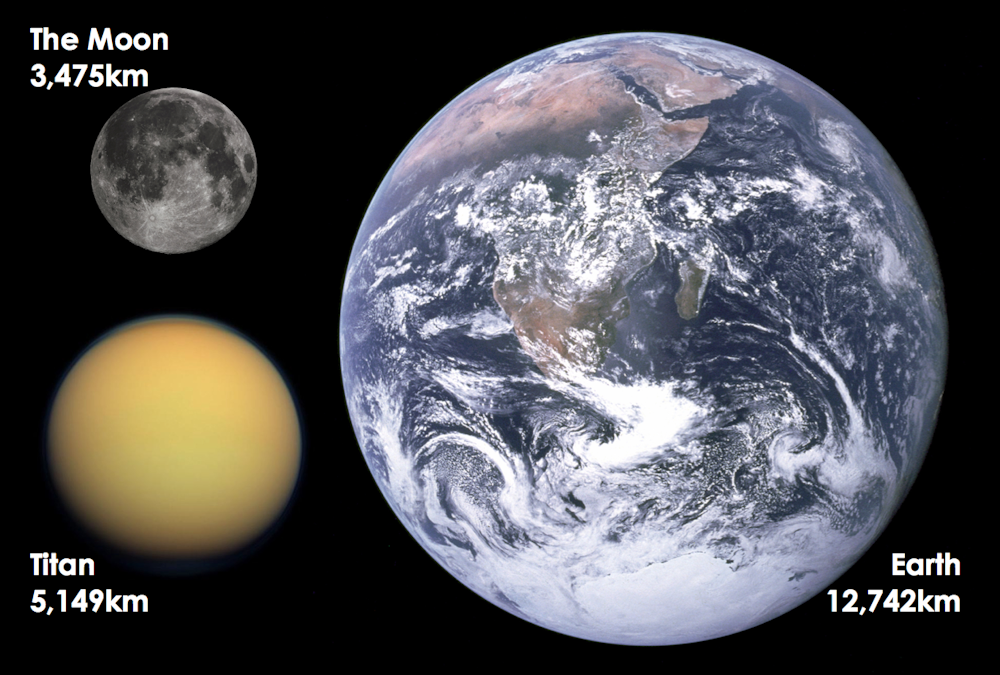 Saturn’s moon Titan compared (by diameter) to the Earth and its Moon.
Wikimedia/The Conversation
Saturn’s moon Titan compared (by diameter) to the Earth and its Moon.
Wikimedia/The Conversation
Examining Titan’s atmosphere
Scientists have developed a very clever technique to examine Titan’s atmosphere using stellar occultations. As Titan enters and exits an occultation, the star’s light would illuminate the atmosphere from behind, but be blocked by the moon itself.
Scientists then record subtle changes in brightness of the star over a few minutes, which represents a profile of the atmosphere’s density with height.
This method was used to study Titan’s atmosphere before, during a stellar occultation in 2003.
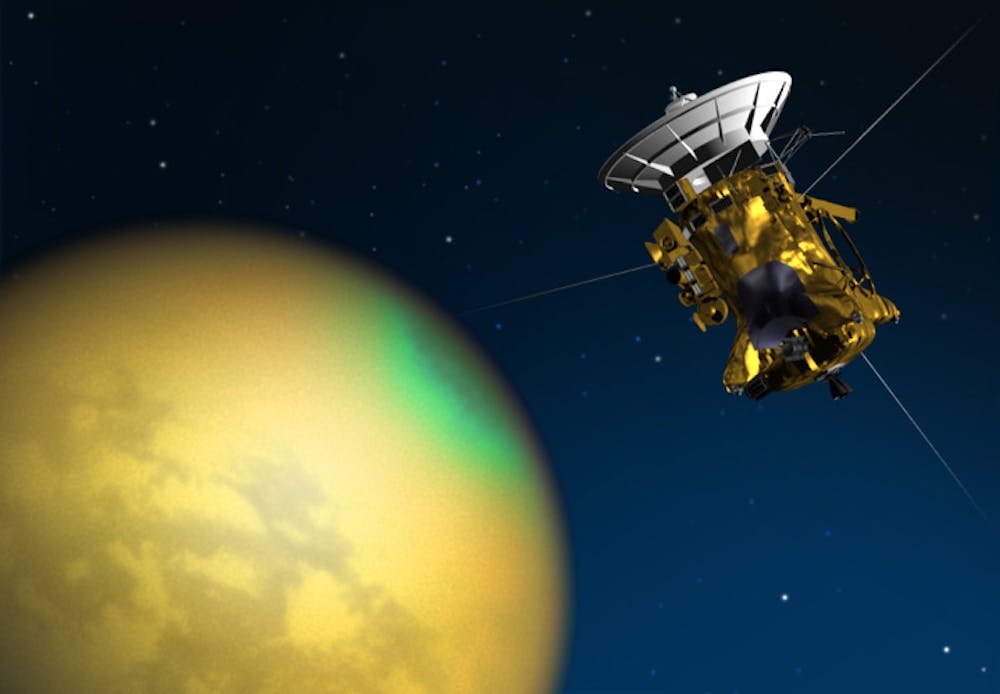 Artist’s concept of Cassini’s June 4, 2010, flyby of Saturn’s moon Titan.
NASA/JPL
Artist’s concept of Cassini’s June 4, 2010, flyby of Saturn’s moon Titan.
NASA/JPL
But in 2005, when Cassini’s Huygens lander arrived at Titan and descended to its surface, the atmospheric profile measured from its instruments did not match that derived from the 2003 occultation. This fuelled the question of how variable is the state of Titan’s atmosphere.
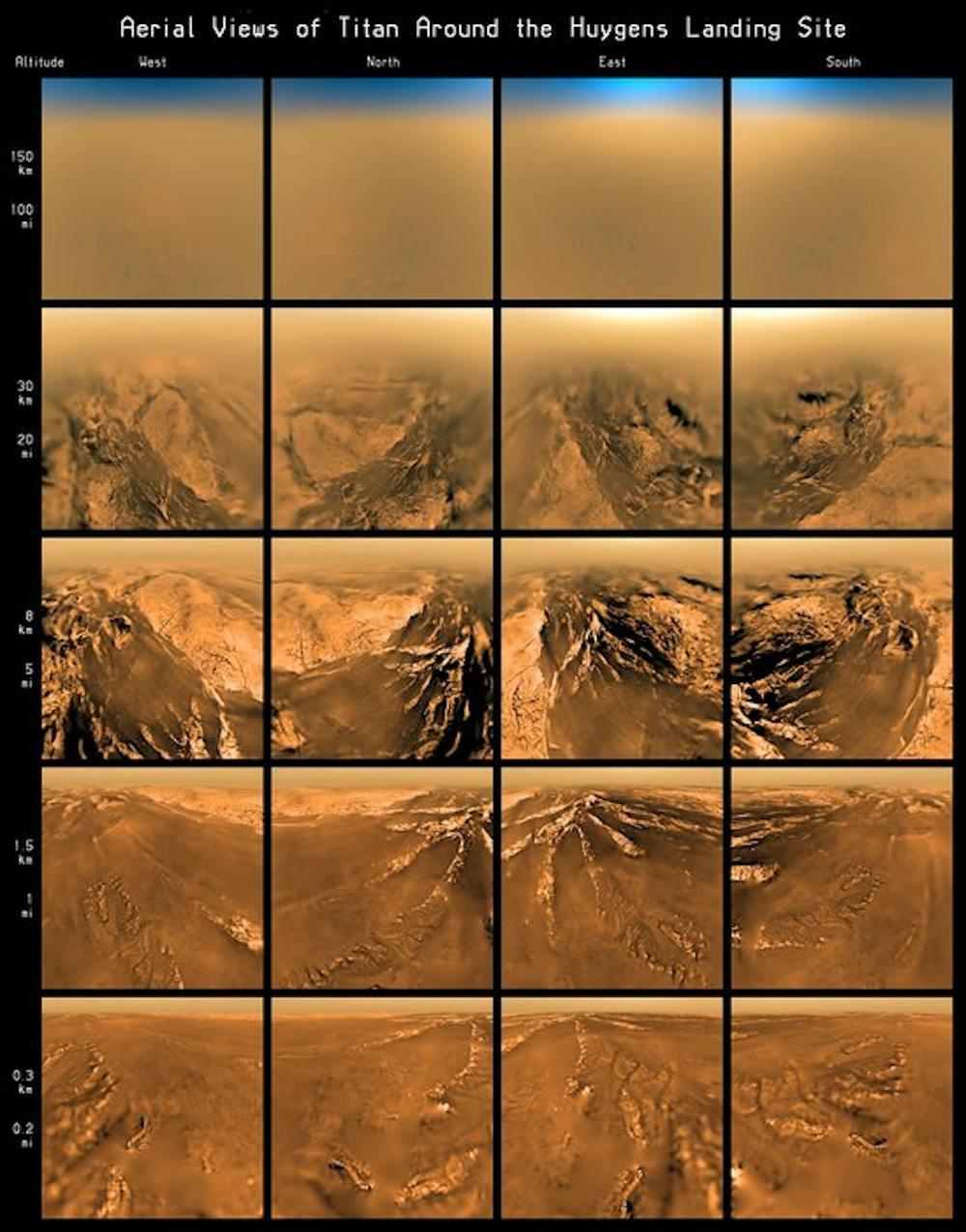 Composite of Titans surface taken by Huygens at different heights.
ESA/NASA/JPL/University of Arizona
Composite of Titans surface taken by Huygens at different heights.
ESA/NASA/JPL/University of Arizona
Since the Cassini mission ended in 2017, NASA’s Karsten Schindler said there was keen interest in any new atmospheric observations from occultations:
Occultations remain the only means to study Titan’s upper atmosphere and its evolution for the foreseeable future.
Countdown to the July occultation
So how were the latest observations made, and how was the data gathered?
From the air, the plan was for the July 18 occultation to be recorded by a camera mounted on a telescope of the Stratospheric Observatory of Infrared Astronomy (SOFIA) on board a Boeing 747 aircraft.
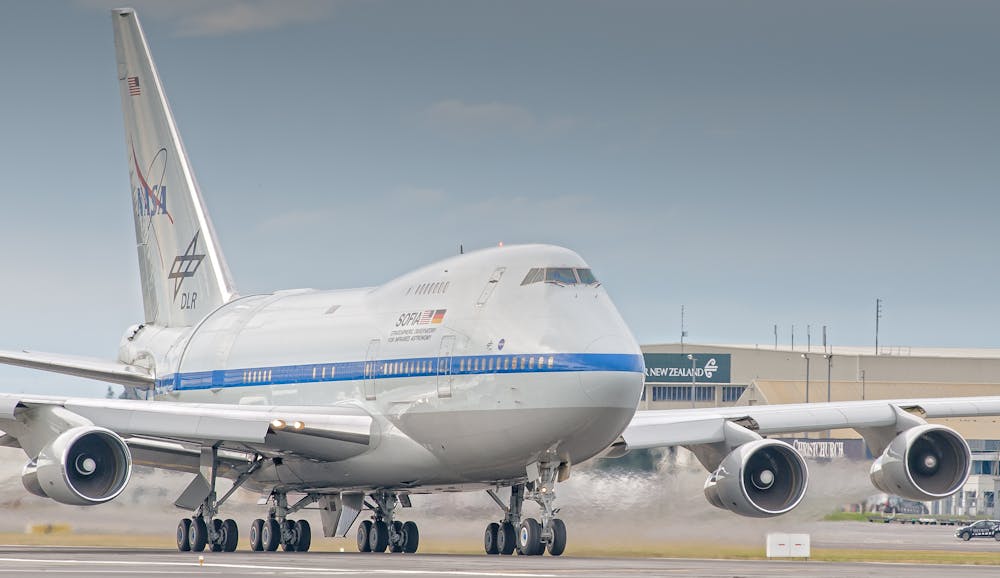 SOFIA takes off from Christchurch International Airport in 2017.
SOFIA/ Waynne Williams
SOFIA takes off from Christchurch International Airport in 2017.
SOFIA/ Waynne Williams
That’s right: a telescope mounted inside a modified passenger plane imaging an object more than 1 billion kilometres away! SOFIA would fly above the clouds between Australia and New Zealand.
From the ground, several facilities across Australia were to attempt to record the occultation.
The University of Western Australia’s Zadko Telescope, located about 80km north of Perth (see map, below), was identified by NASA as a ground facility sensitive enough to contribute to the project.
The most obvious deal breaker was the weather. July is one of the wettest months at the Zadko telescope site. But, as we found out, there were other unforseen challenges.
Three days to occultation
NASA’s Karsten Schindler arrived at the UWA research site, at Gingin, on Monday July 16, armed with a case filled with delicate cameras, cables and electronics.
The camera was the key to record the event. The current Zadko telescope camera cannot record fast enough to capture the rapid changes in brightness of the occulted star.
The Zadko Telescope was fitted out with a fast shooting (a frame every few seconds), NASA camera, more like a movie camera than a standard astronomical camera. After hours of installation, the new imaging system needed to be tested.
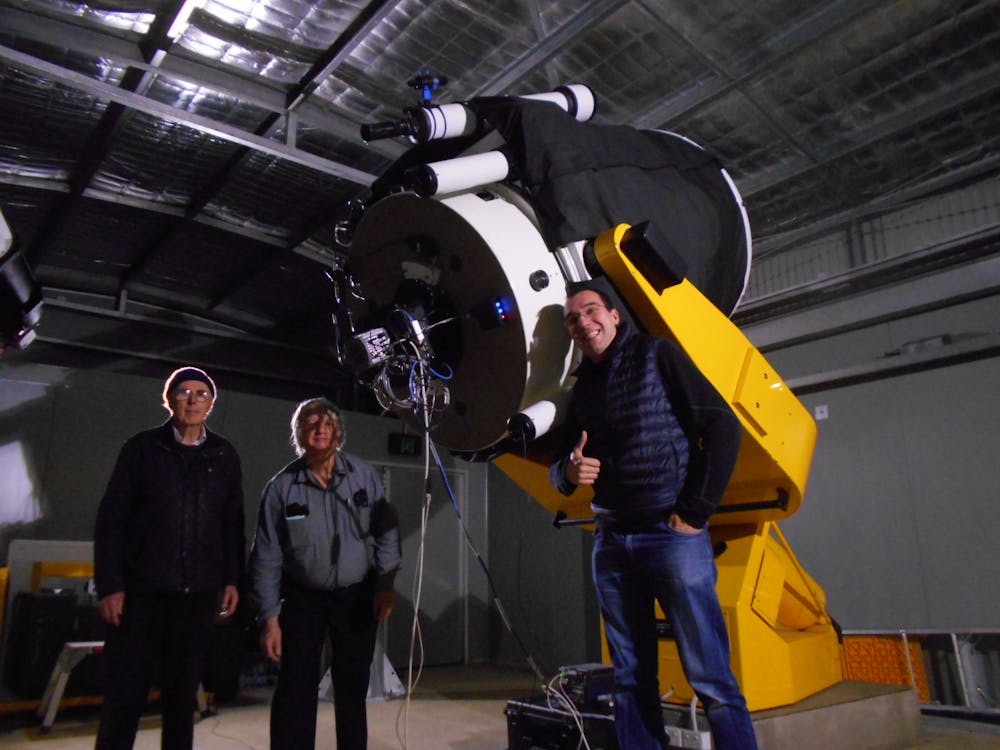 Ground occultation team: John Kennwell, Arie Verveer, Karsten Schindler with the Zadko Telescope in the background.
Unfortunately, the observatory roof would not open because of a faulty sensor. No Monday test, but hey, we still had Tuesday to test the system? Onsite engineers scrambled to fix the sensor ready for Tuesday.
Two days to occultation
On Tuesday, I received the following text message from the site.
11:07pm: Rain sensor working but clouded out … cheers Arie. So no chance testing the camera and weather forecast for Wednesday was bleak.
The day of occultation
Despite the cloud and nearly constant rain showers, team occulation (Karsten, Arie and John) were on site ready to start pointing the telescope and activate the imaging.
“Up to 10pm it was still raining,” Karsten told me the next morning. “Then a miracle happened.”
Less than an hour before the event, and he said the weather changed.
“The clouds seemed to vaporise away, leaving a totally cloudless sky with 100% visibility. I have never seen anything like it.”
The team swung into action, pointing the telescope at the target star, focusing the camera. At the designated occulation time 11:05pm, Karsten hit the image acquisition button, enabling the camera to take hundreds of images over a few minutes.
Read more: What Cassini's mission revealed about Saturn's known and newly discovered moons
Eager to see if the data contained the signature of an occulation, the team performed a preliminary analysis within minutes. Yes, there was a clear occulation signature, a big dip in the brightness of the star at exactly the predicted time of the occulation.
Next morning I was informed that SOFIA had also captured the event.
The data recorded from the Australian ground stations and by SOFIA will be analysed over the coming weeks and published in peer reviewed journals.
But one thing the journals won’t highlight is the excitement of the observation, and the enormous effort by a few individuals who helped acquire this data that should hopefully give us a better understanding of the atmosphere of Titan.
Authors: David Coward, Associate professor, University of Western Australia



















