

Health care is responsible for 7% of our carbon emissions, and there are safe and easy ways this can be reduced
- Written by: Scott McAlister, Research Fellow, The University of Melbourne
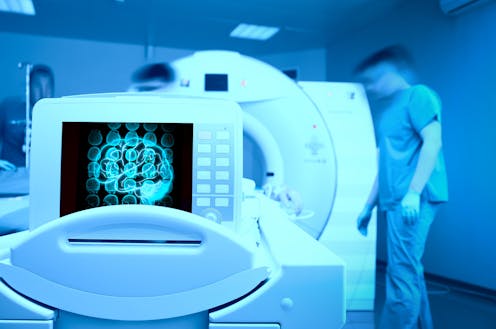
While we think of carbon emissions coming from manufacturing and agriculture, we don’t often think of those arising from health care. In Australia, health care is responsible for 7% of national carbon emissions, while globally, health care is responsible for 4.4% of emissions.
If global health care was a country, it would be the world’s fifth largest emitter. The warming resulting from health-care’s emissions in turn cause harm to human health through heatwaves, wildfires, increased mosquito-borne infectious diseases, and undernutrition due to drought and lower fish stock.
In short, treating patients indirectly causes human harm, at odds with the mission of health-care professionals to increase the duration and quality of patients’ lives.
Read more: Five ways hospitals can reduce their environmental footprint
What can health care do about its emissions?
Analysis of the UK’s National Health Service’s (NHS) emissions shows nearly 45% of its carbon emissions come from purchasing equipment and medicines, with only 10% coming from the electricity and gas needed to run hospitals and other health services.
We don’t currently have detailed data on Australia’s health sector emissions, but assuming we are similar to the UK, reducing emissions will require changes in how health-care professionals provide care.
There are things health care can start doing today to reduce its emissions, while not harming patients.
Scans
Our latest research has shown one MRI scan has a carbon footprint of 17.5kg CO₂ equivalent, which is the same as driving a car 145km, while one CT scan has a footprint of 9.2kg CO₂ equivalent, or driving 76km.
These are significantly higher than X-rays (0.76kg CO₂ equivalent, 6km) and ultrasound (0.53kg CO₂ equivalent, 4km).
While imaging is important in providing information to doctors in many circumstances, it is often unnecessary. For example, studies have shown 36-40% of imaging for lower back pain, and 34-62% of CT scans for lung blood clots are unnecessary. These scans were assessed as unnecessary because they were given to patients who didn’t need them according to evidence-based guidelines or decision rules. Such scans offer little or no benefit to patients, may result in harm, and waste resources.
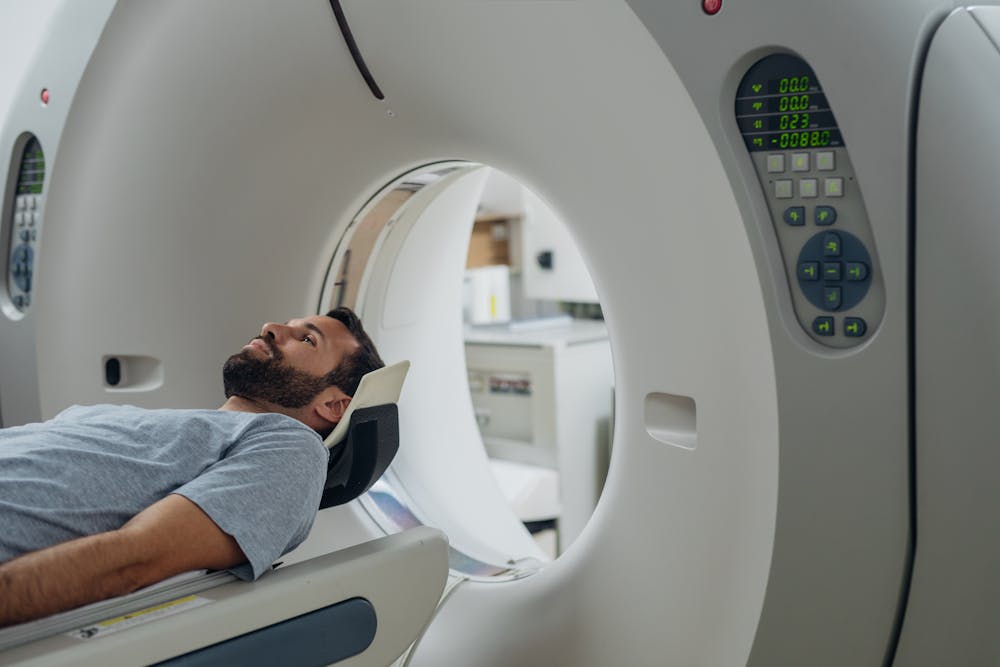
There are also opportunities to use low-carbon scans instead of high-carbon, such as using ultrasound rather than MRI for shoulder scans.
Other research we have performed has shown the impact of blood tests is between 49-116g CO₂ equivalent per test. While individually small, more than 70 million blood tests are performed annually in Australia. Like imaging, studies have shown 12-44% of blood tests are unnecessary.
Some specific tests are ordered unnecessarily at even higher rates. For example, it’s estimated over 75% of Vitamin D blood tests in Australia are unnecessary, with this costing Medicare more than $80 million annually.
Read more: Health care has a huge environmental footprint, which then harms health. This is a matter of ethics
Gases
Around 5% of the UK’s healthcare emissions come from anaesthetic gases and metered dose inhalers, commonly called puffers, used for the treatment of asthma.
Anaesthetists can use the clinically equivalent anaesthetic gas sevoflurane (144kg CO₂ equivalent per kilogram) instead of desflurane (2,540kg CO₂ equivalent per kilogram).
Nitrous oxide or laughing gas (265kg CO₂ equivalent) can be excluded from general anaesthesia without harm, and there are calls for a reduction in its use as acute pain relief for childbirth due to its high levels of emissions.
Midwives, however, have cautioned mothers should not be be made to feel guilty about their pain relief choices, and suggested hospitals could introduce nitrous destruction systems to allow its ongoing use.
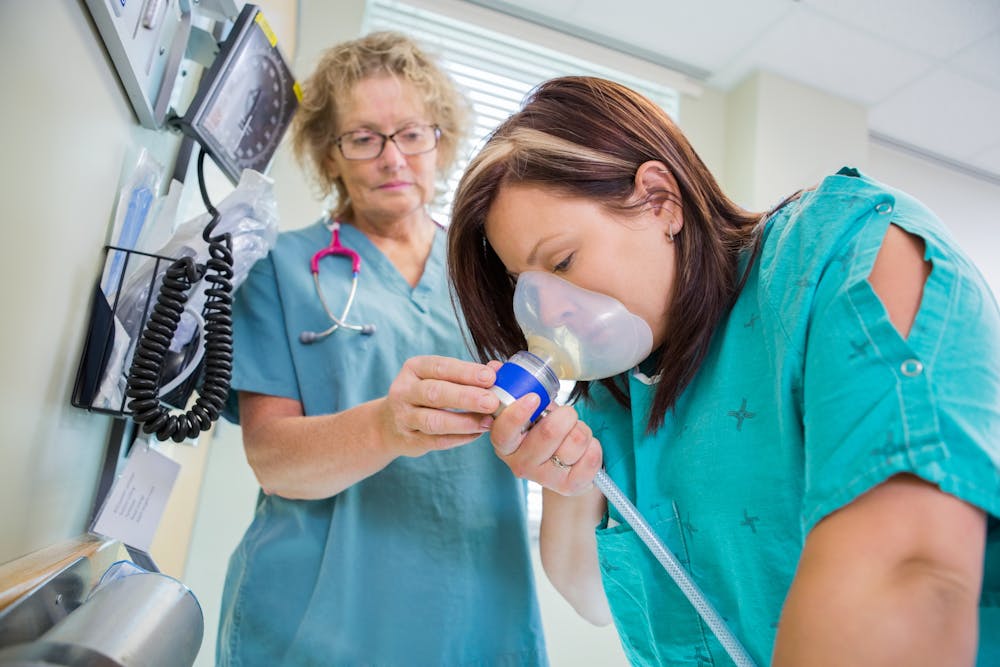 Nitrous oxide is often used during childbirth.
Shutterstock
Nitrous oxide is often used during childbirth.
Shutterstock
Metered dose inhalers contain hydrofluorocarbons, which are potent greenhouse gases. A patient using a preventer and a bronchodilator to stop wheezing can be safely moved from using metered dose inhaler delivery to the same drugs, delivered using a dry-powder inhaler in most cases.
This shift reduces their annual carbon footprint from 439kg to 17kg CO₂ equivalent. Importantly, it can be achieved without changing health outcomes for patients, as can be seen with 90% of inhalers in Scandinavian countries now being dry-powder, with no change in respiratory outcomes.
Read more: Climate mitigation – the greatest public health opportunity of our time
Getting health care to net-zero
These are only a few examples of how health care can reduce its emissions while not compromising patient safety or quality of care – either by moving from high carbon to low carbon alternatives, or by reducing unnecessary testing or treatments.
The Australian Medical Association and Doctors for the Environment have called for Australian healthcare to be net-zero by 2040, with an interim emission target of an 80% reduction by 2030.
This can be achieved, but will require both ongoing education of current and future health-care professionals about low-carbon care, and targeted commitments by individual health-care organisations, and federal and state health departments.
Authors: Scott McAlister, Research Fellow, The University of Melbourne


















