

Remembering Antarctica's nuclear past with 'Nukey Poo'
- Written by: Hanne E.F. Nielsen, PhD Candidate in Antarctic Representations, University of Tasmania
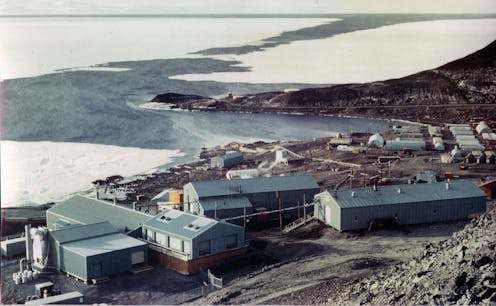
We think of Antarctica as a place to protect. It’s “pristine”, “remote” and “untouched”. (Although a recent discovery reveals it’s less isolated from the world than previously thought.)
But it wasn’t always this way. Between 1961 and 1972 McMurdo Station was home to Antarctica’s first and only portable nuclear reactor, known as PM-3A, or “Nukey Poo.” The little-known story of Nukey Poo offers a useful lens through which to examine two ways of valuing the far south: as a place to develop, or a place to protect.
Read more: How an alien seaweed invasion spawned an Antarctic mystery
The story of Nukey Poo
By the late 1950s nuclear power was viewed with optimism, as an exciting new solution to both the world’s energy and social problems. The Antarctic Treaty was signed in 1959, designating Antarctica as a place for international scientific cooperation. Both the USA and USSR were original signatories, and both were concerned about the possible use of nuclear weapons in the far south.
The Antarctic Treaty therefore included freedom of inspection of all facilities, and stipulated “any nuclear explosions in Antarctica and the disposal there of radioactive waste material shall be prohibited”.
When Nukey Poo was built by the US Navy it was described by Admiral George Dufek as “a dramatic new era in man’s conquest of the remotest continent.”
While the early explorers set out with flags, pitting their bodies against the elements to claim new territory, nuclear technology represented a modern way for man to triumph over the hostile environment. PM-3A was seen as a trailblazer, and – if all went well – it was planned to be first of many installed in Antarctica.
Dufek also envisaged nuclear energy making possible a wide range of human activities in the far south. His imagined version of “Antarctica in the Year 2000” included nuclear-driven greenhouse crop production, geoengineering of the world’s weather, and mining ventures that helped broker world peace.
While geoengineering in the forms of slowing the melt of glacial ice, solar geoengineering, and marine geoengineering continue to be discussed, mining is prohibited by the 1991 Protocol on Environmental Protection to the Antarctic Treaty. Contemporary visions of Antarctic futures tend to focus on environmental change and reducing human impacts, rather than enhancing the human presence.
Nuclear optimism fades
“Nukey Poo” began producing power for the McMurdo station in 1962, and was refuelled for the first time in 1964. A decade later, the optimism around the plant had faded. The 25-man team required to run the plant was expensive, while concerns over possible chloride stress corrosion emerged after the discovery of wet insulation during a routine inspection. Both costs and environmental impacts conspired to close the plant in September 1972.
This precipitated a major clean up that saw 12,000 tonnes of contaminated rock removed and shipped back to the USA through nuclear-free New Zealand. The clean up pre-dated Antarctica’s modern environmental protection regime by two decades, and required the development of new standards for soil contamination levels.
This elaborate process ensured that the US did not violate the Antarctic Treaty by disposing of nuclear waste on the continent. It also foreshadowed a shift in environmental attitudes away from development and use, towards protection; the removal of so much as one pebble from the Antarctic without requisite permits is now prohibited.
Today, all that physically remains at the site of the PM-3A reactor is a missing hillside and a plaque. Nuclear power is no longer viewed with the optimism of the 1960s, thanks to disasters such as Chernobyl and Fukushima.
The site where Nukey Poo once stood has been designated as a Historic Site and Monument under the Antarctic Treaty System, putting it in the same category as the huts of early explorers such as Mawson and Shackleton.
However, a site with a past of nuclear contamination does not sit well within modern narratives of Antarctica as a place to protect, so this episode in the continent’s history is not often told.
Read more: Why remote Antarctica is so important in a warming world
When Admiral Dufek wrote in 1960 “Antarctica will be a fantastic land in the future” he had a very different vision in mind to the Antarctica we see today. Today, the far south is not a place to be improved upon with human innovation, so much as a place to be protected from our influence – including climate change.
The episode of Nukey Poo reveals the modern association between science and the Antarctic environment has not always been so. In demonstrating how Antarctica went from being seen as territory to conquer to a fragile environment, we are reminded that its protection cannot be taken for granted
Authors: Hanne E.F. Nielsen, PhD Candidate in Antarctic Representations, University of Tasmania
Read more http://theconversation.com/remembering-antarcticas-nuclear-past-with-nukey-poo-99934



















