Mental distress is much worse for people with disabilities, and many health professionals don't know how to help
- Written by: Anastasia Hronis, Clinical Psychologist, University of Technology Sydney
It’s no secret COVID is having a drastic impact on people’s wellbeing, and has worsened an already a rising trend in mental health problems. The Australian Institute for Health and Welfare’s latest figures indicate some of our most vulnerable are struggling even more than most.
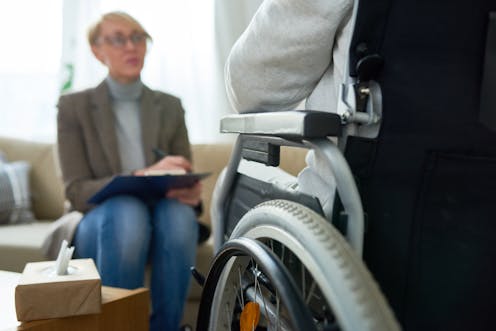
People with disabilities are experiencing very high rates of mental health difficulties and psychological distress. Yet health professionals often don’t feel equipped to treat people who are experiencing both disabilities and mental health difficulties.
About one in six Australians have a disability, equating to around 4.4 million people. The latest figures show two-thirds of people with a disability report low to moderate levels of psychological distress, while around a third report high or very high levels of psychological distress.
This compares to 92% of people without disability who report low to moderate psychological distress, and 8% who report high or very high distress. Almost a quarter of adults living with a disability report their mental health has worsened during the pandemic period.
Why the difference?
Research tells us there’s a strong link between physical health and mental health. Some health behaviours are likely to have a detrimental effect on wellbeing, such as poor diet and inactivity.
In general, people with a disability are more likely to engage in risky health behaviours than people without a disability. This includes not eating enough fruit and vegetables per day (47% compared to 41%), being overweight or obese according to body mass index (72% compared to 55%), and not doing enough physical activity for their age (72% compared to 52%).
Not only do people with disabilities have higher rates of mental health difficulties and health risk behaviours, they also face significant barriers when it comes to accessing effective and timely healthcare. These barriers include lengthy wait times for healthcare, inaccessibility of buildings, costs and experiences of discrimination, including by health professionals.
Be disabled or have mental health problems – but not both
Working across the mental health and disability sectors, it is not uncommon to hear of people falling between the cracks of services. Someone may present to a disability-specific health service, and be turned away due to a co-occuring mental health difficulty. They might then present to a mental health service and be turned away due to having a disability.
A range of factors contribute to this issue. Services are often funded in a way that requires them to have certain criteria for the clients who can be seen. This unfortunately means those who do not meet the criteria are turned away.
Health and mental health practitioners agree people with disabilities have the right to receive good mental heath care and access to services. But clinicians such as psychologists and counsellors report low confidence when working with people with disabilities, and insufficient training in how to best help them.

Barriers can cause discrimination
For a long time, people with certain disabilities such as intellectual disabilities were excluded from many mental health treatments. It was assumed that due to difficulties with learning and processing information, they did not have the capacity to engage in therapy.
Only in the past decade has this started to shift, with emerging mental health treatment programs developed specifically for people with disabilities.
A lack of training can also result in a form of discrimination called “diagnostic overshadowing”. This is when a health practitioner attributes a person’s symptoms to an already existing disability or mental illness, rather than fully exploring the symptoms and considering alternate diagnoses.
Often, once a patient has a confirmed diagnosis, there is a tendency to attribute all new behaviours or symptoms to that diagnosis. As a result, diagnoses may be inaccurate or get missed. And treatment might not be adequate or effective.
Investment and training is needed
If we are to improve the mental health and wellbeing of people living with a disability, greater investment is needed. Doctors and practitioners require specialised training to work with clients with both disabilities and mental illness.
We also need greater collaboration between health, disability and mental health professionals, and increased communication so services work together rather than in isolation. We can look to the University of New South Wales’ Department of Developmental Disability Neuropsychiatry, University of Technology Sydney’s Graduate School of Health and Westmead Children’s Hospital for examples of mental health and disability needs being integrated. Other services should follow this path.
As always, prevention and early intervention is key. While it is important we can effectively treat people who require help, it is also important for us to curb the rising trend of mental illness.
Authors: Anastasia Hronis, Clinical Psychologist, University of Technology Sydney