

August in Kabul shows how life changed overnight for so many in Afghanistan
- Written by: Tony Walker, Vice-chancellor's fellow, La Trobe University
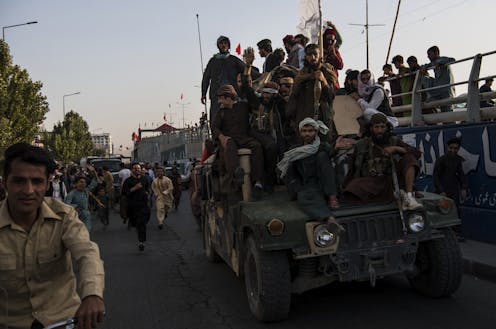
On page 79 of August in Kabul, Andrew Quilty introduces us to Nadia Amini, a 19-year-old student of Tajik descent who attends a madrassa, or religious school, in the Afghan capital. She is completing her third-semester exams with ambitions to become a lawyer.
None of that came to pass as the Taliban swept into Kabul in mid-August, 2021. In the process, Nadia’s own life disintegrated.
Review: August in Kabul: America’s last days in Afghanistan – Andrew Quilty (MUP)
Her father had promised her as a bride to a Taliban fighter to buy protection for his family. She resisted. Her brother beat her while her father looked on. Her mother was unable or unwilling to intervene.
She abandoned the family for an uncertain future.
Nadia’s personal story is a thread that runs through Quilty’s account of the last chaotic days of a failed American nation-building exercise that began with an assault on al-Qaeda strongholds and ended in disaster.

America’s retaliation for al-Qaeda’s attack on the American homeland on September 11, 2001, had run its course in shambolic scenes from Karzai International Airport as desperate Afghans clung to the undercarriage of a departing aircraft, only to fall to their deaths.
In his own reconstruction of what happened in the last days of the American and NATO-supported regime in Kabul, Quilty takes us inside a military command post guarding the approaches to the capital where Captain Jalal Sulaiman was making a heroic stand against a Taliban encirclement.
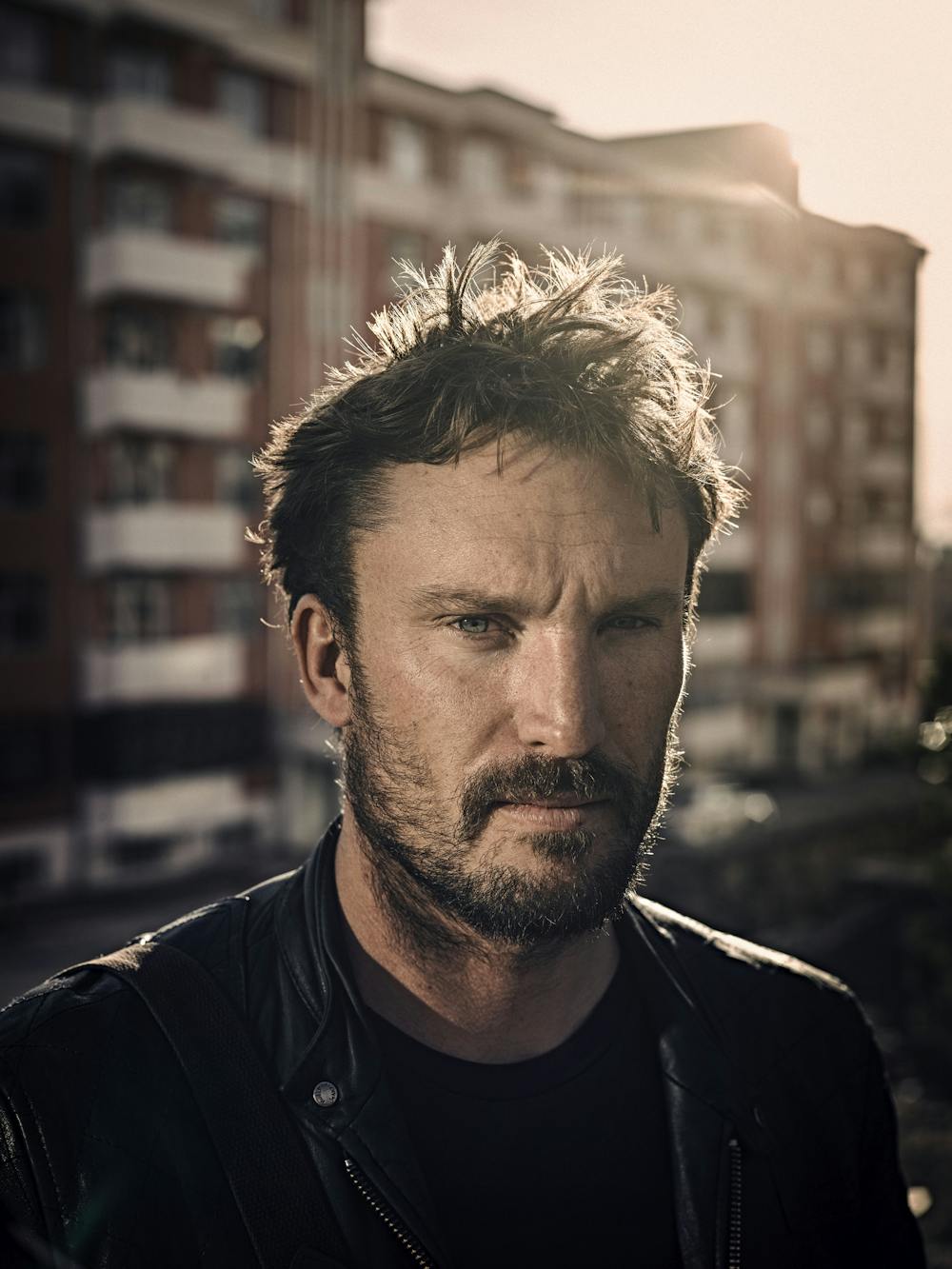 Andrew Quilty.
MUP
Andrew Quilty.
MUP
Running low on ammunition and water, without the sort of air cover provided by the departed American and NATO forces, Sulaiman’s ability to withstand the Taliban advances crumbled.
As a professional soldier he had tried to make a fight of it, but the cause was hopeless. These scenes were repeated across Afghanistan as provincial capital after capital fell to the Taliban, often without a shot being fired.
The regime in Kabul, without American and NATO military support and with its own army unwilling to fight, had been exposed for what it was – an empty shell.
Read more: Afghanistan a year after the Taliban occupation: An ongoing war on human rights
End of a bloody affair
August in Kabul is a reporter’s attempt to make sense of the overnight disintegration of a regime in which the US and its NATO partners had invested billions of dollars and thousands of lives.
Quilty’s tortured, decade-long love affair with Afghanistan, in which he exhibited extraordinary bravery as a frontline photo-correspondent, tumbles over itself in a densely-written book that would have benefited from thinning out in places.
A dramatis personae to identify the main players would also have been helpful.
On occasions, the contents of a reporter’s notebook spill onto the page in a way that requires quite a bit of concentration to keep up. That said, this is a book worth persevering with as a record of a longtime observer’s reactions to the end of a bloody affair, not in weeks, or days, but in hours, even minutes.
Quilty witnessed a moment when it all fell apart.
 Hundreds of Afghans wait outside a perimeter gate on the northwestern side of Hamid Karzai International Airport as a military transport plane departs during the mass-evacuation operation that saw a reported 120 000 non-combatants airlifted out of the Afghan capital in the last two weeks of August. 24 August 2021.
Andrew Quilty
Hundreds of Afghans wait outside a perimeter gate on the northwestern side of Hamid Karzai International Airport as a military transport plane departs during the mass-evacuation operation that saw a reported 120 000 non-combatants airlifted out of the Afghan capital in the last two weeks of August. 24 August 2021.
Andrew Quilty
In a way, what is surprising is that reporters and analysts were surprised at the speed with which Afghan resistance disintegrated. Once American air power was withdrawn and the Trump administration engaged the Taliban in what was known as the Doha process, the game was pretty much up.
Doha was the location of negotiations aimed at ending the US involvement in Afghanistan. These concluded with what was known as the Doha Agreement in early 2020. Effectively, the Trump administration legitimised the Taliban. A Taliban victory was probably inevitable. This made it virtually certain.
Nearly 2,000 Americans died in combat in Afghanistan. Thirty eight Australians lost their lives. This was America’s longest war, longer than both world wars, longer than Vietnam, longer than Iraq, at a cost of trillions of dollars.
Quilty picks out moments when it should have been clear the Afghan war was a losing proposition. One of these was in 2009 when US President Barack Obama announced a surge of troops and in the same speech revealed when the military offensive would end.
He quotes David Kilcullen, the Australian counter-insurgency expert, as saying:
We basically told the Taliban exactly how long they needed to wait until we’d be gone.
‘Low frequency disquiet’
Early in his book, Quilty uses an expression familiar to correspondents in war zones. He speaks of
low frequency disquiet that distinguishes a city that while not at war per se, hosts regular, isolated acts of war.
This had been his experience over nine years as resident of a city that had experienced “low frequency disquiet’’ punctuated by random acts of violent terrorism since the US and its NATO allies had put the Taliban to flight in 2001.
The Americans and their friends then found themselves enmeshed in an unwinnable war in a country that had defied efforts to pacify it over centuries. Afghanistan’s history might’ve been better understood.
Read more: How Joe Biden failed the people of Afghanistan — and tarnished US credibility around the world
In his efforts to explain why it all went wrong, Quilty spends quite a lot of his book inside the presidential palace among advisers to the President Ashraf Ghani whose fate it was to be in power when the Taliban were at Kabul’s gates last August.
Staffers like Hamed Safi, media adviser to the president, provide an insider’s perspective on the last days of the doomed Ghani regime, and all the moral dilemmas that attach themselves to participants in the dying moments of a failed enterprise.
Do I run, or do I stay? How do I ensure the safety of my family? Will our armed forces be able to hold out against the Taliban, even for a few days?
The answer to the last question came emphatically on August 15 when a few shots in the air in the vicinity of the presidential palace and the ministries sowed panic. Police were removing their uniforms. They were abandoning security posts at the airport. Looting had begun.
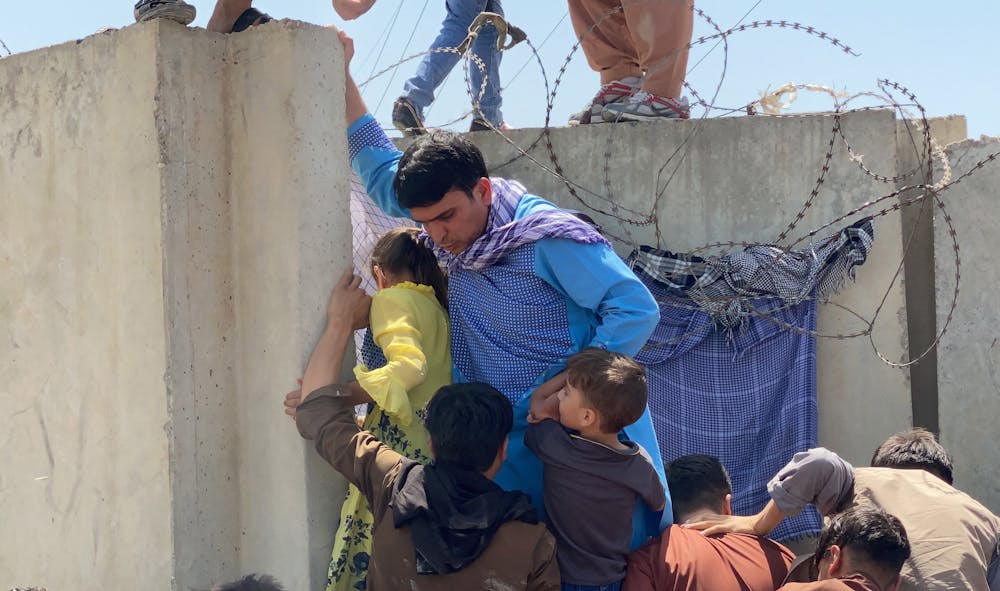 People struggle to enter the airport to flee the country in August 2021.
Stringer/AP
People struggle to enter the airport to flee the country in August 2021.
Stringer/AP
The Taliban were claiming victory.
In a cameo that reveals the extent to which President Ghani was detached from the reality of the disaster happening around him, his youthful national security advisor, Mohib Hamdullah went to Ghani’s residence to tell him to leave the country.
"Mr President, it’s time to leave,” Hamdullah told Ghani who was preparing for a meeting at the Ministry of Defence.
The game was up.
In three helicopters, Ghani fled to nearby Uzbekistan. He was president no longer. Afghanistan had fallen to the Taliban in days.
Ashraf Ghani would become a footnote in history.
 Taliban fighters take control of the Afghan presidential palace in Kabul after President Ghani fled the country.
Zabi Karim/AP
Taliban fighters take control of the Afghan presidential palace in Kabul after President Ghani fled the country.
Zabi Karim/AP
Meanwhile, Nadia Amini had taken refuge in the safe house provided by an aid worker for women at risk from the Taliban. She helped out, and when she left the house she carried a razor blade.
“The next time that I am captured by the Taliban, I can defend myself. Kill myself,’’ she told Quilty.
These are raw moments.
On 6 April, 2022, Nadia secured a safe passage out of Afghanistan.
Andrew Quilty might yet tell us what happened to her.
Authors: Tony Walker, Vice-chancellor's fellow, La Trobe University


















