

What is love? In pop culture, love is often depicted as a willingness to sacrifice, but ancient philosophers took a different view
- Written by: Oscar Davis, Lecturer in Philosophy and History, Bond University
Woven through Thor: Love and Thunder, Taika Waititi’s latest contribution to the Marvel Cinematic Universe, is a sentimental and age-old commentary on mortality and love.
In this intergalactic rom-com, the hammer-wielding Gods of Thunder face the shady “god butcher” Gorr in a race to the Gates of Eternity. Gorr has inherited his god-killing gift through a contract with the Necrosword, at the price of his own impending death.
Meanwhile, Thor’s ex-girlfriend, Dr. Jane Foster, is diagnosed with terminal cancer. Despite her best scientific efforts and the magic of the Mjolnir, she too only manages to delay the inevitable.
The stage is set for a story about love where the stakes are high because time is short.

Gorr’s god-killing spree is fuelled by revenge for the loss of his daughter, Love. Towards the end of the film, Thor risks his life to spend his final moments with Jane. He leaves Gorr to choose between his desire for revenge and spending his dying wish to revive Love. In awe of this sacrifice, Gorr chooses Love.
In the end, both Thor and Gorr put love before themselves.
The film thus appears to celebrate the youthful romantic love we find in Pyramus and Thisbe, or more famously Romeo and Juliet. But it also provides an opportunity to rethink this popular conception of love. Though they are godly, the central characters in this film find themselves grappling with mortal questions.
Does true love require self-sacrifice? This is where the philosophers come in.
Read more: For the love of Thor! Why it's so hard for Marvel to get its female superheroes right
An ancient Greek dinner party
The ancient Greeks explored practically everything: the nature of the universe, how to organise a society and achieve justice, how to teach courage, what it means to be a good friend – and, of course, the art of love.
Greek philosophers mostly agreed that our primary purpose in life was to achieve a state of being known as eudaimonia. The eudaimonic life is a life well lived. But just what kind of beings are we? What are the virtues conducive to a good life? At the heart of these questions is, according to the ancient Greeks, the highest virtue: knowledge.
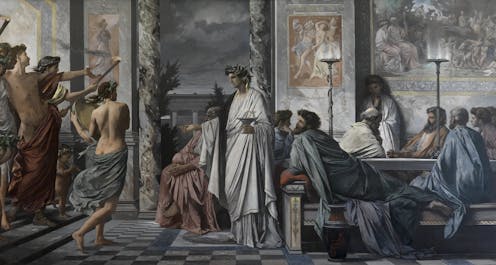
The most famous dialogue on love, Plato’s Symposium, set in 416 BCE, consists of a series of speeches exploring different perspectives on the nature of love and desire.
The dialogue takes place in the house of Agathon, who is celebrating his victory in a tragedy-writing competition. On this particular night, the speakers agree that, rather than get drunk again, they will each give a speech in honour of Eros, the God of Love.
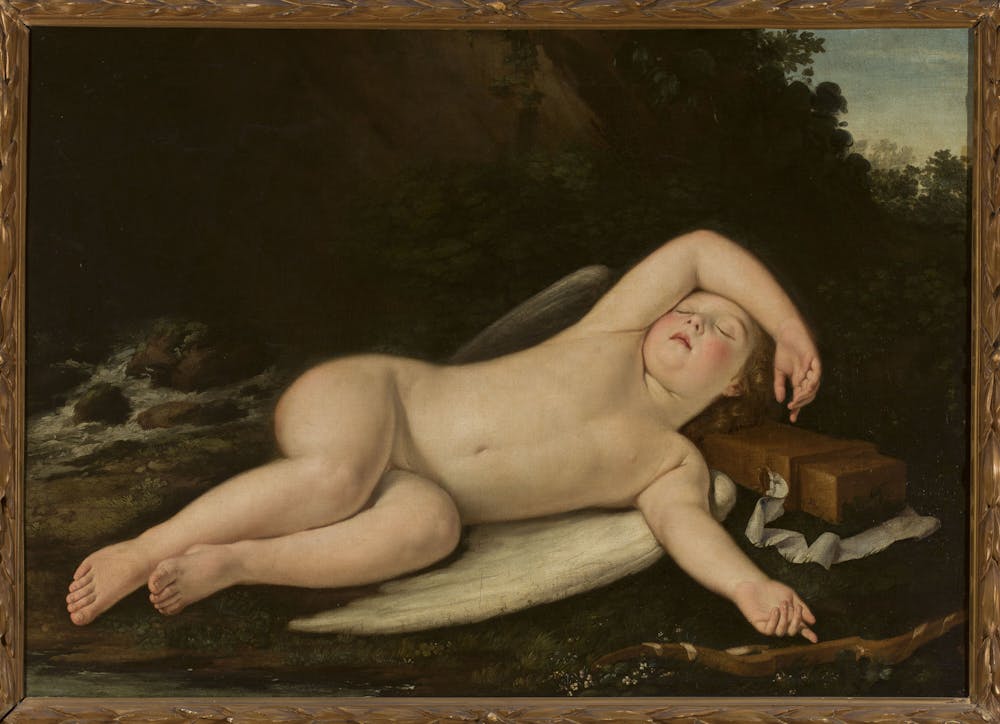 Francesco Albani, Sleeping Eros (circa 1625-1650).
Wikimedia Commons
Francesco Albani, Sleeping Eros (circa 1625-1650).
Wikimedia Commons
The seven speakers are the ancient equivalents of the authorities of conventional erotic wisdom we have today. We meet a writer, a comedian, a philosopher, a scientist, an old lover, a young lover, and a hedonist. This curated list of invitees – we don’t really know if it is by Plato’s invention or Agathon’s invitation – are the representatives of the varieties of opinions on what love is.
Read more: Guide to the classics: Plato’s Republic
 If Thor and Gorr were invited to Plato’s Symposium, they might have agreed with Phaedrus’ claim that we would “rather die a thousand deaths” than be seen as a coward in the eyes of a lover. Bravery and courage are a gift from Eros to lovers, Phaedrus argues, and these virtues are honoured most highly when they belong to love.
Then there is Pausanias, who distinguishes between two kinds of love. There is the basic lover, who sees the function of love as purely instrumental and who “loves the body rather than the soul”.
And there is the richer kind: noble, lifelong love. Noble lovers see their beloved in a deeper way, honoring them for their intelligence and what makes them unique.
Aristophanes, the comedian in attendance, provides some comic relief and shares a myth which has become legend. To understand love, he says, you must understand our nature and development. He claims that lovers were once joined at the back and were round all over with four arms and four legs.
There was one head to the two faces, which looked opposite ways. The creature could walk or, if necessary, cartwheel at high speeds.
One day, the creatures conspired against the gods. In retaliation, Zeus decided to lessen their strength by slicing each creature in two. Apollo then made some important anatomical corrections, ensuring our heads face forwards rather than backwards, and pulling the skin in from the edges and tying it into the middle of the belly, making what we know as the navel.
“Love is born into every human being,” states Aristophanes; “it calls back the halves of our original nature together; it tries to make one out of two and heal the wound of human nature.”
We are all looking for our matching half, in order to feel whole.
If Thor and Gorr were invited to Plato’s Symposium, they might have agreed with Phaedrus’ claim that we would “rather die a thousand deaths” than be seen as a coward in the eyes of a lover. Bravery and courage are a gift from Eros to lovers, Phaedrus argues, and these virtues are honoured most highly when they belong to love.
Then there is Pausanias, who distinguishes between two kinds of love. There is the basic lover, who sees the function of love as purely instrumental and who “loves the body rather than the soul”.
And there is the richer kind: noble, lifelong love. Noble lovers see their beloved in a deeper way, honoring them for their intelligence and what makes them unique.
Aristophanes, the comedian in attendance, provides some comic relief and shares a myth which has become legend. To understand love, he says, you must understand our nature and development. He claims that lovers were once joined at the back and were round all over with four arms and four legs.
There was one head to the two faces, which looked opposite ways. The creature could walk or, if necessary, cartwheel at high speeds.
One day, the creatures conspired against the gods. In retaliation, Zeus decided to lessen their strength by slicing each creature in two. Apollo then made some important anatomical corrections, ensuring our heads face forwards rather than backwards, and pulling the skin in from the edges and tying it into the middle of the belly, making what we know as the navel.
“Love is born into every human being,” states Aristophanes; “it calls back the halves of our original nature together; it tries to make one out of two and heal the wound of human nature.”
We are all looking for our matching half, in order to feel whole.
 We are all looking for our matching half, according to Aristophanes.
Edgar Chaparro/Unsplash
Aristophanes’ story has become the most romanticised of them all.
Eryximachus, a doctor, sets out a scientific approach to the subject of love. Love affects everything in the universe, he argues, including plants and animals. It is a powerful force which is the source of life’s satisfaction. It brings us good friends and partners and brings us closer the gods. Love governs beautiful music and the harmony of the universe. When love is balanced inside of us, the result is health.
Agathon the tragedian argues that love fades as we age and becomes a practical love – agapē. The god of love “seeks food among flowers” and therefore will not settle on body or soul “whose flower has faded away”.
The Philosopher
We are all looking for our matching half, according to Aristophanes.
Edgar Chaparro/Unsplash
Aristophanes’ story has become the most romanticised of them all.
Eryximachus, a doctor, sets out a scientific approach to the subject of love. Love affects everything in the universe, he argues, including plants and animals. It is a powerful force which is the source of life’s satisfaction. It brings us good friends and partners and brings us closer the gods. Love governs beautiful music and the harmony of the universe. When love is balanced inside of us, the result is health.
Agathon the tragedian argues that love fades as we age and becomes a practical love – agapē. The god of love “seeks food among flowers” and therefore will not settle on body or soul “whose flower has faded away”.
The Philosopher
 Head of Socrates in Palazzo Massimo alle Terme, Rome.
Wikimedia commons, CC BY-SA
Socrates recounts a conversation with the philosopher Diotima who, he says, taught him everything he knows about love. Diotima shows Socrates that love is a kind of joint ascension towards something greater. Love leads us towards good and beautiful things, the highest of which is knowledge.
Loving then, according to Diotima, is helping each other to become better people – to live more fulfilled eudemonic lives, together. We should show those we love “the great sea of beauty” that is the world and spark a love of wisdom.
Love, then, is a passionate, joint contemplation of the wonders of the universe.
Although Socrates’ speech is the longest and most philosophically intricate in the Symposium, it is not necessarily the definitive argument. Socrates gives us a richer conception of love than the other more conventional romantic accounts, taken as individual views.
But what is unique about the Symposium is that, unlike Plato’s other dialogues, the speeches do not end in aporia – a state of perplexity induced by Socrates’ methodical questioning (known as elenchus). This gives credence to the view that each of the speeches contains an element of truth and this makes love unlike other matters.
There is some truth to Aristophanes’ comedic myth. When you love someone, you treat their heart as if it were your own.
Eryximachus is right that love does bring us good friends and partners, and perhaps Agathon is right to say that love changes shape as we age.
What the Ancient Greeks are sure about is that fulfilled lives are marked by our practice of virtue – and this means that within all of our relationships, we ought to love with kindness, forgiveness, generosity, and patience.
Read more:
Friday essay: 3 ways philosophy can help us understand love
Authors: Oscar Davis, Lecturer in Philosophy and History, Bond University
Head of Socrates in Palazzo Massimo alle Terme, Rome.
Wikimedia commons, CC BY-SA
Socrates recounts a conversation with the philosopher Diotima who, he says, taught him everything he knows about love. Diotima shows Socrates that love is a kind of joint ascension towards something greater. Love leads us towards good and beautiful things, the highest of which is knowledge.
Loving then, according to Diotima, is helping each other to become better people – to live more fulfilled eudemonic lives, together. We should show those we love “the great sea of beauty” that is the world and spark a love of wisdom.
Love, then, is a passionate, joint contemplation of the wonders of the universe.
Although Socrates’ speech is the longest and most philosophically intricate in the Symposium, it is not necessarily the definitive argument. Socrates gives us a richer conception of love than the other more conventional romantic accounts, taken as individual views.
But what is unique about the Symposium is that, unlike Plato’s other dialogues, the speeches do not end in aporia – a state of perplexity induced by Socrates’ methodical questioning (known as elenchus). This gives credence to the view that each of the speeches contains an element of truth and this makes love unlike other matters.
There is some truth to Aristophanes’ comedic myth. When you love someone, you treat their heart as if it were your own.
Eryximachus is right that love does bring us good friends and partners, and perhaps Agathon is right to say that love changes shape as we age.
What the Ancient Greeks are sure about is that fulfilled lives are marked by our practice of virtue – and this means that within all of our relationships, we ought to love with kindness, forgiveness, generosity, and patience.
Read more:
Friday essay: 3 ways philosophy can help us understand love
Authors: Oscar Davis, Lecturer in Philosophy and History, Bond University 

















