

Ice shelves hold back Antarctica's glaciers from adding to sea levels – but they're crumbling
- Written by Alexander Fraser, Senior Researcher in Antarctic Remote Sensing, University of Tasmania
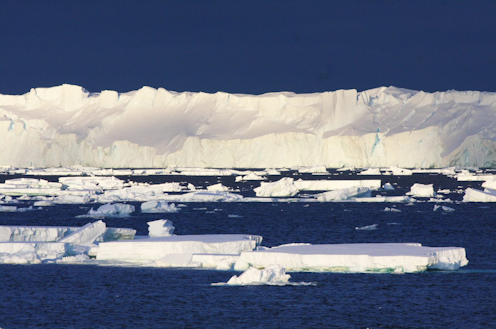
As Antarctica’s slow rivers of ice hit the sea, they float, forming ice shelves. These shelves extend the glaciers into the ocean until they calve into icebergs.
But they also play a crucial role in maintaining the world as we know it, by acting as a brake on how fast the glaciers can flow into the ocean. If they weren’t there, the glaciers would flow faster into the sea and melt, causing sea levels to rise.Unfortunately, Antarctica’s ice shelves are not what they were. In research published today in Nature, we show these ice shelves have significantly reduced in area over the last 25 years due to more and more icebergs breaking off. Overall, the net loss of ice is about 6,000 billion tonnes since 1997.
Previous estimates of ice shelf loss come from satellite measurements, which captured ice shelves gradually thinning in recent years. We tracked how much extra ice had been lost as icebergs calve away from the retreating edge of the continent. We found Antarctica’s ice shelves have lost twice as much mass as previous studies suggested.
Ice shelves are now weaker than at any time since at least the 1990s. This has led Antarctica’s glaciers to begin adding more water to the oceans, and more quickly. To date, much of the concern about the cryosphere – the world’s frozen parts – has focused on the fast-melting Arctic sea ice. But as climate change intensifies, Antarctica will begin melting in earnest, contributing more to sea level rise.
What we measured
We built numerical models to figure out what ice shelf thinning and loss of area mean for the ability of ice shelves to resist new ice being pushed in from upstream glaciers.
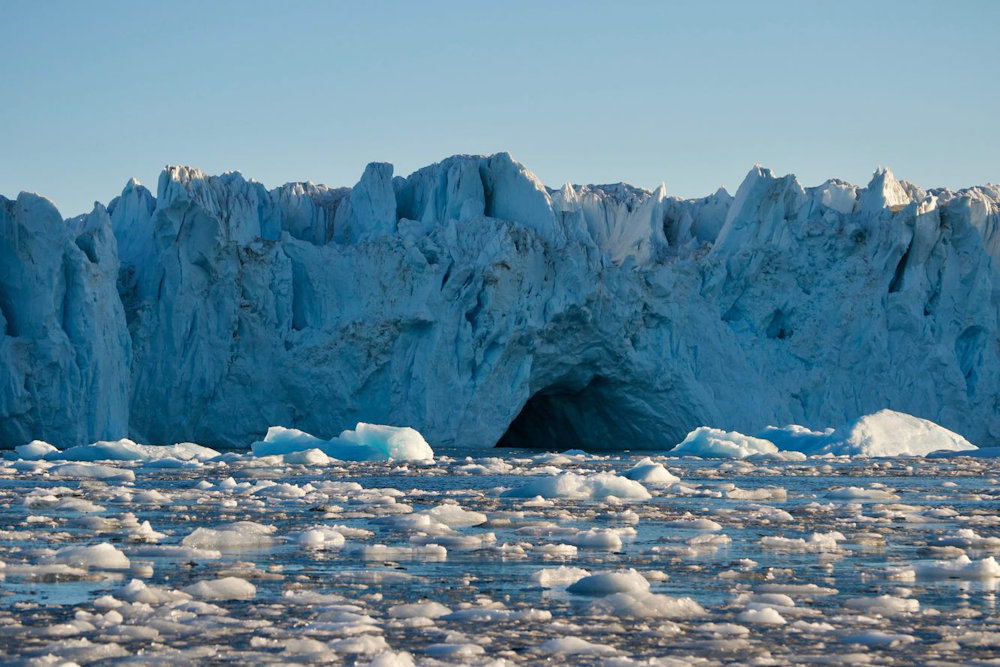
Our work shows the drop in ice shelf area has led to more ice flowing into the sea since 2007, as calving has weakened ice shelves and allowed some of the world’s largest glaciers to accelerate.
We found the Pine Island Glacier and the so-called “Doomsday” Thwaites Glacier – which could destabilise the entire West Antarctic ice sheet if it melts – are highly sensitive to calving, and are already increasing their contribution to sea level rise as their protective ice shelves crumbled.
Iceberg calving is a natural process. In any climate, we expect to see massive flat-top icebergs periodically break off and float away. So while no single calving event should be taken as cause for alarm, the long term trend is concerning. We found a majority of Antarctica’s ice shelves have lost mass since the late 1990s.
Why are Antarctic ice shelves shrinking? There’s no single answer. Some ice shelves such as the Wilkins Ice Shelf have already seen catastrophic disintegration, while others are retreating slowly and some are even advancing. But overall, these ice shelves are shrinking.
We know one cause of ice shelf retreat is the thinning of ice shelves, which is largely caused by relatively warm seawater eroding the base of these shelves.
We also know iceberg calving increases whenever Antarctica’s protective ring of sea ice weakens. This year, Antarctica saw the lowest sea ice extent ever recorded since measurements began in the 1970s. We’ve also seen entire ice shelves collapse when warmer air temperatures create surface meltwater that can cut through hundreds of metres of ice shelf.
Read more: Warmer summers threaten Antarctica’s giant ice shelves because of the lakes they create
Four giant ice shelves are still in good shape
Antarctica’s four largest ice shelves are the Ross, Ronne, Filchner, and Amery. These vast floating sheets of ice tend to calve off giant icebergs once every few decades.
All four are on track for major calving events in the next 10 to 15 years, and none would normally be cause for alarm. The problem is calving will come on top of steady ice shelf loss. When the major ice shelves do calve off huge icebergs, they will leave the Antarctic Ice Sheet smaller than we’ve ever seen it.
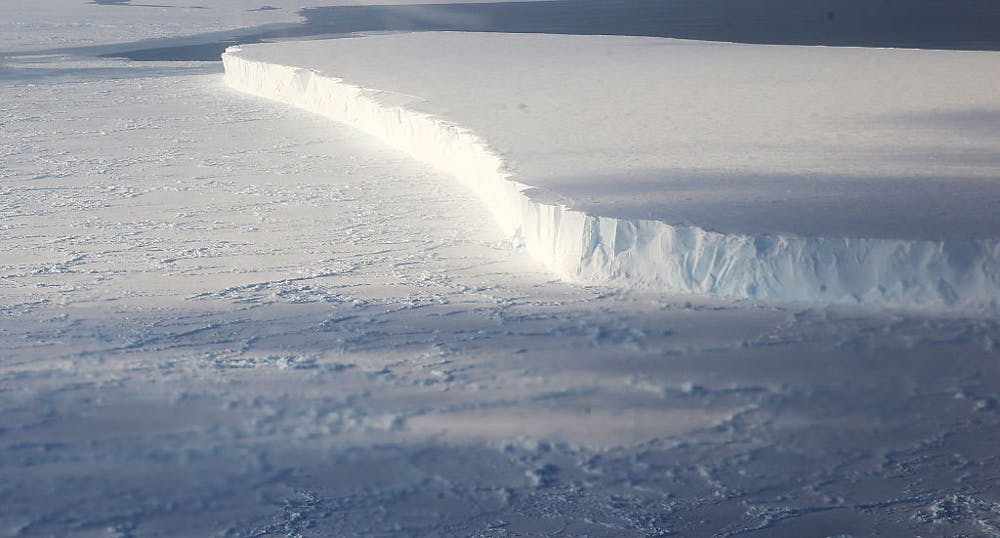 Enormous tabular icebergs like this one are often formed by calving from ice shelves. This iceberg near the coast of West Antarctica is seen from a window of a NASA Operation IceBridge airplane in 2016.
Getty
Enormous tabular icebergs like this one are often formed by calving from ice shelves. This iceberg near the coast of West Antarctica is seen from a window of a NASA Operation IceBridge airplane in 2016.
Getty
But while we’re not yet seeing any abnormal behaviour in these four major ice shelves, the overlooked losses from all the smaller ice shelves fringing the continent are adding up. Earlier this year, one smaller ice shelf collapsed entirely.
The most troubling changes of the past few decades are less photogenic than sudden ice shelf collapse. Bit-by-bit, West Antarctica’s Thwaites ice shelf has retreated.
Read more: How a near-perfect rectangular iceberg formed
Each calving event has left the ice shelf weaker and allowed the Thwaites Glacier behind it – the size of the state of Victoria – to flow faster into the ocean. While the Thwaites ice shelf is relatively small, it is vital. Until now, it has acted like a plug. If it keeps retreating, it could potentially destabilise the entire West Antarctic ice sheet and unlock several metres of sea level rise.
Climate change is the big picture
Our warming atmosphere and ocean are the root cause. Given the long lag time between greenhouse gases trapping heat and actual warming, it stands to reason that what we’re seeing in Antarctica right now is at least partly a response to warming gases dumped into the atmosphere decades or even a century ago. That means we’re already locked into more ice shelf retreat, as emissions have continued rising.
Antarctica holds around 30 million cubic kilometres of ice, a truly enormous figure. That represents around 90% of the world’s surface fresh water. If it all melted, seas would rise almost 60 metres. Humanity’s decisions will shape what Antarctica will look like in decades to come, and how much ice will remain.
Read more: Ice world: Antarctica's riskiest glacier is under assault from below and losing its grip
Authors: Alexander Fraser, Senior Researcher in Antarctic Remote Sensing, University of Tasmania

















