

Hilda Lewis' The Gentle Falcon, a vivid, touching tale of the court of a medieval child queen
- Written by: Stephanie Trigg, Redmond Barry Distinguished Professor of English Literature, The University of Melbourne
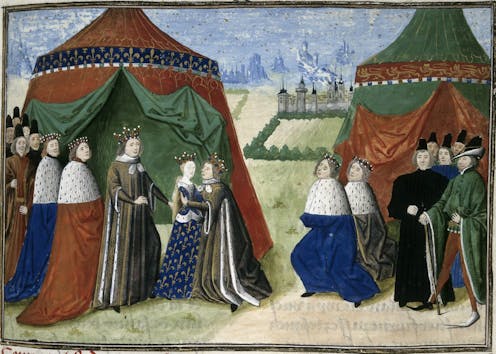
Fiction has a way of planting seeds in the mind that can germinate for a long time before they spread into root systems or blossom into conscious ideas. A book can change you dramatically overnight, but it can also take its own sweet time.
When I was about 11 or 12, I was given Hilda Lewis’s medieval novel The Gentle Falcon (1952) as a school prize. We would now describe this as Young Adult fiction. It is also an excellent example of the kind of historical fiction that offers the reader an immersive experience in another world.
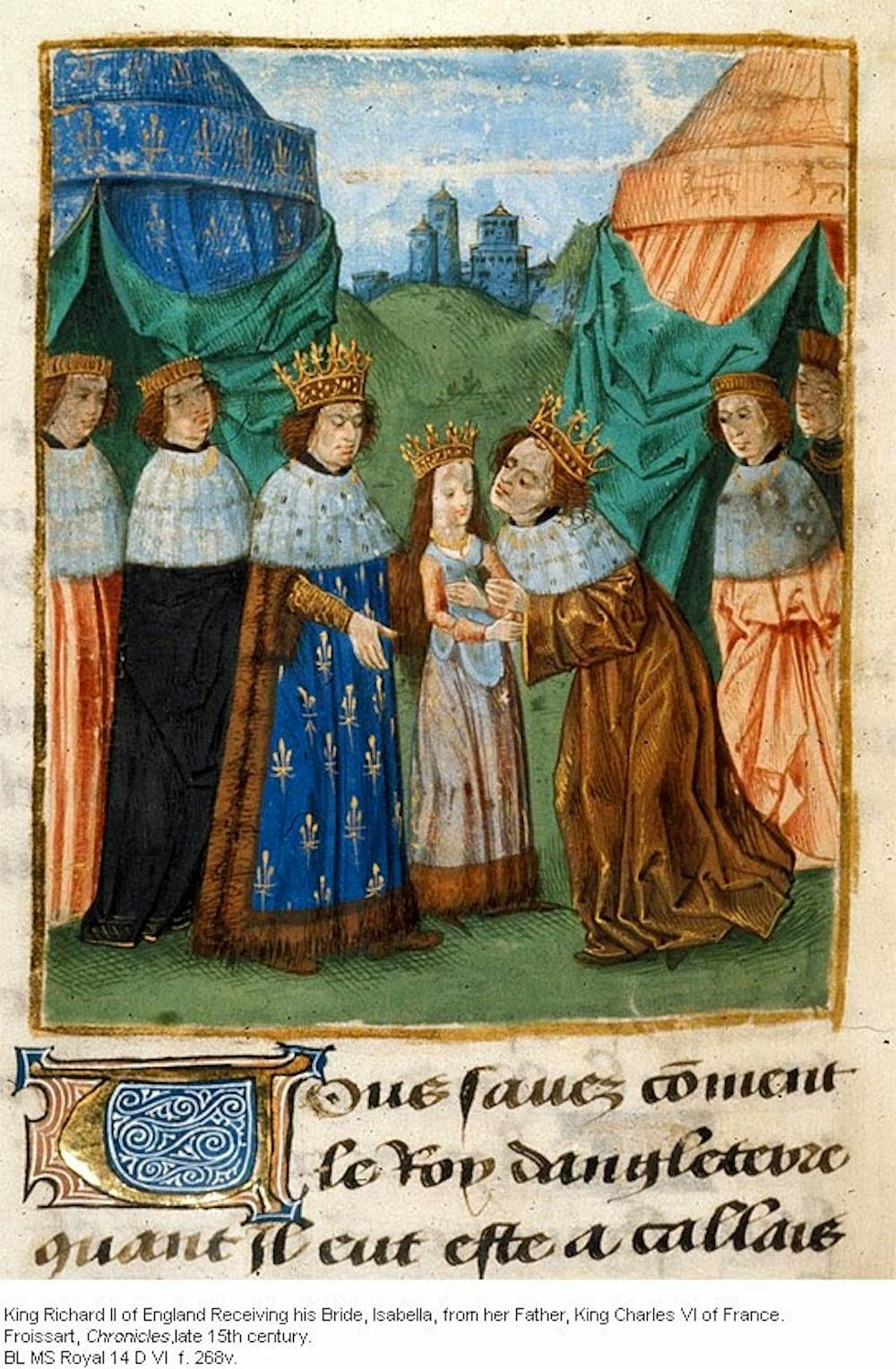
The Gentle Falcon opens in 1396 when Richard II of England, then aged 29, is about to marry his second wife, the six-year-old princess Isabella of France. These historical events are shown to us through the eyes of Lewis’s fictional heroine, an English girl, Isabella Clinton, who at the age of 15 is given the job of being companion to the new queen.
Lewis’ medieval world is brilliantly illuminated. In contrast to some historical fiction, where authors fill their pages with the results of their painstaking research, Lewis shows this world indirectly, rather than explaining every detail. As Sybille (as she is renamed by the queen) moves from her country life of genteel poverty into the richly decadent royal court, she starts to take in and make sense of the medieval world around her, in memorable details of fabrics, textiles and food; the vanities and vagaries of social rituals and adult politics; and most importantly, the emotional landscape of leaving home and growing up.
Sybille must learn the ways of the court and its great lords and ladies. At the same time, she wants the grave young queen to remember she is a child; it is her great aim to make her laugh.
But young Isabella yearns to be a proper, grown wife to the much older King Richard: mercurial, charismatic and deeply unpopular. The emotional networks are compelling, as these two young girls negotiate their different pathways through the vexed adult worlds of international and local politics.
 An anonymous portrait of Richard II King of England, painted in the 1390s, found in Westminister Abbey.
Wikimedia Commons
An anonymous portrait of Richard II King of England, painted in the 1390s, found in Westminister Abbey.
Wikimedia Commons
Richard’s reign is problematic from the beginning and the novel circles around his last difficult years, as he progressively alienates most of his supporters. Eventually, in 1399, Richard is disposed by his cousin, Henry Bolingbroke, who takes the throne as Henry IV, the first king of the Lancastrian dynasty.
Richard is then murdered. These events are disastrous for the queen, who at ten years of age finds herself widowed and isolated in England. Sybille’s life is also in danger and she takes refuge in France.
 I remember feeling torn between wanting to identify with this proud English girl, while also blushing for her slowness in understanding the complexities of the court, and what it might mean to fall in love (both for herself and the queen).
We also observe her jealousy of the beautiful cross-dressing French spy, Jehanne, sent to investigate Sybille’s suitability as a companion for the queen.
Sybille was irresistible as a narrative point of focus for a young reader: someone learning about a glamorous, difficult and fashionable world, but someone who was equally and passionately interested in politics. And in the long-honoured tradition of young adult fiction, Sybille was also someone maturing through adolescence into young womanhood.
Read more:
Chaucer’s great poem Troilus and Criseyde: perfect reading while under siege from a virus
Medieval scholars are often asked what book first turned them in the direction of medieval studies. The Gentle Falcon didn’t make me think I wanted to become a medievalist. And yet the imaginative pathways it offered into the medieval world stuck with me for a long time. Here is a good example, a brief and tantalising glimpse of Chaucer that anchors the novel in the historical world:
The King knew a fine painting when he saw one; and many a time Gilles had seen little Master Chaucer, a manuscript almost as big as himself under his arm, waiting to see the King and sure of his welcome.
Even though most medieval critics would now think this scene was unlikely — since most of the poetry read at the English court would have been written in French — this sighting of the poet has nevertheless resonated with me in my many years of reading and writing about Chaucer.
I remember feeling torn between wanting to identify with this proud English girl, while also blushing for her slowness in understanding the complexities of the court, and what it might mean to fall in love (both for herself and the queen).
We also observe her jealousy of the beautiful cross-dressing French spy, Jehanne, sent to investigate Sybille’s suitability as a companion for the queen.
Sybille was irresistible as a narrative point of focus for a young reader: someone learning about a glamorous, difficult and fashionable world, but someone who was equally and passionately interested in politics. And in the long-honoured tradition of young adult fiction, Sybille was also someone maturing through adolescence into young womanhood.
Read more:
Chaucer’s great poem Troilus and Criseyde: perfect reading while under siege from a virus
Medieval scholars are often asked what book first turned them in the direction of medieval studies. The Gentle Falcon didn’t make me think I wanted to become a medievalist. And yet the imaginative pathways it offered into the medieval world stuck with me for a long time. Here is a good example, a brief and tantalising glimpse of Chaucer that anchors the novel in the historical world:
The King knew a fine painting when he saw one; and many a time Gilles had seen little Master Chaucer, a manuscript almost as big as himself under his arm, waiting to see the King and sure of his welcome.
Even though most medieval critics would now think this scene was unlikely — since most of the poetry read at the English court would have been written in French — this sighting of the poet has nevertheless resonated with me in my many years of reading and writing about Chaucer.
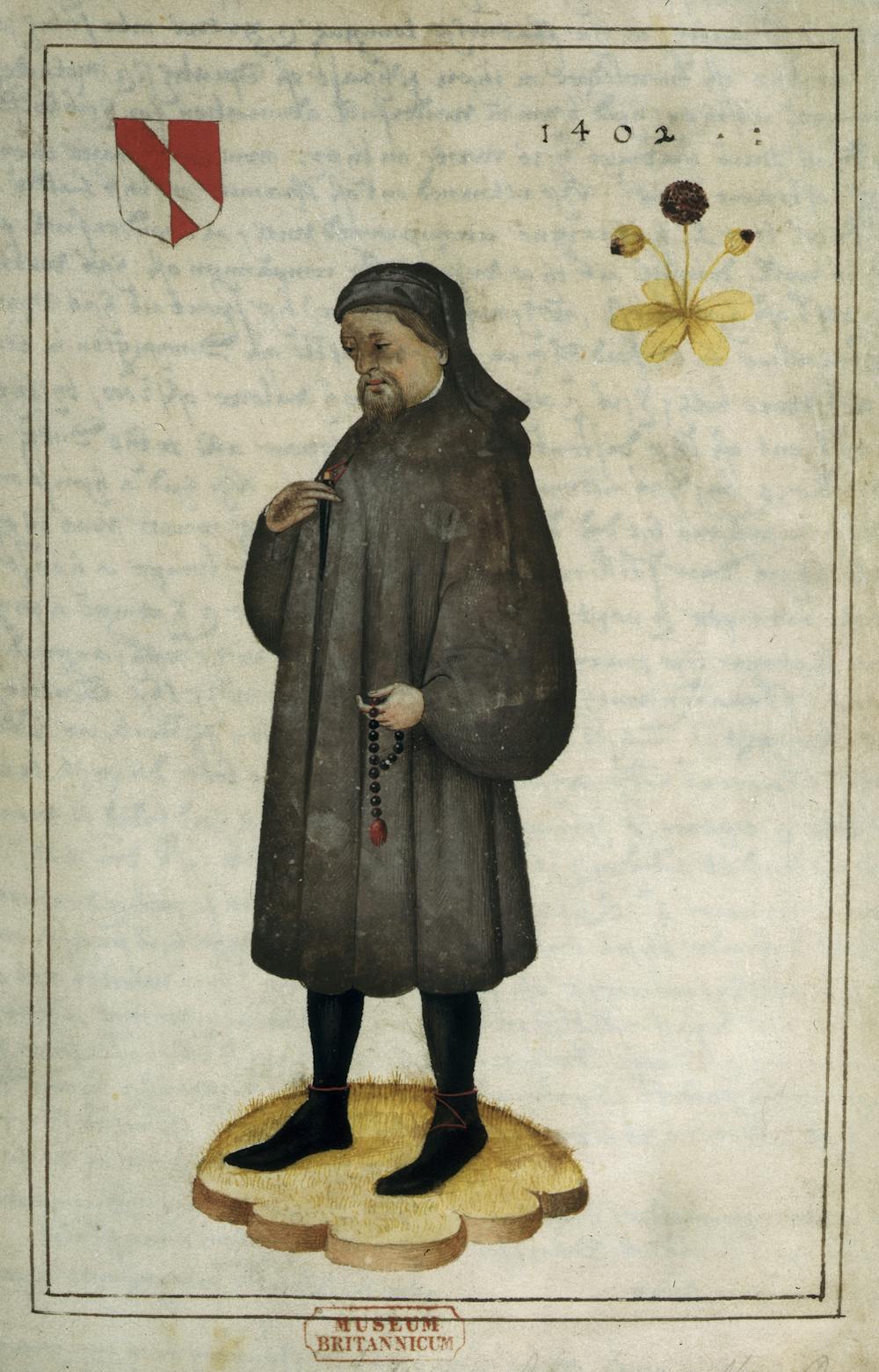 Portrait of Chaucer (16th century).
Wikimedia Commons
There’s something about that clever pairing of adjectives too — Chaucer is a master and yet approachably “little” — that accords with this book’s aesthetic of making what is unfamiliar come to seem familiar and known.
Many years later, I realised this strategy accords with Chaucer’s own representations of himself in The Canterbury Tales as unthreatening and cuddly, “a popet (a little doll) in an arm t’enbrace/ For any woman, small and fair of face.”
On a larger scale, too, The Gentle Falcon often plays out striking and dramatic scenes of ritual encounters: the 800 knights, half from England and half from France, who stand motionless in full armour — “an avenue of stone knights!” — then in an instant fall to their knees as Richard of England and Charles VI of France meet to formalise the wedding agreement.
Or, when the widowed queen is eventually returned to France, she courteously gives jewels and money to the English court ladies who have been her guards.
Read more:
When literature takes you by surprise: or, the case against trigger warnings
When I was doing some work on Queen Isabella several years ago with another medieval scholar, Stephanie Downes, I realised how closely Lewis draws on medieval chronicles for these and many other scenes.
The most famous is that of Jean Froissart, from Valenciennes in Flanders, who spent many years at the English court, but there are others too, which Lewis carefully mentions in her suggestions for further reading at the end of the novel.
Portrait of Chaucer (16th century).
Wikimedia Commons
There’s something about that clever pairing of adjectives too — Chaucer is a master and yet approachably “little” — that accords with this book’s aesthetic of making what is unfamiliar come to seem familiar and known.
Many years later, I realised this strategy accords with Chaucer’s own representations of himself in The Canterbury Tales as unthreatening and cuddly, “a popet (a little doll) in an arm t’enbrace/ For any woman, small and fair of face.”
On a larger scale, too, The Gentle Falcon often plays out striking and dramatic scenes of ritual encounters: the 800 knights, half from England and half from France, who stand motionless in full armour — “an avenue of stone knights!” — then in an instant fall to their knees as Richard of England and Charles VI of France meet to formalise the wedding agreement.
Or, when the widowed queen is eventually returned to France, she courteously gives jewels and money to the English court ladies who have been her guards.
Read more:
When literature takes you by surprise: or, the case against trigger warnings
When I was doing some work on Queen Isabella several years ago with another medieval scholar, Stephanie Downes, I realised how closely Lewis draws on medieval chronicles for these and many other scenes.
The most famous is that of Jean Froissart, from Valenciennes in Flanders, who spent many years at the English court, but there are others too, which Lewis carefully mentions in her suggestions for further reading at the end of the novel.
 Richard II meeting with the rebels of the Peasants’ Revolt of 1381 from the Chronicles of Jean Froissart.
Wikimedia Commons
The Gentle Falcon, then, weaves a compelling, woman-centred emotional narrative around the raw materials of historical chronicles. In the best traditions of the bildungsroman — the novel about the coming-of-age of the protagonist — it also dramatises the process of being an outsider and learning about the world.
Its emotional complexity, and the beauty and danger of the medieval world, have stayed with me long past my first encounter.
Read more:
The book that changed me: how Priya Satia's Time’s Monster landed like a bomb in my historian's brain
Authors: Stephanie Trigg, Redmond Barry Distinguished Professor of English Literature, The University of Melbourne
Richard II meeting with the rebels of the Peasants’ Revolt of 1381 from the Chronicles of Jean Froissart.
Wikimedia Commons
The Gentle Falcon, then, weaves a compelling, woman-centred emotional narrative around the raw materials of historical chronicles. In the best traditions of the bildungsroman — the novel about the coming-of-age of the protagonist — it also dramatises the process of being an outsider and learning about the world.
Its emotional complexity, and the beauty and danger of the medieval world, have stayed with me long past my first encounter.
Read more:
The book that changed me: how Priya Satia's Time’s Monster landed like a bomb in my historian's brain
Authors: Stephanie Trigg, Redmond Barry Distinguished Professor of English Literature, The University of Melbourne 

















