

Is there such a thing as 'too old' to co-sleep with your child? The research might surprise you
- Written by: Sarah Blunden, Associate Professor and Head of Paediatric Sleep Research, CQUniversity Australia
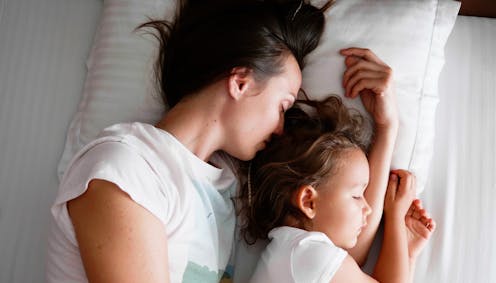
Clueless actor Alicia Silverstone recently told a podcast she co-sleeps with her 11-year-old son, explaining she is “just following nature”.
“Bear and I still sleep together,” she told The Ellen Fisher Podcast last month. “I’ll be in trouble for saying that, but I really don’t care.”
As Silverstone predicted, a backlash followed. Fans accused her of “ruining” her child, while others called it “creepy”. One psychologist said it would create “boundary issues”.
I am a psychologist who directs a clinic specialising in sleep difficulties in children from birth to 18 years. I am also a researcher in paediatric sleep. I have seen first-hand the strong opinions people have about parents co-sleeping (or not) with their children.
While we need to be mindful of safety and SIDS when co-sleeping with infants, there is no problem with co-sleeping with older children in and of itself.
How common is co-sleeping?
Co-sleeping, like many aspects of parenting, is often the subject of vehement disagreements.
While proponents argue it nurtures the parent-child attachment, reduces children’s anxiety and helps children sleep, critics say it stunts a child’s independence and disrupts parents’ sleep and intimacy.
But it is more common than people may realise and is under-reported. I have found in my work that before their child is born, parents often say they don’t want to co-sleep, but often end up doing it over time.
Data of rates of co-sleeping in school-age children in western countries are scarce. But recent studies show in China, 25% of pre-adolescents co-sleep. In Brazil up to 47% of school-aged children sleep in their parents’ bed at least sometimes, while 30% of school-aged children co-sleep in Italy.
Why do western countries frown on co-sleeping?
In western societies, the idea that children should sleep on their own only emerged during the 19th century.
Before this, the communal house and communal bedroom, shared by siblings and parents, was the norm (and still is in many societies).
But with the emergence of nuclear families in Victorian times came the need for increased discipline with children who were independent from their parents. Bedrooms were “privatised” and sleeping alone was thought to instil self-regulation in children.
Co-sleeping was also seen as something “poor people” did, as wealthier families could afford a bed for each child.
By the early 20th century, there were fears over-indulgent parenting styles would spoil children and co-sleeping became synonymous with raising lazy, difficult children.
What does the research say?
As social animals, children are not biologically primed to sleep alone. This is something they often need to learn with support from a parent or other trusted adult. Gaining the confidence and resilience to sleep alone is not a given and some children, especially sensitive or anxious children, need more time and assistance.
There is no scientific time frame in which this needs to occur, only societal expectations. Indeed, research confirms supporting and nurturing a sensitive child while learning to sleep alone (if necessary or desired) is more effective than forcing them to sleep alone.
Read more: Why do kids hate going to sleep, while adults usually love it?
One of the key arguments against co-sleeping is that, children who co-sleep become more dependent on their parents both at sleep time and also in general. It is viewed as a bad habit that will be difficult to break.
Parents may be warned “once a co-sleeper always a co-sleeper”. The research does not support this claim.
In fact, research shows that while co-sleeping may result in a temporary dependence on a parent, in the longer term it results in a child who is more resilient, gaining the skill of solo sleeping when they are more able to cope.
A child who co-sleeps also does not necessarily continue to co-sleep. As they get older, sleeping alone is often simultaneous with increasing independence. Similar to all other learned habits in older children such as dressing and tidying their rooms, children will not always need their parents to do it for them, and when parents deem this appropriate they can be taught and guided to do it themselves.
There is no guideline for an age when co-sleeping should be stopped or started, just as there is no guideline for when comfort toys should be kept or discarded.
These factors are largely driven by societal expectations and parents’ own choice (which is of course, is influenced by society).
Worried your kids are ‘too old’ for co-sleeping?
If parents are enjoying co-sleeping with their children but think they “should” stop, keep these points in mind:
co-sleeping has a bad reputation. There are social myths that co-sleeping is “bad” and it develops inappropriate daytime or night-time behaviours, dependency on parents and bad habits for life. But co-sleeping does not have negative outcomes in and of itself
if your child is co-sleeping consider the reasons they doing this. Is it due to anxiety, sensitivity or sleep disturbance? If so, these can be effectively treated by a professional
maybe you just like co-sleeping. As long as there are no obligations – both parties are doing it because they want to – there is no issue
both parent and child can stop co-sleeping when they want. Co-sleeping is a learned behaviour, and can be unlearned at any time. Child psychologists and some GPs are increasingly offering interventions to get children used to sleeping alone, and offer parenting strategies to help this happen in a child friendly and supportive way.
Authors: Sarah Blunden, Associate Professor and Head of Paediatric Sleep Research, CQUniversity Australia


















