

Electric on-demand public transport is making a difference in Auckland – now it needs to roll out further
- Written by Benjamin Kaufman, PhD Candidate, Cities Research Institute, Griffith University
Earlier this month, New Zealand released a new plan for sustainable public transport to start shunting transport emissions from currently 39% of total domestic carbon dioxide production towards net zero.
Transport minister Michael Wood announced the plan would:
support the provision of ‘on-demand’ public transport services […] deliver routes and services that reflect community needs and incentivise the decarbonisation of the fleet.
However, what is missing is a roadmap to achieving these sustainability goals. Decarbonisation of the public transport fleet is already happening in parts of New Zealand and examples of current local best practice can help us understand what can be deployed at a national scale and where it is likely to have the most impact.
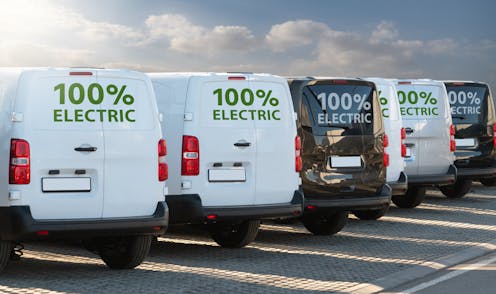
In October last year, Auckland Transport (AT) removed a low-performing diesel bus route operating in the suburbs of South Auckland. In its place, they launched AT Local, a fully electric on-demand public transit service powered by a fleet of small, electric vehicles and routed by technology from Liftango.
This cut AT’s annual carbon dioxide emissions by about 100,000kg. Our analysis suggests that appropriate nationwide deployment of on-demand services such as AT Local will help New Zealand reach net-zero targets.
What is on-demand public transit?
Imagine Uber buses: small vehicles operating within a zone and providing trips to and from the destinations you want to go to, when you want to. No more schedules, no more fixed routes. Instead of using physical bus stops, they use virtual stops placed throughout a service area. Drivers are guided by an algorithm that optimises routing for pick-ups and drop-offs.
On-demand services are typically supported by a user app, a driver app and a call centre. Users request rides which are communicated to drivers while trips sometimes pick up other passengers along the way to their destinations. The best part? Unlike private ride shares, they usually cost around the same fare as a traditional bus – and often integrate payments and transfers between services.
Read more: 1 million rides and counting: on-demand services bring public transport to the suburbs
On-demand is unique in its ability to provide a public service that can rival car ownership in terms of flexibility and convenience. It can ultimately improve the reach, frequency and quality of public transport and also helps reduce travel costs for individuals as petrol prices increase, making travel more affordable for low-income New Zealanders.
Each service covers a zone rather than a linear route. This means anyone living in that area now has access to public transit. For those who don’t live close to bus stops, this might be the first time they can use public transit for their daily travels.
In Auckland, our analysis shows AT Local covered 38% more people compared to the previous network, providing access for an additional 6,400 residents in Papakura. The majority of AT Local riders are from the outside of the previous public transit network catchment.
During the month from July 23 to August 22, 69.8% of trips started or ended more than 400m from a bus stop (the industry standard walking distance for access to transit) and 39.7% connected riders to the train network. This shows there is a huge demand from the community for better transit options.
On-demand public transport also provides a higher quality service for riders, picking them up closer to their homes and dropping them at their destinations. For riders who have trouble walking long distances to the bus stop, this is a game changer. Some services deploy wheelchair-accessible vehicles that can be allocated to riders based on their need.
On-demand removes roadblocks to fleet decarbonisation
Electric vehicles are difficult to come by and large electric buses even more so. Without using smaller vehicles, it will be difficult for fleets to fulfil the mandate to purchase only zero-emissions public transport buses by 2025.
On-demand works well with smaller electric vehicles and requires comparatively less charging infrastructure than full-size electric buses. Smaller vehicles are becoming easier to source, making it possible to deploy new on-demand services more quickly.
Reaching emission targets will be much easier if fleets transition to small electric vehicles now rather than having to wait years until electric buses are commonplace.
Developing a nationally scalable roadmap
In order to provide sustainable on-demand public transport, two questions need to be considered:
1. Where should we replace current public transport with on-demand transit?
By first evaluating our current networks, it will become clear which bus routes are performing well and where we could improve services.
The main routes that should be explored for replacement are called feeder or coverage services – ones that meander through neighborhoods providing limited coverage at low frequencies and limited value to customers. By replacing these routes with on-demand, riders can be given more direct access to their main destinations, encouraging people to shift away from private cars.
2. Where should we provide new services that help the most people?
Historically, transit has mainly been focused on serving densely populated urban areas, leaving those in the suburbs and rural regions under or un-served. This has led to large populations of people relying on expensive and polluting cars to complete their daily travels.
On-demand changes this perspective by providing zonal coverage of these areas rather than stop-based routing, providing equal access to all residents.
Delivering on-demand services to the suburbs will bring new riders to transit, as shown in our AT Local analysis. Greenfield residential developments should also be considered for on-demand deployments to allow new home owners to adopt sustainable travel patterns as soon as they move in.
AT Local proves it is possible to rapidly reduce carbon emissions from our public transportation using technology and vehicles already available, while simultaneously increasing a mode shift towards public transport.
Authors: Benjamin Kaufman, PhD Candidate, Cities Research Institute, Griffith University

















