

we asked catfish why they trick people online
- Written by: Eric Vanman, Senior Lecturer in Psychology, The University of Queensland
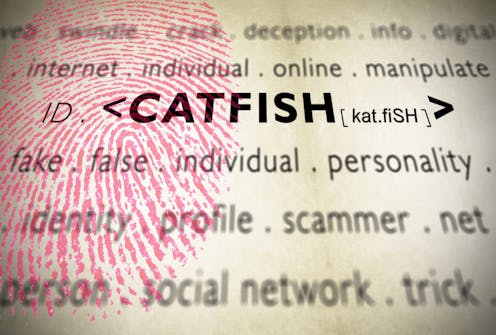
If you have engaged with internet culture at all in recent years, you have probably come across the term “catfish”, first coined in the 2010 documentary of the same name.
A catfish is someone who uses false information to cultivate a persona online that does not represent their true identity. This commonly involves using stolen or edited photos, usually taken from an unwitting third party.
Catfish will use this information to create a more appealing version of themselves, then engage in continued one-on-one interactions with another person (or people) who are unaware of the deception.
Read more: Facebook is fighting social media identity theft in India, but it's a global problem
Falling prey to catfish
In the 2010 documentary, Nev Schulman learns that a woman with whom he has developed an online relationship over nine months is actually fake. Another married woman (who originally claimed to be her mother) has used pictures from a model’s account to create the complicated, phoney relationship.
There have been several high-profile cases of catfishing reported in the media since then.
Singer Casey Donovan, in her 2014 memoir, wrote about a six-year relationship that turned out to be fake – in her case, the catfish even lied about her gender.
In 2011, NBA star Chris Andersen became embroiled in a catfishing scandal that ended in prison time for the catfish.
Then there is the popular MTV reality docuseries, hosted by catfish victim Nev Schulman himself. It is currently in its seventh season of “[taking] online romances into the real world”.
A complicated problem
Since 2016, the Australian Competition and Consumer Commission (ACCC) has collected and published data on dating and romance scams.
Its website provides detailed statistics of reported romance fraud in Australia, yet there is little information available about social catfishing – deception in the absence of financial fraud. There are also questions about the legality of impersonating someone who does not exist.
Read more: A record $340 million lost to fraud in Australia, says latest ACCC report
Until these issues are resolved, there is no clear avenue to pursue for victims of social catfish. Victims may remain unaware of the deception for months or years – another reason catfishing often goes unreported – making it even harder to quantify.
The personality traits of catfish scammers
As smartphones and connected devices become ever more pervasive, the chances of falling victim to deception are increasing along with our screen time.
But what sort of person becomes a social catfish?
We have begun psychological research to investigate this question. In the past year we have recruited 27 people from around the world who self-identified as catfish for online interviews.
The interviews focused mainly on their motivations and feelings about their catfishing behaviour. Some of our key findings included:
- Loneliness was mentioned by 41% of the respondents as the reason for their catfishing. One respondent said:
I just wanted to be more popular and make friends that could talk to me, some part of the day.
Others claimed that a lonely childhood and ongoing struggles with social connection were contributing factors.
- Dissatisfaction with their physical appearance was also a common theme, represented in around one-third of responses:
I had lots of self-esteem problems … I actually consider myself ugly and unattractive … The only way I have had relationships has been online and with a false identity.
Another respondent said:
If I try to send my real, unedited pictures to anyone that seems nice, they stop responding to me. It’s a form of escapism, or a way of testing what life would be like if you were the same person but more physically attractive.
- Some reported using false identities or personas to explore their sexuality or gender identity. For example:
I was catfishing women because I am attracted to women but have never acted on it … I pretend to be a man as I would prefer to be in the male role of a heterosexual relationship than a female in a homosexual relationship.
- More than two-thirds of responses mentioned a desire to escape:
It could seem magical, being able to escape your insecurities … But in the end, it only worsens them.
- Many reported feelings of guilt and self-loathing around their deceptive behaviour:
It’s hard to stop the addiction. Reality hit, and I felt like a shitty human.
More than one-third of participants expressed a desire to confess to their victims, and some had continued relations with them even after coming clean.
Somewhat surprisingly, around a quarter of respondents said they began catfishing out of practicality, or because of some outside circumstance. One said:
Being too young for a website or game meant I had to lie about my age to people, resulting in building a complete persona.
No simple solution
What does it take to become a catfish, and how should we deal with this growing problem? Unsurprisingly, our initial research suggests that there’s no simple answer.
Social catfishing seems to provide an outlet for the expression of many different desires and urges. Although not yet officially a crime, it is never a victimless act.
Read more: Not all online catfish are bad, but strong communities can net the ones that are
As we move further online each year, the burden of harmful online behaviour becomes greater to society, and a better understanding of the issues are needed if we are to minimise harm in the future. From our small survey, it appears that catfish themselves aren’t universally malicious.
Psychologist Jean Twenge has argued that the post-millenial generation is growing up with smartphones in hand at an early age and are thus spending more time in the relatively “safe” online world than in real-life interactions, especially compared with previous generations.
Catfishing will likely become a more common side-effect for this generation in particular.
The next phase of our research is to learn what we can do to help both victims and the catfish themselves. We hope to recruit at least 120 people who have catfished so that we can develop a more thorough picture of their personalities. If you have been a catfish, or know someone who has, please contact us to participate in our research: tinyurl.com/catfishstudy.
The author would like to acknowledge the contribution to this article of Samantha Lo Monaco, an honours student at the University of Queensland.
Authors: Eric Vanman, Senior Lecturer in Psychology, The University of Queensland
Read more http://theconversation.com/its-not-about-money-we-asked-catfish-why-they-trick-people-online-100381


















