

How the jobs summit shifted gender equality from the sidelines to the mainstream
- Written by Leonora Risse, Senior Lecturer in Economics, RMIT University
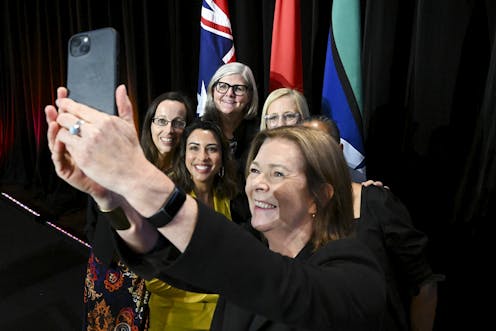
The last time an Australian government hosted a national jobs summit, only one woman was present. It was 1983, and that woman was Susan Ryan, a minister in the Hawke government and the trailblazing architect of the Sex Discrimination Act.
Fast forward 39 years to the 2022 Jobs and Skills Summit, and half of all participants and presenters were women.
After the opening keynote address from economist Danielle Wood, the first panel session was dedicated to equal opportunities and pay for women. The scheduling was intentional, signalling the seriousness with which the government views the issue, and setting the stage for a gender focus to be interwoven into all policy deliberations.
It had the desired effect: the need to dismantle barriers to women’s participation, better value the economic contribution of the care sector, and invest in safer and more equitable workplaces was threaded throughout all subsequent sessions of the summit.
Read more: View from The Hill: Summit triggers immediate action and elevates gender equality
The trigger for change?
The government had already made it clear gender equality was on its agenda, prioritising areas such as childcare affordability and addressing pay inequity in its election commitments.
At the summit, it was clear Australia’s extreme labour shortages had heightened many businesses’ motivation to see more women participating in the economy. Economic crises have a way of shifting equity issues from the sidelines to the mainstream.
There was widespread agreement that the barriers facing women in the workforce – indeed, the barriers facing all marginalised groups including older workers, people living with a disability and migrants – are not only unfair but also a massive handbrake on our economy.
Policy outcomes will need more work
While there was consensus that something needs to be done to break down the barriers to women’s workforce participation, including improving childcare access and affordability, the reality is that implementing these policy reforms will need more analysis, consultation and time.
On childcare, calls to bring forward childcare subsidies must firstly recognise the childcare sector is already under strain. Many providers are struggling with worker shortages and waiting lists that can’t be met, especially in regional areas. Reducing the out-of-pocket costs of childcare for families will activate higher demand on a sector whose supply is already stretched to capacity.
This brings a risk that providers will end up lifting fees to cope with capacity constraints, or won’t be able to deliver the quality of service they aspire to.
From a practical perspective, the government has good economic reason to hold off on its childcare subsidy increases until these immediate pressures can be addressed. This takes us back to the need to invest more in the care sector from the start, including lifting wages of care workers to reflect their true worth to the economy.
There is also scope to recalibrate childcare subsidies to better target the working women whose workforce participation is being hamstrung the most by current settings.
It’s women working part-time, and want to increase to four or five days per week, who are most financially penalised for doing so.
Setting the subsidy to neutralise Effective Marginal Tax Rates (EMTRs) across all days of work – so that women’s workforce decisions are based on their productive capabilities and aspirations, not childcare costs – would be an innovative way to transform childcare from a welfare measure to an economic enabler. These will be considerations for the review of the childcare sector that the government is tasking the Productivity Commission to undertake.
On paid parental leave, the summit heard calls to expand current provisions to 26 weeks of paid leave, supported by mechanisms to encourage a more equal sharing of care between parents. Evidence shows it’s the sharing mechanism that really matters for making progress on gender equality and boosting women’s workforce involvement.
Preserving a use-it-or-lose-it allocation of paid parental leave for fathers is essential for encouraging men to be more involved in unpaid care and freeing up women to participate more fully in paid work. Rather than leaving it up to households to decide, this policy works because it cuts through the barrier of social stigma faced by men and legitimises men’s roles as carers.
As the government develops its paid parental leave policy, expanding the non-transferable allocation for fathers should be a focus.
On the gender pay gap, the government is pursuing a range of measures that have the potential to make inroads. This includes instilling gender equity as an objective of the Fair Work Act, advocating for better pay in female-concentrated professions such as aged care, and initiatives to tackle bias in the workplace such as mandatory gender pay gap reporting.
In my contribution at the summit’s opening panel, I highlighted the importance of applying a gender lens across all policy decision-making, which is known as gender responsive budgeting. It involves evaluating all policy proposals – including the ones that seem gender-neutral – to consider the implications for gender equality outcomes.
The government has committed to gender responsive budgeting and we will see the impacts unfold in forthcoming budgets statements.
Read more: Applying a gender lens to the budget is not about pitting women against men
Remember, we’re talking about people
Although we’re making progress in acknowledging gender inequality as an economic problem, the summit discussions talked a lot in terms of “under-utilising women”, as though women were a piece of machinery or equipment.
In my panel discussion, I argued that gender gaps in our economy should be interpreted as a sign we are not fully recognising women’s strengths and capabilities. This also means we are not fully valuing their contributions to the economy and wider society.
Millions of Australian women are already being exhaustively “utilised” in the economy. However, this is in sectors that are low paid and low status. Or it’s in the form of unpaid care for their children and other family members. I would urge business leaders to think less in terms of “utilisation” and more in terms of “valuing”.
Women proved at the summit that they already bring immense capability. It’s time to properly recognise and value it.
Authors: Leonora Risse, Senior Lecturer in Economics, RMIT University

















