

Nine-Fairfax merger a disaster for quality media
- Written by: Denis Muller, Senior Research Fellow in the Centre for Advancing Journalism, University of Melbourne
All deaths are sudden, even if long expected.
Appropriately enough, this is the opening sentence of a book called Journalism in a Culture of Grief.
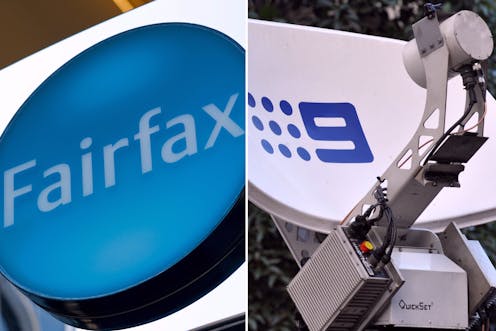
And if ever there was a time of grief for journalism in Australia, it is today, with the announcement that Nine Entertainment is taking over Fairfax Media.
It means the death of Fairfax and is the most consequential change in Australian media ownership in 31 years.
It also means that three of Australia’s best and biggest newspapers – The Age, The Sydney Morning Herald and The Australian Financial Review – are now subsumed into a media conglomerate whose editorial culture is characterised by mediocre journalism.
Nine’s news bulletins consist largely of police stories with a tincture of politics, and highlights of colourful or violent events overseas.
Read more: Australian media at a crossroads amid threats to diversity and survival
Its current affairs program, A Current Affair, is a formulaic procession of stories about consumer rorts and personal tragedies.
So there is a huge question mark over the future editorial quality of the newspapers.
A particularly pressing question is: what will happen to The Age’s investigative unit?
It is led by two of the best investigative reporters Australia has produced, Nick McKenzie and Richard Baker.
In addition to breaking an extraordinary range of major stories on subjects like organised crime and scandals in the banking industry, they have developed a highly successful collaboration with the ABC’s Four Corners team.
It seems very unlikely Nine would allow this collaboration to continue, since it involves a rival television channel.
There is also a question about editorial independence.
Fairfax has a charter of editorial independence, which all owners since 1990 have signed up to. Will Nine sign up to it? Will the charter have any meaning when the newspapers are owned by a company whose chairman, Peter Costello, was treasurer in the Liberal-National Coalition government of former Prime Minister John Howard?
The answers to these questions will not be known for some time. They will depend largely on who is given editorial control of the combined operation. Since the Nine CEO, Hugh Marks, is to be CEO of the combined operation, it seems more likely than not that it will be a Nine executive who calls the editorial shots, too.
The takeover also means a further loss of diversity in an already highly concentrated media-ownership landscape. The big players are now down to four: News Corp, Nine, Seven West Media and the ABC.
And it is almost certain to mean the loss of yet more journalists’ jobs.
Since 2012, more than 3,000 jobs have been lost across Australian journalism. Yet, if the takeover is really going to represent “compelling value” for shareholders, as Fairfax chairman Nick Falloon says, then newsroom “synergies” – to borrow the corporate jargon – are likely to be essential.
The Fairfax company’s death throes have been painful and prolonged.
They began in 1987, when the younger son of Sir Warwick Fairfax, “young Warwick”, privatised it. That meant buying out all the public shareholders, for which purpose “young Warwick” borrowed AU$1.6 billion from the National Australia Bank.
Even with the revenue from the “rivers of gold” then flowing in from the classified ads of The Age and The Sydney Morning Herald, “young Warwick” could not meet his debts to the bank, which promptly sold him up.
In a highly politicised auction, during which Paul Keating and the then-Labor prime minister, Bob Hawke, sought assurances from prospective buyers concerning political outlook, the company fell into the hands of a London-based Canadian, Conrad Black.
There followed a procession of ownership changes, board reshuffles and short-lived chief executives that left the company rudderless and vulnerable.
Shortly after the turn of the millennium, when the digital revolution began to engulf the media, a weakened and incompetently managed Fairfax was ill-equipped to respond.
A series of disastrous mistakes by successive boards resulted in Fairfax missing out on opportunities to buy into the new online advertising platforms in cars, jobs and real estate.
Hubris and arrogance led incumbent board members to believe that these markets could not function without the mountains of classified advertisements carried by The Age and Herald on Saturdays.
Read more: Mixed media: how Australia's newspapers became locked in a war of left versus right
By 2005, the shift in revenue to online platforms was discernible, and the trend has been accelerating ever since.
As a result, the company was increasingly unable to meet the demands of the share market for profit growth, and so became the object of sustained takeover speculation.
When the federal government changed the laws in September last year to allow once again cross-media ownership between newspapers, radio, television and online, speculation about a merger between Nine and Fairfax grew stronger.
Today that speculation became a reality.
The Fairfax story has all the elements of Greek tragedy: heroism in the creation of the company, then a combination of comedy, pride, stupidity, greed, arrogance and hubris to bring it down.
Authors: Denis Muller, Senior Research Fellow in the Centre for Advancing Journalism, University of Melbourne
Read more http://theconversation.com/a-modern-tragedy-nine-fairfax-merger-a-disaster-for-quality-media-100584


















