

Heat 2, the book sequel to Michael Mann's film, is 'fundamentally bizarre' – but superb
- Written by Ari Mattes, Lecturer in Communications and Media, University of Notre Dame Australia
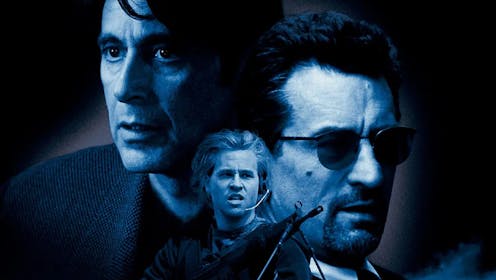
There is something fundamentally bizarre about Heat 2. It’s a sequel, as its name suggests, to writer-director Michael Mann’s classic cops and robbers film, Heat, from 1995. But it’s a novel.
And let’s face it, novelisations – the products of media corporations looking to open more avenues for exploiting their product – are notoriously bad. They’re one rung above Mills & Boon in the publishing/literary hierarchy, virtually glossier versions of fan fiction.
Review: Heat 2 – Michael Mann and Meg Gardiner (HarperCollins)
Heat 2’s strangeness is perhaps best epitomised by the coupling of actors’ names with character mentions on the book’s blurb – though there are no actors in a novel. We are reading a literary sequel to a film. This is weird.
But let’s be clear: Heat 2, written by Mann and crime novelist Meg Gardiner is not a novelisation. It’s a rich, tightly plotted original work set in the story world of the film.
Read more: How crime fiction went global, embracing themes from decolonisation to climate change
Ethereal, electric brutality
Like Heat, the novel’s narrative unfolds in the labyrinthine spaces of post-industrial global capitalism: in the cracks and detritus of modernity, in the non-places.
This is a world where high-tech consumer products sit alongside covert military weapons in the marketplace. Where shopping malls proliferate like airports, with private armies – and where the internet is just one part of a logistical infrastructure forever greasing the wheels of capitalism.
Legal or illegal, it makes no difference, the novel suggests. Only the players change. They seek investment and profit wherever it comes, supported by security and communications systems and informational flows. Mann and Gardiner are clearly awed by the ethereal, electric brutality of this thing, this hyper-object called “free trade.”
The trailer for Michael Mann’s 1995 film, Heat.We follow protagonist Chris Shiherlis (played by Val Kilmer in the film) following his escape from Los Angeles the day after the film ends. Hiding out in the “Day-Glo fever dream” of “criminal Disneyland”, Ciudad del Este – the Paraguayian free-trade zone city – Chris transforms into a different kind of criminal.
His activities shift from the paramilitary-style robberies of Neil McCauley (played by Robert De Niro in the film) and his crew towards a high-tech, dark-web-savvy kind of global trade, firmly outside of “the combat zones of urban America”. Partnered with local businesswoman Ana Liu, he works to develop and expand their commerce in illegal strategic systems.
Many of the characters from the film are reprised here, and you can virtually credit the actors with much of the writing. Robbery and homicide detective Vincent Hanna, for example, was memorably embodied in the film by Al Pacino. In Heat 2, Hanna is Pacino, and we can hear Pacino’s intonation and delivery in every piece of dialogue.
If anything, Heat 2’s Hanna is even more unhinged than the film version, living in an amphetamine-fuelled electric haze, throwing people off roofs, yelling at suspects in vintage Pacino fashion.

Wry humour and global action
The immersive, detailed world of the film – Mann famously shot Heat across 95 Los Angeles locations, fully embracing neon LA in all its sprawling splendour – is recreated in the novel. But its criminal underworld of stoics and sadists is offset in places by a wry humour. In this era of sequels and remakes, of the relentless merchandising of cinematic universes, there’s something humorous, even, in the banal simplicity of the title: Heat 2.
But perhaps the most impressive aspect of the novel is its seamless plotting of multiple storylines. The narrative spans the globe from 1988 to 2000, crossing North and South America, Singapore, and Indonesia.
The action proper begins in Chicago in 1988 – where Mann launched his cinematic career with the masterpiece, Thief - tracking McCauley and crew in parallel to Hanna, as he hunts for the prime antagonist of the novel: Otis Wardell, a home invader-rapist and all-round bad dude. We follow the organisation and execution of a daring cartel heist south of the border, then follow Shiherlis as he builds a life for himself in a new, non-American world.
But it all comes back to LA – for Mann, one suspects, it always does. The story culminates in the year 2000 in Los Angeles, the whole thing coming together in splendidly operatic fashion. It’s a dazzling crescendo of action supported by a narrative architecture that is simple, yet immensely satisfying.
Read more: GoodFellas at 30: Scorsese's massively influential, virtuoso gangster film
Why a novel?
So, the big question: why a novel and not a film? There may be financial reasons for this – it’s hard and expensive to make a film, even for someone as tried and true as Mann – but the limitations are built into the material itself.
It would have been a travesty to entrust these roles to other actors following the canonical status of Heat. And how could you make a film about characters set several years earlier using the same actors? It probably could have been done with some makeup a couple of years after Heat was released, but by 2022? Forget it. And using CGI to make actors look younger never quite works.
Michael Mann, Al Pacino and Robert De Niro share stories of making Heat.The most important medium-specific aspect of any narrative is, of course, its style. Style is the thing that converts the presentation of information into art – the expressive dimension of a work foundational to its aesthetic qualities.
There have been some exceptionally written, stylistically idiosyncratic popular novels that have been perfectly translated into film. Thomas Harris’s Red Dragon is a great example, made by Mann as Manhunter in 1986. The pop, neon-lit prose of Harris is adapted effortlessly into Mann’s high modernist aesthetic, so that reading the novel and watching the film become strangely similar experiences.
Thomas Harris’s Red Dragon, remade by Michael Mann as ‘Manhunter’, is a novel ‘perfectly translated into film’.An equivalent thing is at play in Heat 2. Mann/Gardiner’s style perfectly translates the style of Heat into a radically different medium. This is no small feat.
We read prose that interweaves vivid and precise description with expressionistic, existentially charged passages. We are awed, as in the film, by the starkly drawn genre characters, by the melancholic, romantic images of solitary figures battling for survival in a sparkling but meaningless universe of complex and overlapping forces.
In the novel, as in film, sunsets “burn nuclear red”, nights are “starkly clear, moonlit, stars cast about like careless diamonds”, and Hanna is described thus:
Pursuing a sequence of unknowns to its origins in dark and wild places or on the concrete anonymity of cityscape, that action is what made him go.
But the colour never obscures the clarity of the narrative or takes away from its momentum.
At the same time, Mann/Gardiner do things in the novel that simply wouldn’t work in a film. The backstories of characters are presented in the novel as memories, snippets of information, in a way that would seem far too expositional in a film. It works, for example, when we learn in the novel that McCauley read Camus in Folsom Prison. But this detail would be pretentious and annoying in a film.
Mann has always been an auteur interested in what it means to be American. He studied in London, and has approached the question throughout his career with an internationalist sensitivity across multiple films and genres – from his kinetic adaptation of the The Last of the Mohicans (by the godfather of American action novels, James Fenimore Cooper), to the biopic of American boxing icon Muhammad Ali.
This continues in Heat 2, with the literary medium giving him more opportunity to explicitly think about and theorise this Americaness.
How good is it?
Would this stand alone as a novel outside of its relation to Heat? Possibly not. But then, it’s probably not meant to: it is named Heat 2, after all.
 And the dullest part – the only dull part – is the prologue, a six-page recap of the plot of the film that reads like a colourless synopsis. I guess it has to be here for people who haven’t seen the film – but why would they be reading Heat 2?
Is this as good a novel as Heat is a film? Probably not. Heat routinely features in top 50 critic lists and enjoys enduring popularity. Heat 2 is excellent, written in lightning prose with flashes of brilliance, but it probably wouldn’t make anyone’s top 50 list of novels.
That said, its near seamless continuation of the story world of its antecedent makes reading it an incredibly pleasurable experience. And many of the touches that define Mann as an auteur – a hyper-real sense of place, an interest in the brutality and efficiency of global capitalism, a sense of character through surface details – are present in Heat 2.
And it is more effectively written than most mass-market crime novels, with crisp action matched by description vivid in detail, spare in execution.
Indeed, from the frenetic opening to the brilliantly wry final line, Heat 2 is a superb novel. I recommend watching – I mean, reading – it today!
Authors: Ari Mattes, Lecturer in Communications and Media, University of Notre Dame Australia
And the dullest part – the only dull part – is the prologue, a six-page recap of the plot of the film that reads like a colourless synopsis. I guess it has to be here for people who haven’t seen the film – but why would they be reading Heat 2?
Is this as good a novel as Heat is a film? Probably not. Heat routinely features in top 50 critic lists and enjoys enduring popularity. Heat 2 is excellent, written in lightning prose with flashes of brilliance, but it probably wouldn’t make anyone’s top 50 list of novels.
That said, its near seamless continuation of the story world of its antecedent makes reading it an incredibly pleasurable experience. And many of the touches that define Mann as an auteur – a hyper-real sense of place, an interest in the brutality and efficiency of global capitalism, a sense of character through surface details – are present in Heat 2.
And it is more effectively written than most mass-market crime novels, with crisp action matched by description vivid in detail, spare in execution.
Indeed, from the frenetic opening to the brilliantly wry final line, Heat 2 is a superb novel. I recommend watching – I mean, reading – it today!
Authors: Ari Mattes, Lecturer in Communications and Media, University of Notre Dame Australia 
















