

reflecting on Queen Elizabeth II's long relationship with Australia
- Written by Giselle Bastin, Associate Professor of English, Flinders University
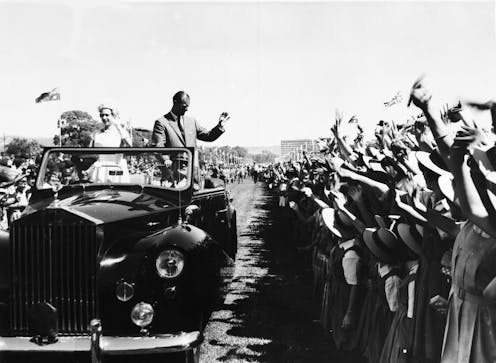
“Elizabeth the Second, by the Grace of God Queen of Australia and Her other Realms and Territories, Head of the Commonwealth” has died. Given her advanced years, this has long been expected, yet it still seems incredible this woman who has been Australia’s queen for the duration of most Australians’ lives is no longer with us.
While the focus of the formalities and ceremony of the passing of Queen Elizabeth II will centre on London and the UK, there is no doubt it will be keenly observed by many Australians.
The queen liked Australia and Australians. She came here 16 times throughout her reign and was, famously, on her way to our shores in 1953 when she learned her father had passed on and she was now queen.
Her visits to Australia – from her first in 1954 through to her last in 2011 – offer a snapshot of the changing relationship Australians have had with their sovereign and with the monarchy.
An enthusiastic nation
The queen’s 1954 tour took place during a time described by historian Ben Pimlott as the age of “British Shintoism”. Deference to the Crown was paramount in Britain and the Commonwealth, and many Australians were madly enthusiastic about their queen.
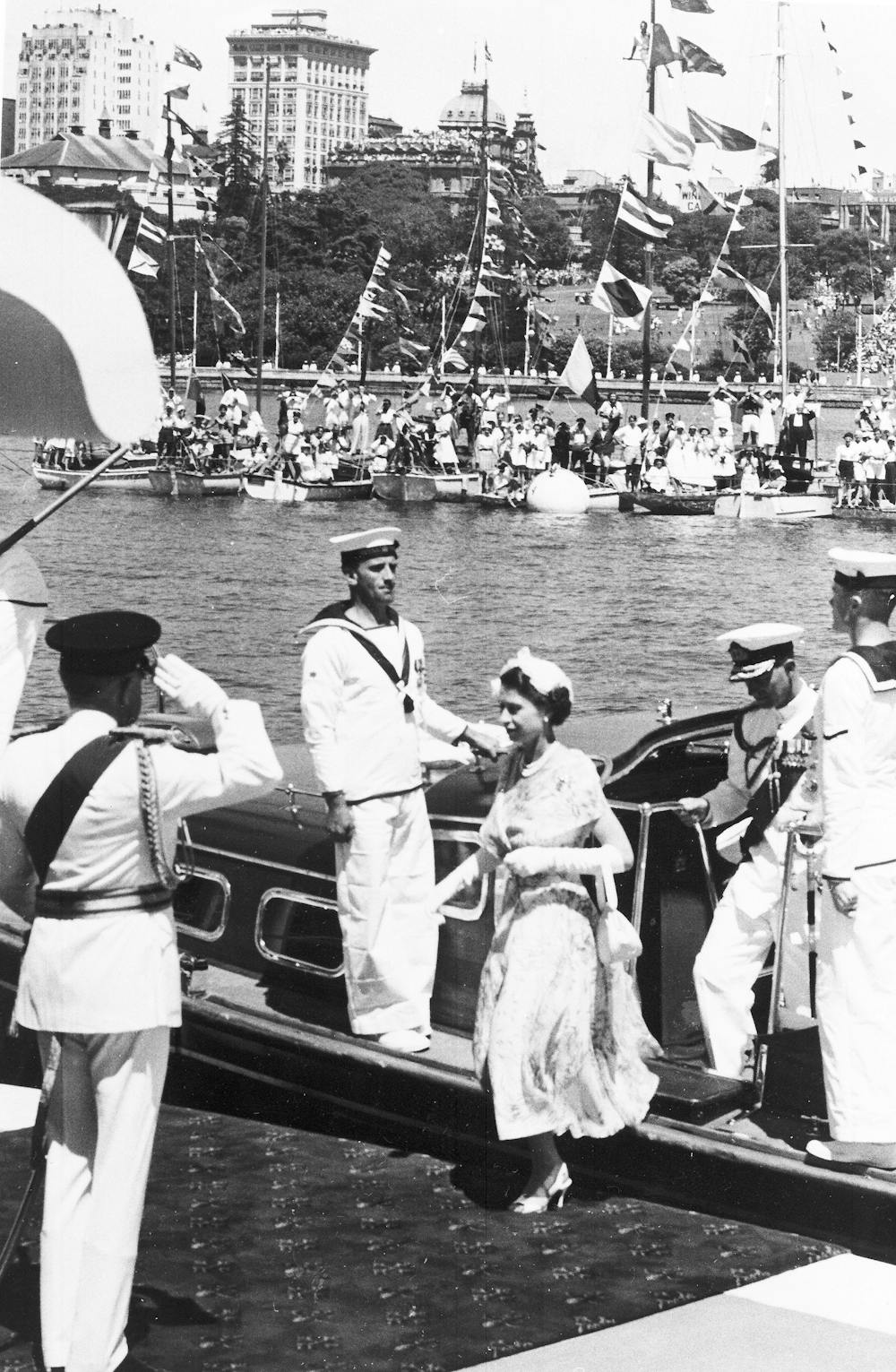
After her arrival at Farm Cove in Sydney on February 3 1954, Elizabeth II became the first British monarch to set foot on Australian soil. The royal tour lasted nearly two months and consisted of a gruelling schedule taking in visits to every state and territory apart from the Northern Territory.
During the tour, the queen greeted over 70,000 ex-service men and women; drove in cavalcades that took in massive crowds; attended numerous civic receptions; and opened the Australian Parliament in Canberra. The tour saw Elizabeth travel 10,000 miles by air and 2,000 miles by road – including 207 trips by car and by appointed royal trains.
It is estimated as much as 75% of the population saw the queen and Prince Philip during this tour.
No Australian prime minister has ever had a reception on this scale or exposure to so many of the country’s citizens.
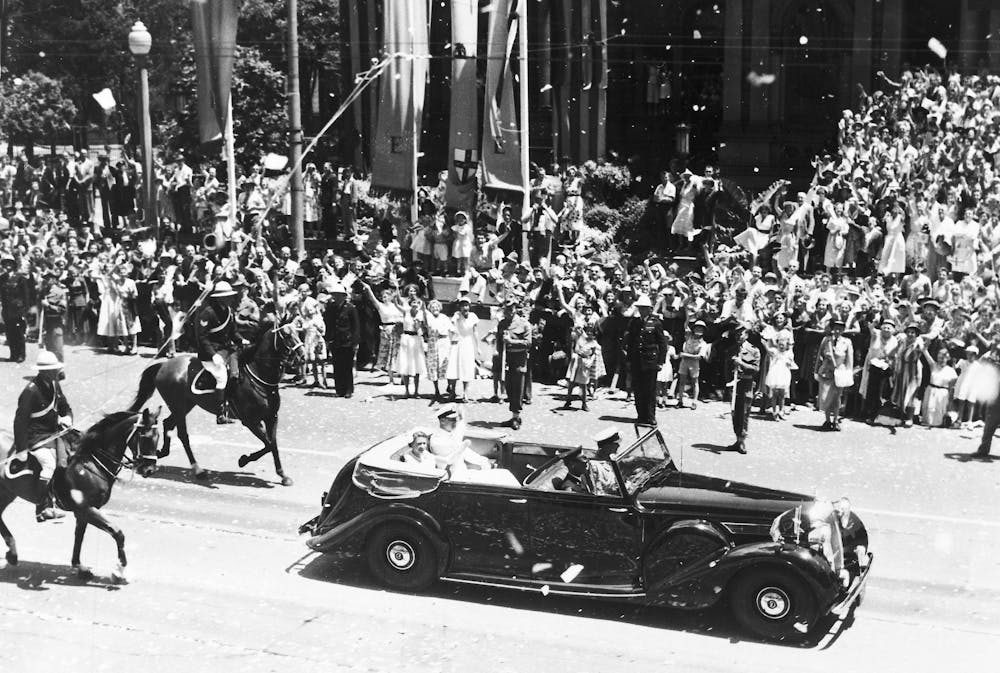 Massive crowds greeted the Queen on her first tour of Australia in 1954.
AP Photo
Massive crowds greeted the Queen on her first tour of Australia in 1954.
AP Photo
A “new” and prosperous country
During her first two tours in 1954 and 1963, the Australia laid-out for display for the queen was depicted as having gone from being a small colonial settlement to a thriving economy that had ridden to prosperity “on the sheep’s back”.
The queen was treated to endless displays of sheep shearing, surf carnivals, wood chopping, whip cracking, and mass displays of dancing and singing by school children. Federal and state dignitaries, mayors and civic leaders from across the political divide jostled to meet and be seen with her; the country’s florists were emptied of flowers for the hundreds of bouquets presented to her by dozens of shy, nervous school children nudged gently forward by awe-struck parents.
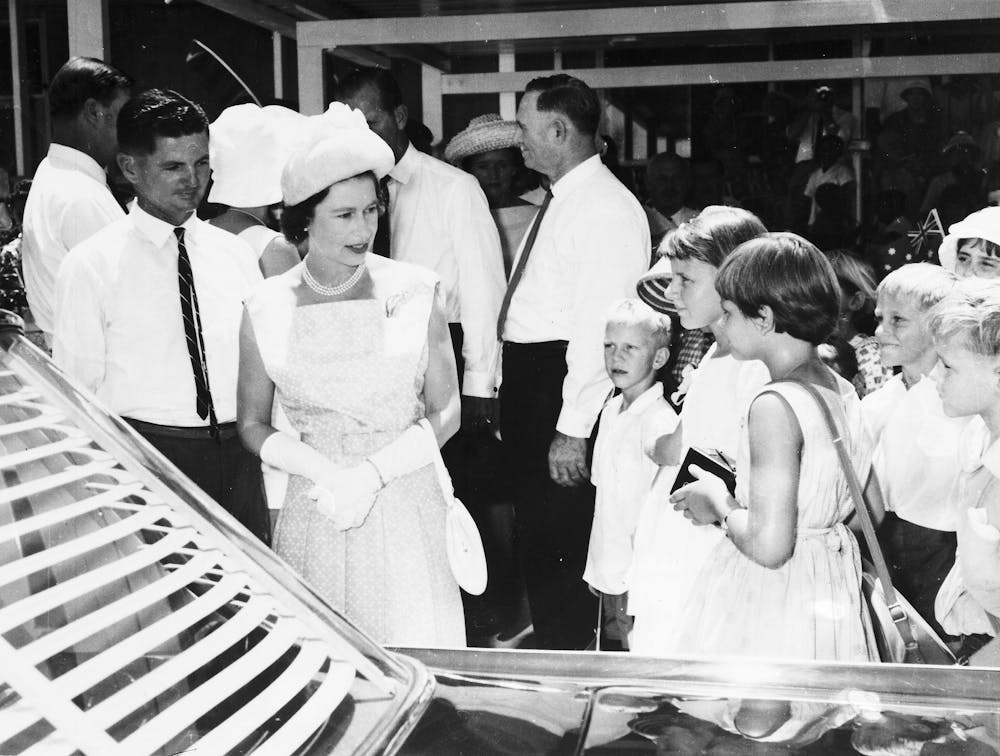 Hundreds of school-children met the Queen on her 1963 tour.
AP Photo
Hundreds of school-children met the Queen on her 1963 tour.
AP Photo
During the early tours, Aboriginal Australians were kept at a discreet distance. Apart from a demonstration of boomerang and spear throwing, the closest the queen came to experiencing anything of Indigenous Australian culture was a ballet performed by the Arts Council Ballet titled Corroboree, with no Aboriginal dancers but dancers with blackened faces.
During the 1970 visit, the queen witnessed the re-enactment of Captain James Cook’s arrival at Botany Bay, with Cook and his crew meeting “the resistance of the Aborigines with a volley of musket fire”.
By 1973, Indigenous Australians were given a more significant role in the royal tours. Aboriginal actor Ben Blakeney, one of Bennelong’s descendants, gave the official welcome during the opening of the Sydney Opera House, and the then unknown actor David Gulpilil was among those performing a ceremonial dance.
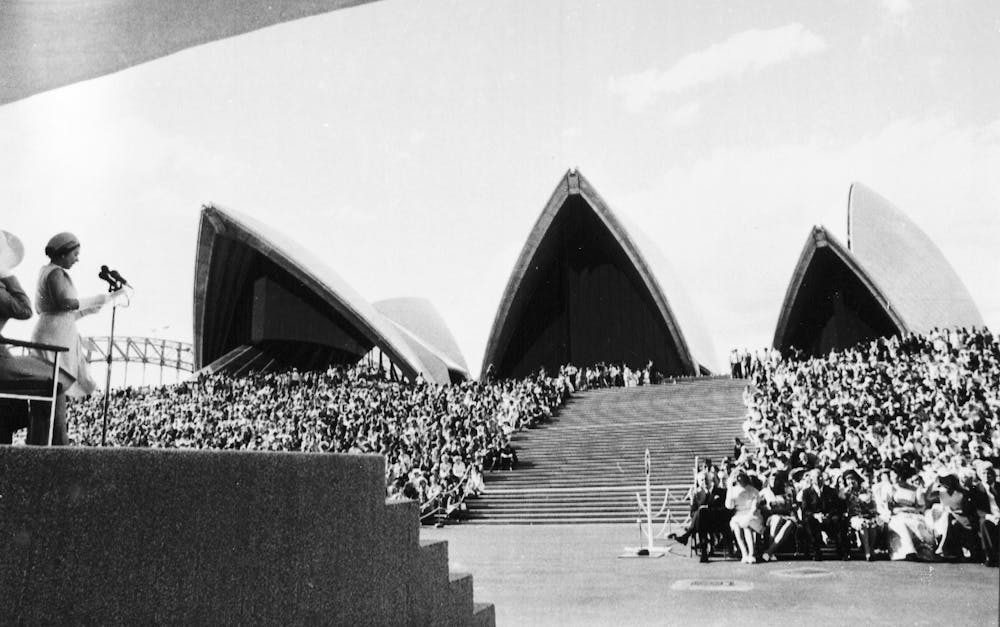 Queen Elizabeth II declares open the Sydney Opera House complex, 1973.
AP Photo
Queen Elizabeth II declares open the Sydney Opera House complex, 1973.
AP Photo
Invited guest, not ruler of the land
As early as the 1963 tour, the nation-wide royal fervour had dimmed a little. The 1963 visit witnessed smaller crowds and fewer mass public events. When Prime Minister Robert Menzies courted the queen with the now-famous line, “I did but see her passing by, and yet I love her till I die”, the ensuing blushes – including the queen’s own – reflected many Australians’ growing sense of embarrassment at public displays and unquestioning expressions of deference.
Despite this, Menzies’ displays of public ardour saw him being granted The Order of the Thistle shortly after, a bestowal which must surely remain the envy of some subsequent prime ministers.
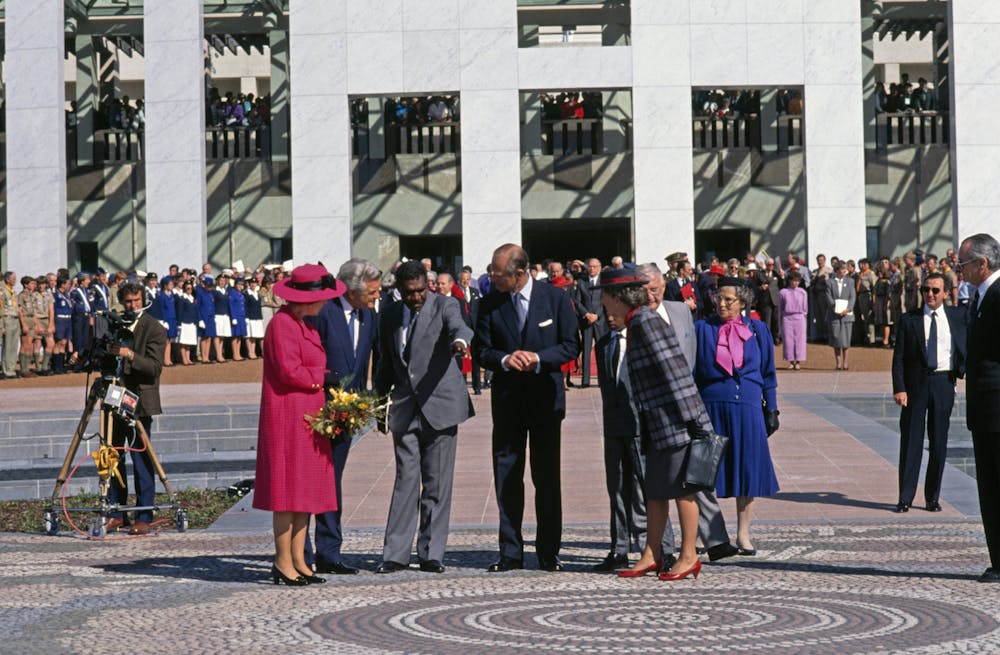 Queen Elizabeth II, Prime Minister Bob Hawke, artist Michael Nelson Jagamara and the Duke of Edinburgh at the official opening of new Parliament House, Canberra, 1988.
The 1977 Silver Jubilee and 1988 Australian bicentenary visits perhaps marked the end of a period of royal tours as overt celebrations of Australia’s ties to Britain. This new flavour of tours positioned the sovereign as an invited guest to an independent, modern and multi-cultural nation.
On her 10th tour in 1986, the queen returned to sign the Australia Act, which brought to an end the ability of the UK to create laws for Australia.
Her role as our sovereign subtly transformed from cutting ribbons and opening Parliament to signing the documents that slowly, by degrees, contributed to the cutting of Australia’s ties to the UK and the Crown.
A question of the republic
By the 12th tour in 1992, the cost of the queen’s visits to Australia were increasingly scrutinised by a public feeling largely indifferent about the royal family. The prime minister of the day, Paul Keating, was seen not so much as an entranced liege lord revelling in the opportunity to see his sovereign “passing by” as one who instead – unthinkingly – committed an act of lèse majesté by placing his bare hand on the royal back and waist as he guided her through the crowd.
The gloves, it seemed, were coming off.
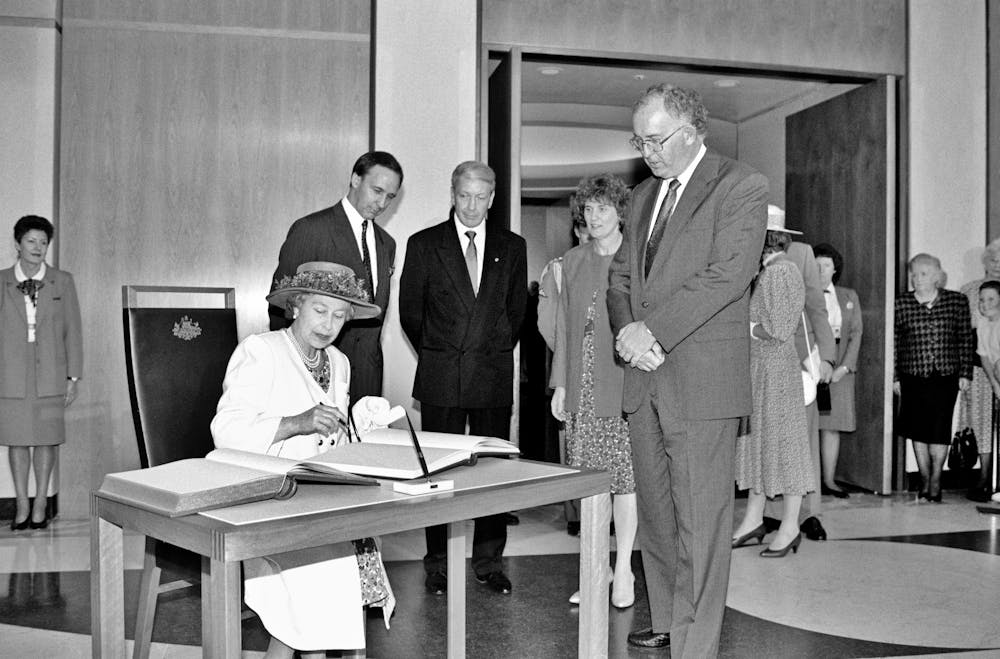 Queen Elizabeth II signs the visitors’ book at Parliament House, while Prime Minister Paul Keating looks on, February 1992.
AAP Image/National Archives of Australia
Queen Elizabeth II signs the visitors’ book at Parliament House, while Prime Minister Paul Keating looks on, February 1992.
AAP Image/National Archives of Australia
The queen made it clear in her last visits to our shores that whether or not Australia should become a republic was a decision for its own citizens to make. Her official announcement after she learned of the result of the 1999 Republic Referendum confirmed this:
I have always made it clear that the future of the Monarchy in Australia is an issue for the Australian people and them alone to decide, by democratic and constitutional means. … My family and I would, of course, have retained our deep affection for Australia and Australians everywhere, whatever the outcome.
In the last decades of her life, the queen retained the affection of many. Her popularity seemed to grow in line with Australians’ increased disenchantment with their home-grown political leaders: the former prime ministers Malcolm Turnbull and Julia Gillard are right to have sensed that any discussion about an Australian republic would have to wait until after Elizabeth II’s death.
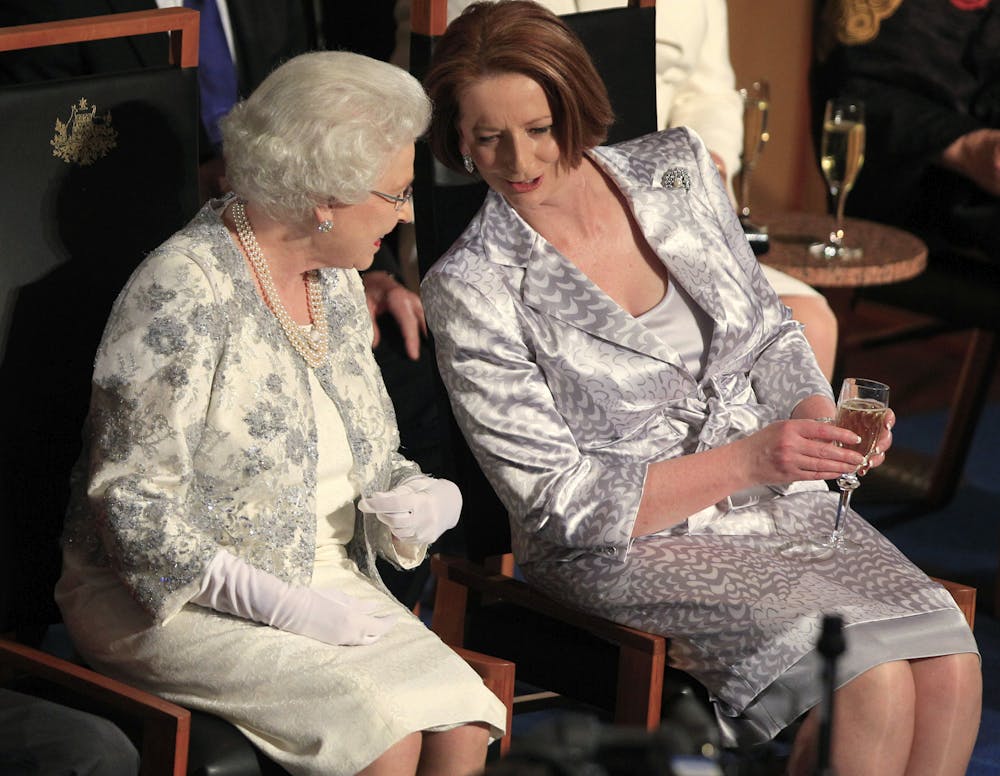 Queen Elizabeth II made her last visit to Australia in 2011, where she met with Prime Minister Julia Gillard.
AP Photo/Rick Rycroft
Queen Elizabeth II made her last visit to Australia in 2011, where she met with Prime Minister Julia Gillard.
AP Photo/Rick Rycroft
Queen Elizabeth II reigned across seven decades and her tours to Australia served as a marker of Australia’s changing relationship with the Crown as well as with its own colonial past and national identity.
Almost certainly, Elizabeth II’s reign as the stalwart, loyal, dutiful, and most cherished and admired of “Glorianas” is one we are unlikely ever to see again.
Authors: Giselle Bastin, Associate Professor of English, Flinders University

















