

Are home-brand foods healthy? If you read the label, you may be pleasantly surprised
- Written by Lauren Ball, Associate Professor and Principal Research Fellow, Menzies Health Institute, Griffith University

The cost of groceries in Australia has sky-rocketed this year. So people may be tempted to switch to home-brand foods to save on their weekly food bill.
Home-brand foods are certainly cheaper. But are they healthy?
Here’s what we know about the nutrients they contain compared with the more expensive named brands.
Read more: How to save $50 off your food bill and still eat tasty, nutritious meals
What are home-brand foods?
Home-brand foods have various names. You might hear them called supermarket own-brand foods, private label, in-house brands, store brands, or retailer brands.
These are foods made specifically for a supermarket (you cannot buy them at a competing store). They are advertised as low-priced alternatives to more expensive items.
Home-brand foods are widely available in Australia and other countries, making up to 30% of what you can buy at a supermarket.
Some people once viewed these as inferior products. But their nutrient content, and wide availability in supermarkets, may play a role in boosting population health. Some evidence shows home-brand foods increase availability and accessibility to more affordable food options, and contribute to improving food safety standards.
Why are they cheaper?
Cheaper prices associated with home-brand products are possible due to lower costs associated with research and development, marketing and packaging. This means we cannot assume lower prices mean cheaper or inferior ingredients.
In fact, supermarkets can influence the ingredients and processing of home-brand foods by benchmarking against named brands.
Before a home-brand product is made, stores will also specify to manufacturers what it should cost to consumers. Manufacturers often choose to use the same ingredients and processes as name-brand products to reduce costs through economies of scale.
This means not having to clean or reprogram equipment between making the different products. It also means most home-brand products are very similar to branded products, aside from the packaging.
However, for mixed foods, such as breakfast cereals and pre-made sauces, the manufacturer may change the ingredients, such as using cheaper or fewer ingredients, to help reduce costs.
Read more: How Australians talk about tucker is a story that'll make you want to eat the bum out of an elephant
How much can I save?
Home-brand products can be up to 40% cheaper than named brands. So yes, home-brand products can make a real difference to the total cost of groceries.
However, some products have bigger cost savings than others, as we show below.
Most labels on supermarket shelves show the cost per 100g (or equivalent) for an item, which can help shoppers choose the most cost-effective option, especially useful when items are on sale.
But are they healthy?
For simple, unprocessed products such as milk, eggs and pasta there is virtually no difference in nutritional quality between home-brand and named brand foods. There is very little the manufacturers can do to modify ingredients to reduce costs.
But sometimes cheaper ingredients are used in higher concentrations in home-brand products. For example, home-brand pre-made pasta sauces may have less of the vegetable ingredients, and greater amounts of sugar, sodium (salt), and additives (such as stabilisers, colours and flavours). This may change the quality and taste.
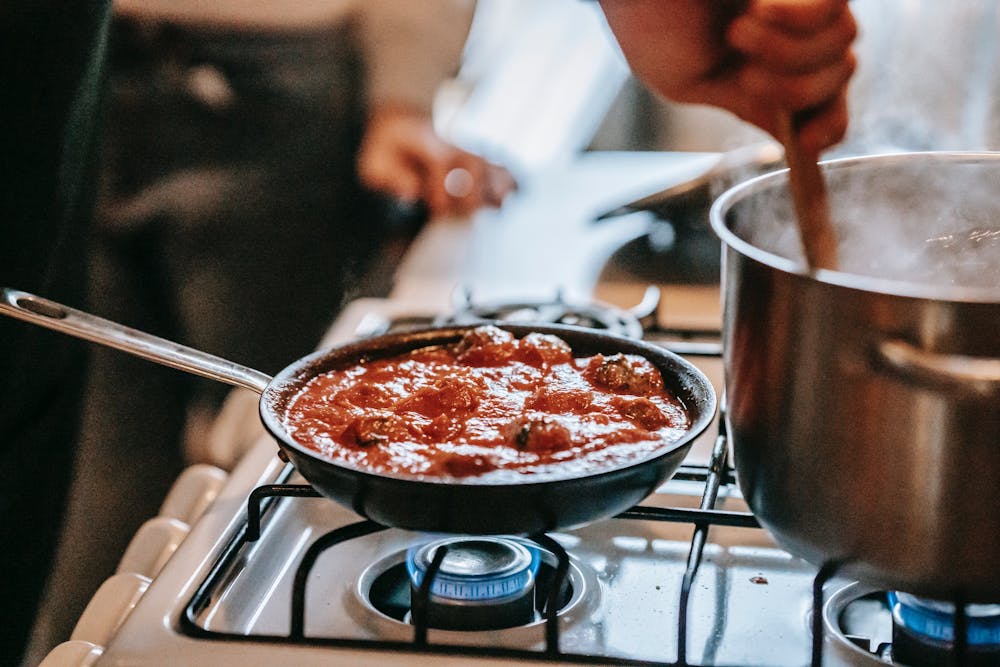 If you’re using pre-made pasta sauce, the quality may vary. So check the label.
Gary Barnes/Unsplash, CC BY-SA
If you’re using pre-made pasta sauce, the quality may vary. So check the label.
Gary Barnes/Unsplash, CC BY-SA
Very few studies have explored how home-brand products may differ in nutritional profile.
Overall, serving size, sodium and other nutrients appear similar across home-brand and named brand food. But there are some differences with certain food types.
Serving sizes
For instance, serving sizes are generally smaller in home-brand pizza, canned legumes, grains, biscuits and ready meals. In fact, edible oil is the only type of food where serving size is greater for home-brand foods.
Salt
Sodium levels of home-brand breakfast cereals, cheese and bread are higher than branded products. But sodium levels of cooking sauces, frozen potato products (such as oven-baked fries) and biscuits are lower in home-brand foods.
Other nutrients
For energy and fat intake, again it seems there are inconsistent differences between home-brand foods compared to branded foods.
How about sugar? Unfortunately, the studies didn’t look at this.
In fact, overall, Australian home-brand products are not consistently nutritionally different to branded products.
Health star ratings
On a related note, unhealthy home-brand products – such as juices, meat pies and muesli bars – are more likely to include a health star rating, compared to nutritious foods. This may incorrectly imply they are a healthy choice.
This means no matter which brand you choose, remember to check the food label to make sure you are getting the quality of food you like for the price you are comfortable with.
Authors: Lauren Ball, Associate Professor and Principal Research Fellow, Menzies Health Institute, Griffith University

















