

'The most significant environmentalist in history' is now king. Two Australian researchers tell of Charles' fascination with nature
- Written by Nicole Hasham, Energy + Environment Editor
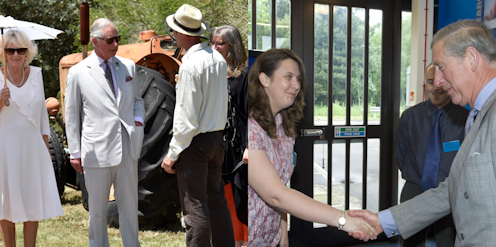
The natural world is close to the heart of Britain’s new King Charles III. For decades, he’s campaigned on environmental issues such as sustainability, climate change and conservation – often championing causes well before they were mainstream concerns.
In fact, Charles was this week hailed as “possibly most significant environmentalist in history”. Upon his elevation to the throne, the new king is expected to be less outspoken on environmental issues. But his advocacy work have helped create a momentum that will continue regardless.
As Prince of Wales, Charles regularly met scientists and other experts to learn more about environmental research in Britain and abroad. Here, two Australian researchers recall encounters with the new monarch that left an indelible impression.
Nerilie Abram, Australian National University
In 2008, I was a climate scientist working on ice cores at the British Antarctic Survey in Cambridge. On one memorable day, Prince Charles visited the facility – and I was tasked with giving him a tour.
At the time, I’d just returned from James Ross Island, near the northern tip of the Antarctic Peninsula. There, at one of the fastest warming regions on Earth, I’d helped collect a 364-metre-long ice core.
Ice cores are cylinders of ice drilled out of an ice sheet or glacier. They’re an exceptional record of past climate. In particular, they contain small bubbles of air trapped in the ice over thousands of years, telling us the past concentration of atmospheric gases.
Read more: I am a climate scientist – and this is my plea to our newly elected politicians
We started the tour by showing Prince Charles a video of how we collect ice cores. We then ventured into the -20℃ freezer and held a slice of ice core up to the lights to see the tiny, trapped bubbles of ancient atmosphere.
Outside the freezer, we listened to the popping noises as the ice melted and the bubbles of ancient air were released into the atmosphere of the lab.
Holding a piece of Antarctic ice is a profound experience. With a bit of imagination, you can cast your mind back to what was happening in human history when the air inside was last circulating.
Prince Charles embraced this idea during the tour, making a connection back to the British monarch that would have been on the throne at the time.
All this led into a discussion about climate change. Ice cores show us the natural rhythm of Earth’s climate, and the unprecedented magnitude and speed of the changes humans are now causing.
At the time of the 2008 visit, carbon dioxide levels in the atmosphere had reached 385 parts per million - around 100 parts per million higher than before the Industrial Revolution. Today we are at 417 parts per million, and still rising each year.
In 2017, Prince Charles co-authored a book on climate change. It includes a section on ice cores, featuring the same carbon dioxide data I showed him a decade earlier.
Last year, the royal urged Australia’s then Prime Minister Scott Morrison to attend the COP26 climate summit at Glasgow, warning of a “catastrophic” impact to the planet if the talks did not lead to rapid action.
And in March this year, the prince sent a message of support to people devastated by floods in Queensland and New South Wales, and said:
“Climate change is not just about rising temperatures. It is also about the increased frequency and intensity of dangerous weather events, once considered rare.”
As prince, Charles used his position to highlight the urgency of climate change action. His efforts have helped to bring those messages to many: from young children to business people and world leaders.
He may no longer speak as loudly on these issues as king. But his legacy will continue to drive the climate action our planet needs.
Peter Newman, Curtin University
In the 1970s, being an environmentalist was lonely work. It meant years of standing up for something that people thought was a bit marginal. But even back then Prince Charles – now King Charles III – was an environmental hero, advocating on what we needed to do.
I met the Prince of Wales in 2015. He and Camilla, the Duchess of Cornwall, visited Perth on the last leg of their Australia tour. I was among a group of Order of Australia recipients asked to meet the prince at Government House. I spoke to him about my lifelong passion – sustainability, including regenerative agriculture.
Read more: Greening the greyfields: how to renew our suburbs for more liveable, net-zero cities
I knew earlier in their trip, Charles had toured the orchard at Oranje Tractor Wine, an organic and sustainable wine producer on Western Australia’s south coast. The vineyard is run by my friend Murray Gomm and his partner, Pam Lincoln, and I’d encouraged them over the years. They’d started winning awards, and it became even more special when the prince came down and blessed it!
The Oranje Tractor is now a net-zero-emissions venture: the carbon dioxide it sucks up from the atmosphere and into the soil is well above that emitted from its operations.
Charles’ eyes really lit up when I mentioned the Oranje Tractor. He was trying to do similar things in his gardening and at his farms – avoiding pesticides and sucking carbon from the atmosphere back into the soil.
Charles has that same knack the Queen had – an extraordinary ability to really listen and engage. To meet him, and see he’s been involved in sustainability as long as I have, it was validating and inspirational.
Now he’s king, Charles will be a little more constrained in his comments about environment issues. But I don’t think you can change who you are. He will just be more subtle about how he goes about it.
Climate change is now at the forefront of the global agenda. But the world needs to accelerate its emissions reduction commitments. If we don’t move fast enough, King Charles will no doubt raise a royal eyebrow – and that’s enough.
Authors: Nicole Hasham, Energy + Environment Editor

















