

Starlink, Amazon and others are racing to fill the sky with bigger satellites to deliver mobile coverage everywhere on Earth
- Written by Melissa de Zwart, Professor (Digital Technology, Security and Governance), Flinders University
Elon Musk’s space tech company SpaceX is rapidly advancing towards its goal of establishing Starlink – a massive satellite network capable of providing high-speed broadband internet across the world.
Starlink claims the network is already servicing more than 30 countries with high-speed internet, including the United States, parts of Australia and most of the United Kingdom. There are about 2,500 Starlink satellites in orbit, with plans to eventually create a constellation of 42,000.
The satellites are in “low Earth orbit” at an altitude of about 550 kilometres. This relative proximity provides the benefit of low latency (less delay in data processing), faster internet, and service for areas that cable internet can’t service.
Beyond internet, however, Starlink and a number of other satellite network providers are also in a race to establish global mobile phone service connection. Some of the latest proposals could be game changers, especially for people on the move and in remote parts of the world. But there are several hurdles to jump first.
Mobile phone service from space is coming
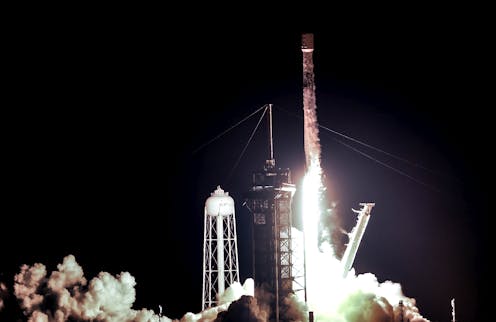
This weekend Starlink launched one of its Falcon 9 rockets for the 14th time, sending another 34 Starlink satellites into space.
The same rocket also carried a very different payload into orbit – a satellite called the BlueWalker 3. It’s the largest commercial antenna array ever launched into space.
Operated by American company AST SpaceMobile, the BlueWalker 3 is expected to provide global satellite phone service (distinct from internet) directly to standard mobile phones from space.
For now, satellite-to-phone connections still require special dedicated handsets, such as through the Iridium network. Iridium provides satellite phone services via its 66 satellites in low Earth orbit (at an altitude of 780km).
AST SpaceMobile will need to launch at least 100 more satellites to obtain global coverage. It has partnered with a number of mobile service providers, who will participate in connectivity tests starting next year. Currently, no date has been set for when the service will become commercially available.
T-Mobile, Apple and Verizon
Musk too plans to expand his Starlink network to provide satellite mobile phone connection directly to mobile devices.
In August, Musk announced a partnership between Starlink and US telecommunication provider T-Mobile. This will link T-mobile users directly to Starlink satellites, providing a limited service of text, MMS, voice messaging and potentially some messaging app connectivity to most of the US (including outside standard service areas).
The service is expected to launch in beta phase by the end of 2023, pending the deployment of second-generation Starlink satellites with larger antennas. However, at this stage it’s only intended as a connection of “last resort”, providing coverage for rescue and emergency services in areas currently without coverage. There are no plans for expansion beyond the US.
These announcements come around the same time as the launch of Apple’s iPhone 14 – the first regular smartphone to allow direct satellite connectivity.
From November, iPhone 14 users will be able to send short SOS messages where no other connection is available. The connection, which uses the Globalstar satellite network, will rely on access to clear skies and may not be available at all times and in all locations.
Similarly, US-based mobile phone service provider Verizon has partnered with Amazon’s proposed Kuiper satellite network to provide mobile services. But the Kuiper network has yet to launch any of its planned 3,200 broadband satellites, so it’s unclear when the additional capacity for mobile phone service connection would roll out.
Moreover, all of these arrangements will involve working out the complicated allocation of mobile phone spectrum licences across the globe.
A licence to operate in the US would not necessarily give access to such rights in another country. For example, America can grant AST SpaceMobile a licence to provide satellite mobile phone connectivity to people in America, but Australia would have to grant a different licence for it to service people in Australia.
Starlink is lobbying to prevent changes to the allocation of the 12GHz spectrum in the US. Last year, the US Federal Communications Commission proposed opening up the 12GHz frequency band (currently used for space-based services) for more widespread use on Earth for 5G mobile connection.
Starlink satellites use this band to communicate data to the ground, so this change would lead to significant interference in its services.
Internet on the move
Starlink internet users within Australia can’t currently obtain a fully mobile service. With some exceptions, such as mobile homes, their service is locked to a single location where their satellite dish is placed.
Elsewhere, things seem to be advancing. In June the US Federal Communications Commission granted Starlink a licence to operate in moving vehicles, including cars, boats, planes and trucks.
And cruise operator Royal Caribbean (which services Australia) recently began installing Starlink terminals on its fleet, after successful internet trials on a cruise earlier this year.
SpaceX is also in negotiation with several commercial airlines regarding its internet service, which will be installed on Hawaiian Airlines flights beginning next year.
Subject to licensing approvals, the Starlink network will also provide internet for its Tesla vehicles – with emergency phone connection only available in the US.
The BlueWalker 3 and 34 Starlink satellites were launched on Saturday, and could be seen from Earth.What about Australia?
Australia, with its vast remote areas, would certainly benefit from mobile phone coverage provided by a low Earth orbit satellite network. It would particularly benefit emergency services, remote communities, long-haul travellers and adventurers.
There are no clues as to when such a rollout may happen here. Yet, with the speed at which these developments are occurring, it seems likely Australians will get access to satellite-to-phone connections sooner rather than later – subject to the necessary licensing approvals.
In the interim, many are concerned about the congestion and light pollution that will arise due to the deployment of so many satellites. The BlueWalker 3, at 64 square metres, has only added to these concerns.
Authors: Melissa de Zwart, Professor (Digital Technology, Security and Governance), Flinders University

















