

Here's how to support quality teaching, with the evidence to back it
- Written by: Jenny Gore, Laureate Professor of Education, University of Newcastle
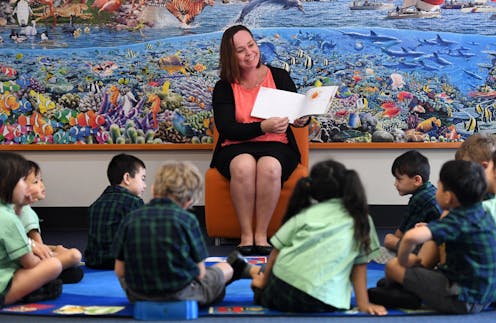
Increasing the quality of teaching in Australia is a political hot issue. Popular solutions include restricting entry to teaching courses to the “best and brightest” and reforming teacher education.
The spotlight is rarely focused on the roughly 300,000 teachers who are already working in our schools except, all too often, when they are criticised for results in the latest round of high-stakes testing.
Every year, millions of dollars are invested in the professional development of teachers in schools in every state and territory, in addition to the professional development investments made by schools, local communities and teachers themselves.
The teacher professional development industry in Australia is thriving with an abundance of expensive courses, events and gurus offering advice or endorsing products, with little evidence (or evidence of limited quality) that any of it improves teaching.
But our research shows that a low-cost approach that relies on teachers learning together, at school, shows significant, quantifiable improvements in the quality of teaching.
Some A$16.4 million funding, announced today, will mean more teachers will benefit from this evidence-based professional development.
How does it work?
Quality Teaching Rounds involves four or more teachers working in a professional learning community, in which they observe and analyse lessons in each teacher’s classroom.
This approach is distinct from professional development that asks teachers to focus on improving the teaching of a particular topic or a particular set of skills. Instead it focuses on enhancing teaching in general.
Teachers are guided by a model of teaching (known as Quality Teaching) that focuses on the intellectual demands of the lesson, the quality of the learning environment and the extent to which learning is made meaningful for students.
The model is already familiar to teachers in NSW and ACT government schools, and in a number of Catholic and independent schools across Australia.
Over one day, the teachers:
- discuss teaching based on a reading proposed by one of the group
- sit in on a lesson taught by one member of the group to observe and analyse the quality of teaching
- independently “code” the lesson in line with the Quality Teaching model
- then regroup to discuss the lesson, and teaching in general.
As teachers observe and discuss teaching in a non-confrontational environment, they become more aware of their strengths and what they can improve to help their students learn.
How do we know it works?
Over 18 months from 2014 to 2015, we observed 192 teachers in 24 NSW government schools (eight in each school).
We observed the teachers before Quality Teaching Rounds (baseline), six months later when the intervention groups in 16 of these schools had finished, and again six months after that. Teachers in the eight “control” schools participated in the rounds after the follow-up observations were completed.
The quality of teaching improved significantly for the participating teachers, with no change in quality for the control group. Effects were still measurable six months later and in the following school year.
Teachers nurtured students’ intellectual depth while ensuring a positive learning environment, and helped students to see the value of their work beyond school. These effects were significant irrespective of sector (primary/secondary), location (urban/non-urban) and years of teaching experience.
Teachers were also better able to judge and refine the quality of their own and each others’ teaching. At the same time, there were significant positive effects on teacher morale and teachers’ feelings of being encouraged and recognised for good work.
Read more: How design thinking can help teachers collaborate
We found gains in teaching quality from a single set of Quality Teaching Rounds involving teachers in as little as four half-days of professional development, typically conducted over the course of one school term. Such significant effects on the quality of teaching overall have rarely been reported in other studies.
Unlike many other teacher workshops or products, our approach can be used across subject areas and year level, with the potential to broaden teacher learning beyond a particular topic, subject or skill set, to teaching in general.
The main cost associated with the approach is releasing teachers from their classrooms to undertake rounds. Schools typically use their professional development budgets for this purpose or find other creative ways to arrange teachers’ off-class time so they can participate.
What does the future hold?
Our approach is used in around 250 Australian schools, but significant philanthropic investment by the Paul Ramsay Foundation should see it expanded to more than 3,500 Australian schools by 2022.
This will be accompanied by a substantial program of research including testing the impact of the approach on student outcomes, using randomised controlled trials and other methods.
Digital technology will help more teachers to take part, including those in small and remote schools, with an aim of reaching 34,000 teachers and 1.3 million students over the next five years.
And we hope to create a Quality Teaching Academy to monitor effects and to support teachers, schools and others in implementing the approach. The aim throughout is to support teachers in strengthening their own capacity for ensuring quality teaching in Australian schools.
Authors: Jenny Gore, Laureate Professor of Education, University of Newcastle
Read more http://theconversation.com/heres-how-to-support-quality-teaching-with-the-evidence-to-back-it-99022


















