

Why 'best before' food labelling is not best for the planet or your budget
- Written by Louise Grimmer, Senior Lecturer in Retail Marketing, University of Tasmania
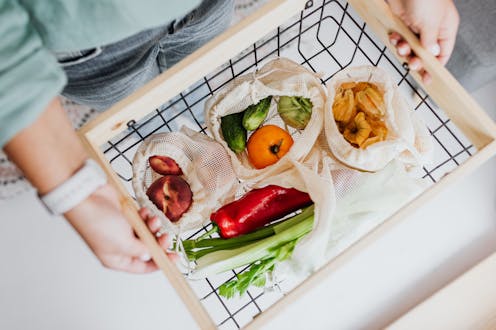
UK supermarkets have removed “best before” dates on thousands of fresh food products in an effort to reduce food waste.
One of the major supermarket chains, Sainsbury’s, is replacing these labels with product messaging that says “no date helps reduce waste”.
Apples, bananas, potatoes, cucumbers and broccoli are among the most wasted foods. Removing “best before” labels from these foods alone will reduce waste by an estimated 50,000 tonnes a year.
In Australia we produce 7.6 million tonnes of food waste every year – about 300kg per person. About 70% of what we throw out is still edible. Why aren’t we following the UK’s example?
Read more: Scrapping use-by dates could prevent huge amounts of food waste – here's what else could help
Some might worry about food safety. But two types of date labels – “best before” and “use by” – are used in Australia. “Use by” labels would still alert us to when food can no longer be regarded as safe to eat.
And consumers will still be able to assess the state of fresh produce for themselves.
Food waste has huge impacts
Food waste costs Australia A$36.6 billion a year.
This waste occurs right across the supply chain, including primary production, manufacturing, distribution, retail and hospitality. However, households produce more than half of the waste, at an average cost per household of A$2,000 to $2,500 a year.
In 2017, the Australian government pledged to halve food waste by 2030 when it launched the National Food Waste Strategy.
This is a complex issue, but one simple solution could be to follow the UK and remove “best before” dates.
Read more: Want to reduce your food waste at home? Here are the 6 best evidence-based ways to do it
How will you know if food is still safe?
Our labelling system is fairly straightforward, but many consumers don’t understand the difference between “best before” and “use by”. This confusion leads them to throw away tonnes of food that’s still suitable for eating.
In Australia, the regulatory authority Food Standards provides guidance for manufacturers, retailers and consumers on using dates on product labels. These dates indicate how long food products can be sold, and kept, before they deteriorate or become unsafe to eat.
Food with a “best before” date can be legally sold and consumed after that date. These products should be safe, but may have lost some of their quality.
Products past their “use by date” are considered not safe.
The food supplier is responsible for placing date labels on the product.
Differences in packaging and date labelling can be subtle. For example, lettuce sold loose or in an open plastic sleeve does not have a “best before” date. The same lettuce packaged in a sealed bag does.
Bread is the only fresh food that uses a different system with “baked on” or “baked for” date labels.
Some foods, such as canned goods and food with a shelf life of two years or more, don’t have to be labelled with “best before” dates because they usually retain their quality for many years. They are typically eaten well before they deteriorate.
Food producers and retailers are keen to keep the labelling status quo, because it makes it easier to manage stock and encourages turnover.
The case for packaging
Some packaging is used to separate branded products such as fruit varieties protected by plant breeders’ rights, organic products and imperfect vegetable ranges. Once packaged, these products require a “best before” date.
Plastic packaging can greatly increase the shelf life of some vegetables. In these cases, it effectively reduces food waste. A striking example is cucumbers. Plastic wrap can extend their shelf life from a few days to two weeks.
Vegetables such as broccoli and cauliflower contain beneficial anti-cancer compounds called glucosinolates. Plastic packaging that seals in specialty gas preserves these longer. However, overcooking quickly erases this packaging benefit.
Read more: Why some plastic packaging is necessary to prevent food waste and protect the environment
Dead or alive?
The chemistry of a fruit or vegetable starts changing the moment it is picked. Some types of produce, such as bananas and pears, are picked early so they ripen in the shop and at home. Other produce, such as sweet corn and peas, rapidly decline in the quality and quantity of flavours and nutrients once they’re picked. Snap freezing is an excellent way to preserve this produce.
Fresh fruits and vegetables are still alive. Their cells remain full of chemical reactions and enzymatic activity.
This is why a cut apple turns brown. It’s also why ethylene gas released from bananas and other fruits can shorten the life of their neighbours in the fruit bowl.
Potatoes, one of the most wasted products, are sold with “best before” dates when packaged in plastic bags. But if stored correctly in low light and in a “breathable” bag (paper or hessian), potatoes stay “alive” and edible for months. Just make sure you cut away any green parts, which contain toxic solanine.
As well as fresh produce’s own cellular activity, there is microbial activity in the form of bacteria and fungi.
Fortunately, we come equipped with a number of evolved chemical sensors. We can feel, see, sniff and taste the state of fruits, vegetables and other products. Trust (and train) your instincts.
Questions to ask yourself
To reduce food waste, we need a combination of approaches, including appropriate packaging, sensible labelling and consumer awareness.
Ideally, the Australian and New Zealand Food Standards Code would be updated to reflect a more nuanced view of packaged fresh foods.
In the short term, consumer awareness and buying power are the best drivers of change. Ask yourself questions like:
Do I need a packaged product?
Does the packaging enhance shelf life?
Would I buy less if it wasn’t packaged?
Thinking about these questions will help us reduce the impacts of food waste.
Authors: Louise Grimmer, Senior Lecturer in Retail Marketing, University of Tasmania

















