

What constitutes a mind? Lars Chittka challenges our perception of sentience with the smallest of creatures
- Written by Eliza Middleton, Laboratory Manager, School of Life and Environmental Sciences, University of Sydney
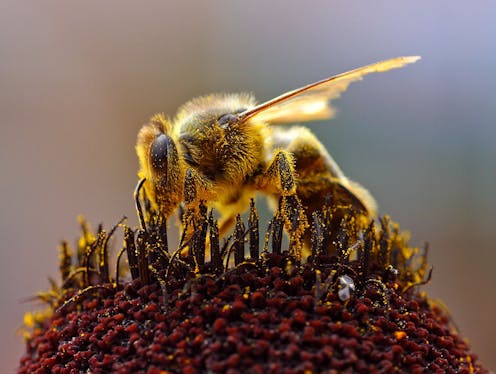
At the beginning of my research career around 15 years ago, any suggestion that a bee, or any invertebrate, had a mind of its own or that it could experience the world in an intricate and multifaceted way would be met with ridicule. As Lars Chittka points out in the opening chapters of The Mind of a Bee, the attribution of human emotions and experiences was seen as naivety and ignorance; anthropomorphism was a dirty word.
Pet owners eagerly ascribe emotions to their animals, but the simple brain of a bee surely could not experience the rich tapestry that is our existence. They are far too simplistic and robotic, right?
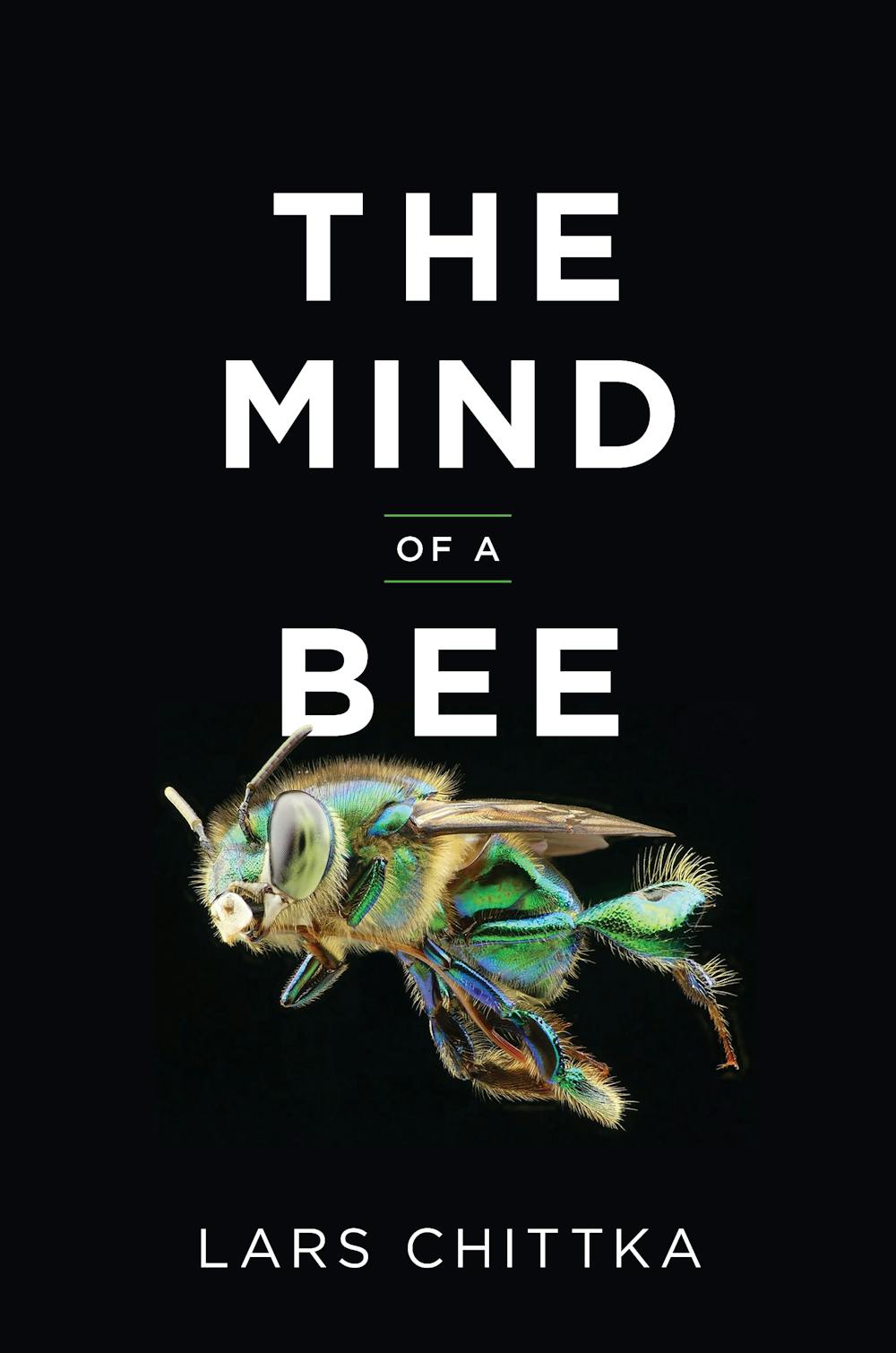
Review: The Mind of a Bee – Lars Chittka (Princeton University Press).
 Lars Chittka.
Wikimedia commons, CC BY-SA
Consciousness and emotion
The punch this book packs is in the subtle build-up to the final chapters, whereupon it becomes increasingly hard to deny the “mind” of a bee.
While it is impossible to prove consciousness in another organism, the research Chittka has collated provides a compelling argument. In The Mind of a Bee, you will read that bees feel emotions and pain, display metacognition (that is, they know what they know), and show individual differences in their ability to learn, with fast and slow learners. Bees are aware of their bodies and the outcomes of their actions, and they display intentionality through tool use – previously only recognised in humans, primates, and the corvidae family of birds.
Regardless of whether you believe a bee has a mind or not, globally there has been a change in research practices as invertebrates are seen to experience the world more fully.
Ethics approval is required for work on some invertebrates, including crustaceans and cephalopods, and statements of ethical treatment of other invertebrates are required for submission of manuscripts to some journals. To suggest an invertebrate, such as a bee, may have these fuller experiences of life is no longer attracting ridicule, but instead is creating an uncomfortable space for insect researchers, who may not wish to confront the reality of their experiments.
We have underestimated the intelligence of bees and other “lower” species for far too long; it is time to pay attention. Chittka shows us that bees have the key ingredients of a mind: they have a representation of space, they can learn by observation, and they display simple tool use. Bees have demonstrated a flexible memory, with ideas of what they want to achieve, an ability to explore suitable solutions to get it, and an awareness of the possible outcomes of their own actions.
Experiments have further shown that bees appear to attach emotional states to rewards and punishments. While their biology and experience of the world is very different to ours, it is reasonable to believe that they do indeed possess a mind capable of experiencing the rich tapestry of life we have so long thought only available to us.
Written with moments of levity and soaked in curiosity, The Mind of a Bee is a delight. While some may not be ready to ascribe sentience to something as “simple” as a bee, this book will prompt you to question why not. As Chittka so eloquently put it in a recent talk: “We are thinking, suffering, enjoying beings in a world of other thinking, suffering and enjoying beings, with different minds and perceptions.”
I for one am looking at the world a little differently with that in mind.
Authors: Eliza Middleton, Laboratory Manager, School of Life and Environmental Sciences, University of Sydney
Lars Chittka.
Wikimedia commons, CC BY-SA
Consciousness and emotion
The punch this book packs is in the subtle build-up to the final chapters, whereupon it becomes increasingly hard to deny the “mind” of a bee.
While it is impossible to prove consciousness in another organism, the research Chittka has collated provides a compelling argument. In The Mind of a Bee, you will read that bees feel emotions and pain, display metacognition (that is, they know what they know), and show individual differences in their ability to learn, with fast and slow learners. Bees are aware of their bodies and the outcomes of their actions, and they display intentionality through tool use – previously only recognised in humans, primates, and the corvidae family of birds.
Regardless of whether you believe a bee has a mind or not, globally there has been a change in research practices as invertebrates are seen to experience the world more fully.
Ethics approval is required for work on some invertebrates, including crustaceans and cephalopods, and statements of ethical treatment of other invertebrates are required for submission of manuscripts to some journals. To suggest an invertebrate, such as a bee, may have these fuller experiences of life is no longer attracting ridicule, but instead is creating an uncomfortable space for insect researchers, who may not wish to confront the reality of their experiments.
We have underestimated the intelligence of bees and other “lower” species for far too long; it is time to pay attention. Chittka shows us that bees have the key ingredients of a mind: they have a representation of space, they can learn by observation, and they display simple tool use. Bees have demonstrated a flexible memory, with ideas of what they want to achieve, an ability to explore suitable solutions to get it, and an awareness of the possible outcomes of their own actions.
Experiments have further shown that bees appear to attach emotional states to rewards and punishments. While their biology and experience of the world is very different to ours, it is reasonable to believe that they do indeed possess a mind capable of experiencing the rich tapestry of life we have so long thought only available to us.
Written with moments of levity and soaked in curiosity, The Mind of a Bee is a delight. While some may not be ready to ascribe sentience to something as “simple” as a bee, this book will prompt you to question why not. As Chittka so eloquently put it in a recent talk: “We are thinking, suffering, enjoying beings in a world of other thinking, suffering and enjoying beings, with different minds and perceptions.”
I for one am looking at the world a little differently with that in mind.
Authors: Eliza Middleton, Laboratory Manager, School of Life and Environmental Sciences, University of Sydney 
















