

We studied 309,544 patent applications – and found inventing is still a man’s world
- Written by: Vicki Huang, Senior Lecturer, Intellectual Property, Deakin University
Are women as successful as men in securing a patent for their invention?
We set out to investigate gender bias in patent outcomes at IP Australia – the government agency responsible for administering intellectual property rights.
To do so, we analysed 309,544 patent applications from across a 15-year period (2001-2015), and categorised close to one million inventors’ names based on whether they sounded male or female.
We found that having a male-sounding first name increases the odds of securing a patent. This gender bias can have serious implications for women’s health, female career progression and equity policies in STEM. But what’s causing it?
Women are increasingly applying for patents
Patents provide a 20-year monopoly over a new invention and are a well-known measure of the output from STEM-based industries.
Global studies show the number of patent applications from female inventors (while still lower than the number from men) has grown significantly over the past 20 years. What has been less clear is whether these applications convert to granted patents.
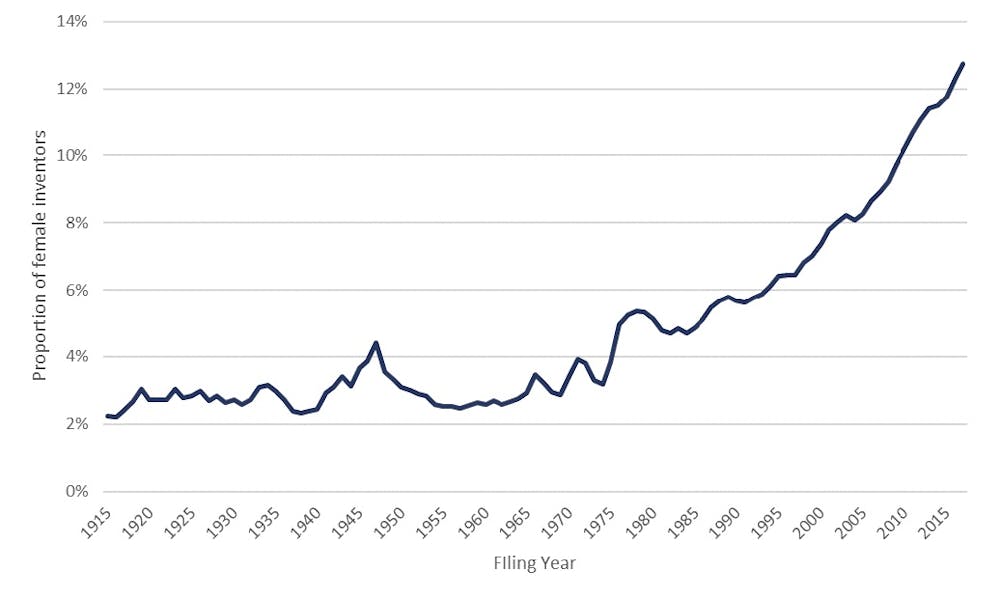
Studies of data from the United States Patent and Trademark Office unfortunately reveal inventors with a female-sounding first name are less successful at having their patent granted than those with a male-sounding first name.
This is irrespective of the technical field and the gender of the patent examiner, and despite evidence that female inventor patents are just as good as male inventor patents.
We wanted to investigate whether a similar gender bias exists for patents filed at IP Australia, where most applications come from non-residents. Inventors who plan to operate internationally will often file in multiple jurisdictions, including filing in Australia.
So unlike studies of the US Patent and Trademark Office, where the majority of patents come from US residents, a study of patents at IP Australia reflects more worldwide applications.
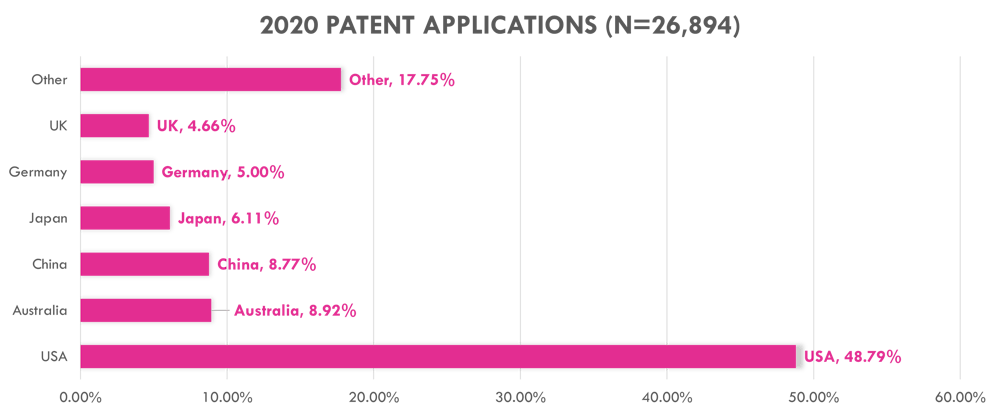 A profile of 2020 patent applications to IP Australia.
IP Australia
A profile of 2020 patent applications to IP Australia.
IP Australia
A gender gap persists
Our analysis of 309,544 patent applications submitted over 15 years found 90% of applications had at least one male inventor. Just 24% had at least one female inventor (typically as part of a mixed-gender team).
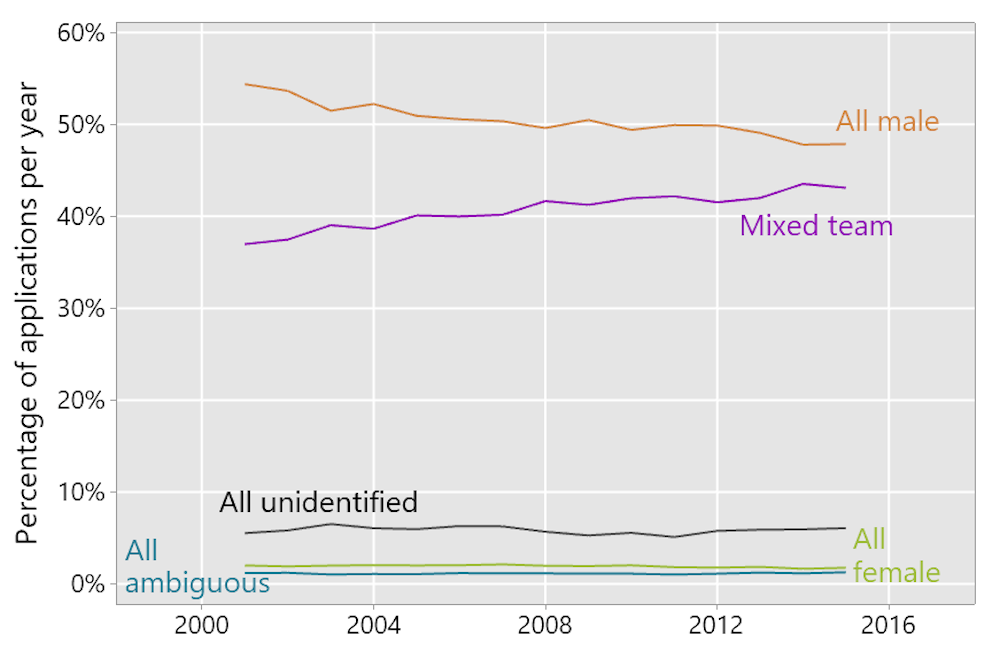 The percentage of applications per year, per team composition (male, female, ambiguous, unidentified).
We then examined whether these applications converted into a successful patent grant. We found inventors with a female-sounding first name had slightly lower odds of having their patent granted.
Also, as the number of males on a team increased, so did the odds of the team being granted a patent – whereas adding a female had a negligible impact. In other words, bigger teams of inventors had more patent success, unless the additional inventors had female-sounding names.
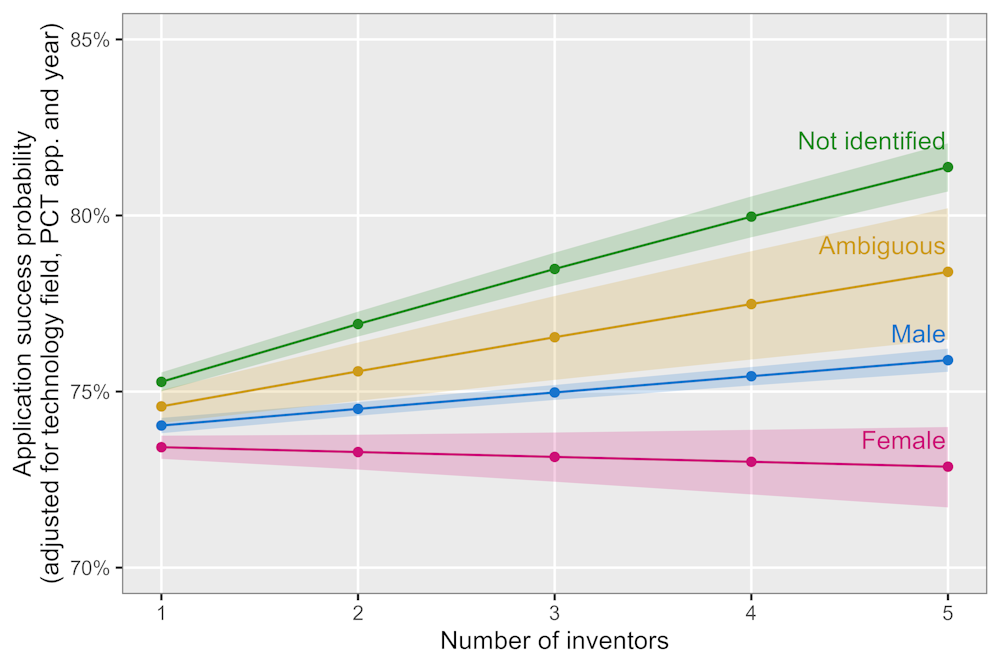 This graph shows the pattern that emerges when you vary the composition of a single-gender team. You can see more men increases chances of success, whereas more women does not.
Author provided
This graph shows the pattern that emerges when you vary the composition of a single-gender team. You can see more men increases chances of success, whereas more women does not.
Author provided
But why is it like this?
One question for us was whether this gender disparity could be explained by the types of fields patents were being granted in, and whether women simply work in less “patentable” fields such as life sciences.
We found more than 60% of female inventors were clustered in just four of 35 technical fields (the 35 science categories recognised in patents). These were all in the life sciences: chemistry, biotechnology, pharmaceuticals and medical technology.
We also found patents in three of these fields had a lower-than-average success rate. In other words, it’s generally harder to get a patent in these fields, regardless of whether you’re a woman or man.
Nevertheless, even after we statistically controlled for the effect of participating in a less successful field, we still found a gender disparity – male-named inventors did better than female-named inventors.
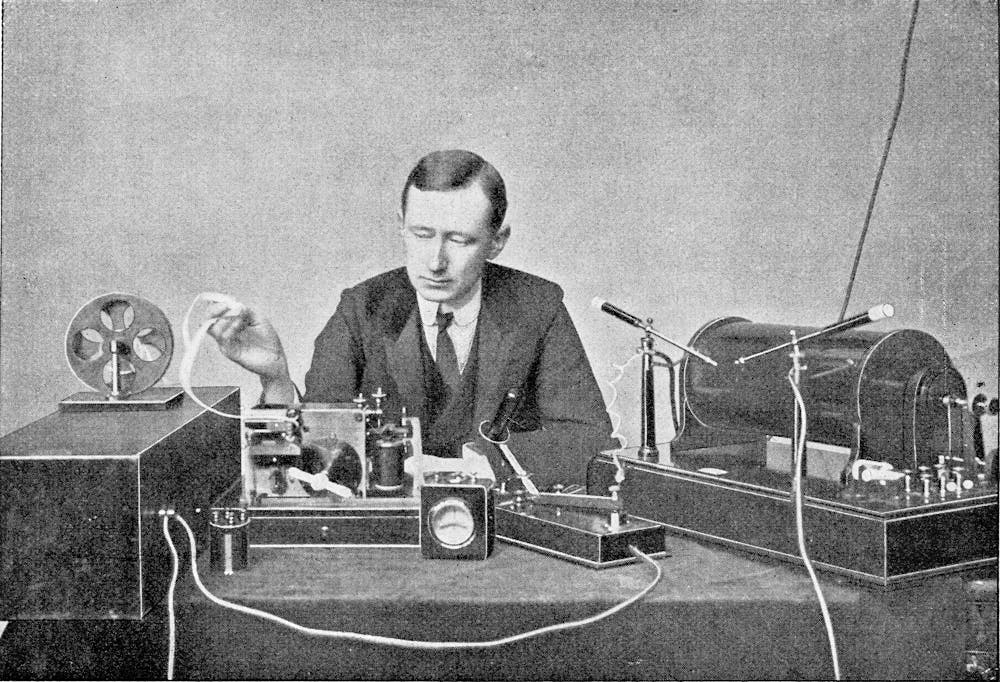 Women are responsible for some of the greatest inventions, yet inventorship remains a male-dominated field. We’ll have to fight historical biases against women if this is to change.
Shutterstock
Women are responsible for some of the greatest inventions, yet inventorship remains a male-dominated field. We’ll have to fight historical biases against women if this is to change.
Shutterstock
Women in STEM must be supported
The implications of women falling out of the patent system are significant for a number of reasons. For one, patents with female inventors are more likely to focus on female diseases.
Also, getting a patent can be important for career progression and for securing investment capital. And research has shown a lack of female inventors today impacts the rate at which girls aspire to be the inventors of tomorrow.
The next step in our research is to find out why there is a gender gap in successful patent applications.
We don’t believe it’s a simple case of gender bias at the patent office. We suspect the issues are complex, and related to the systemic and institutional biases that hold back women’s progress in STEM more generally.
Country and cultural differences may also be at play, particularly since more than 90% of patent applications received by IP Australia come from non-Australian inventors (and overwhelmingly from the United States).
We want to look deeper into our results to figure out what’s driving the gender disparity, and what we can do to support female inventors.
The first step in fixing a problem is acknowledging it exists. We hope our research starts a conversation that prompts people to reflect on their own biases.
Authors: Vicki Huang, Senior Lecturer, Intellectual Property, Deakin University


















