Modern Australian
The Times

Cars have taken over our neighbourhoods. Kid-friendly superblocks are a way for residents to reclaim their streets

  • Written by Matthew Mclaughlin, Research Fellow, Telethon Kids Institute, The University of Western Australia
Cars have taken over our neighbourhoods. Kid-friendly superblocks are a way for residents to reclaim their streets

You might remember your time as a child playing outdoors with friends and walking to school. These activities had tremendous benefits for our health and development.

Today, parents report barriers to letting their kids play, walk and ride in their neighbourhood. The safety of local streets is a major concern.

Read more: Japan's Old Enough and Australia's Bluey remind us our kids are no longer ‘free range’ – but we can remake our neighbourhoods

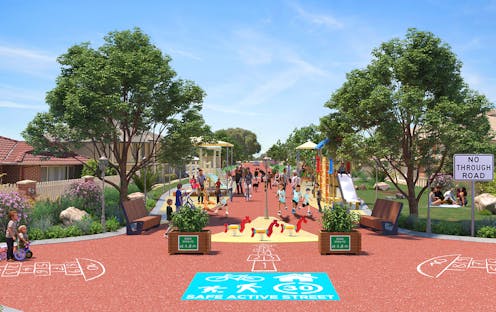
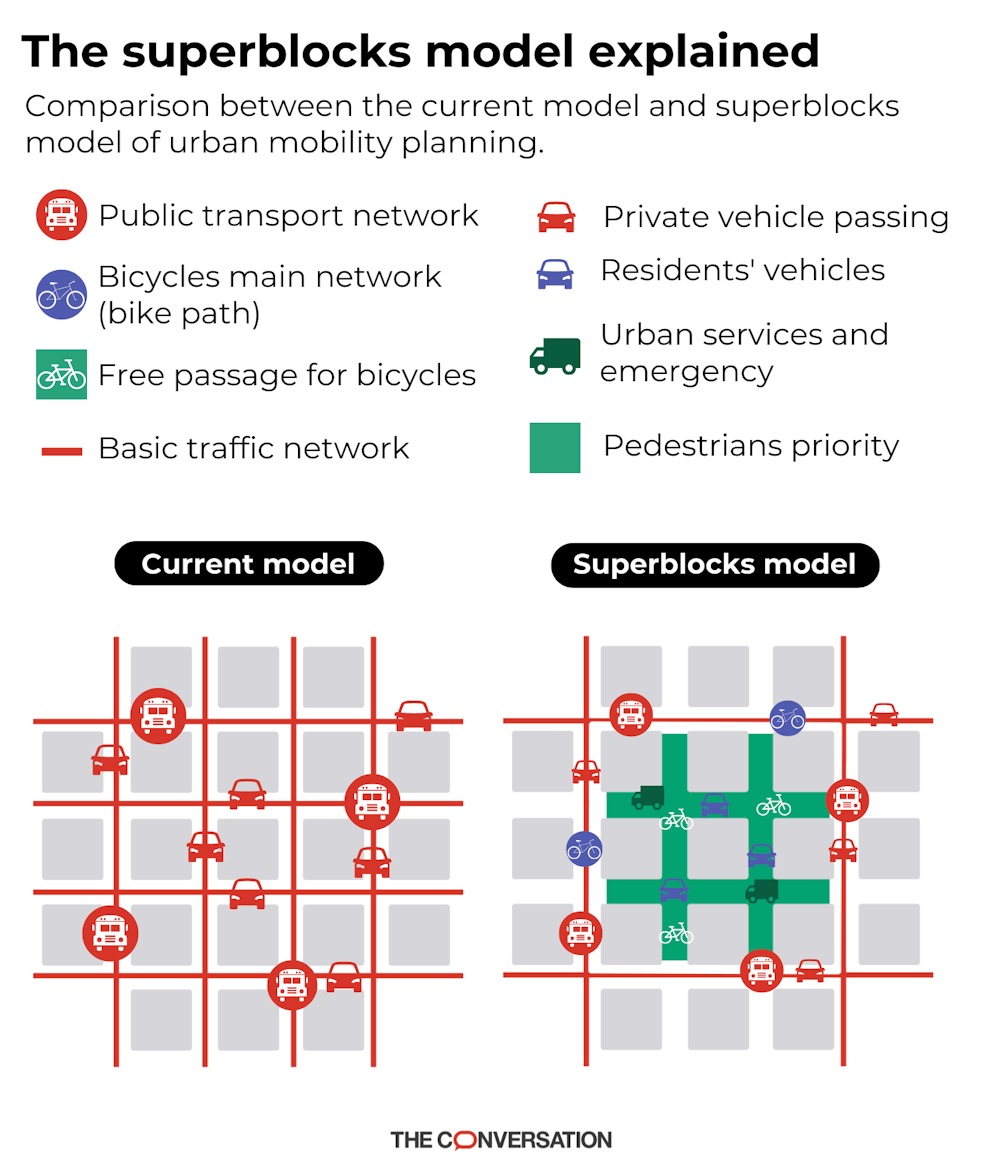
One way to boost communities is to create “superblocks for kids”. Pioneered in cities like Barcelona, a superblock covers several neighbourhood blocks reserved for shared use by cyclists, walkers and residents who simply want to use the street space. Superblocks allow low-speed access for residents’ cars, but exclude through-traffic.

Superblocks have evolved from concepts dating back to the 1970s. Retrofitted and planned examples of more liveable and safer streets can be found from Melbourne to Perth, where there are interesting alternative designs in Willetton and Crestwood.

Transforming neighbourhoods in this way enables us to once again enjoy the public space right on our doorsteps – the street.

Author provided Read more: Superblocks are transforming Barcelona. They might work in Australian cities too Superblocks for kids are a low-cost fix Superblocks are a low-cost solution to the problem of the residential “stroad” – a street-road hybrid that drivers use to avoid congested main roads, many at unsafe speeds. These stroads are a troubled mix of two different functions: roads are through routes, and streets connect neighbourhoods socially and physically. Streets connect houses to local parks, shops and through routes, but are also public places themselves. The dual role of stroads comes at the expense of residents and their children. Superblocks for kids can be retrofitted to existing suburbs to create safer, quieter and more play-friendly streets. They are typically about a square kilometre in area, bounded by main roads and features such as rivers. Ideally, superblocks are clustered together to provide safe access to local amenities and public transport hubs. Everyone can still drive to their home in a superblock, but they might have to take a slightly longer, more circular route. This can reduce traffic by nudging residents to walk and cycle short journeys within their superblock. Various low-cost “filters” exclude through traffic. These filters include: The resulting superblocks are places where kids play on the streets, which are quiet and easy to cross. There’s shade and shelter, places to stop and rest, things to see and do, and the air is clean. People feel safe and relaxed. Neighbourhoods like this promote public health and community camaraderie. Four examples of streets that could be transformed in this way are shown below: Lyall Street, Redcliffe, Perth A pocket park breaks up a rat run to the airport. The Avenue, Mount St Thomas, Wollongong Plantings and bollards eliminate a known rat run. Lithgow Street, Abbotsford, Melbourne Wider kerbs make school drop-offs and pick-ups safer. Meymot Street, Banyo, Brisbane A pocket park and residents-only car access create a safer and quieter street. Rat-running is a big problem Almost twice as many cars are on Australian roads today as 20 years ago. Coupled with the rise of satellite navigation technology, this has led to more drivers using residential streets as rat runs to avoid congested main roads. Decades of prioritising cars in Australian communities have created a serious safety issue. Overall, serious road injuries are on the rise. Despite small declines in road deaths, deaths on local streets haven’t fallen. People feel less safe on their local streets, but we know what we can do to improve safety. Preventing rat-running leads to cleaner air, less noise, safer streets and more walking, riding, wheelchairs and mobility scooters. These results all promote stronger communities. Read more: Despite lockdowns, 1,142 Australians, including 66 kids, died on our roads in the past year. Here's what we need to do Everyone benefits from kid-friendly neighbourhoods A remarkable feature of building neighbourhoods for kids is how quickly residents reoccupy their streets. People emerge from their houses to talk, their voices no longer drowned by vehicle noise. Thoroughfares become communities. Children come out to play. As physical activity researchers, we know that getting children to move more is an urgent issue. Australian kids score a D- for overall physical activity levels on international ratings. Australian adults also have low levels of physical activity. Neighbourhoods for kids help everyone enjoy the benefits of becoming more active. For kids, the street can connect them to nature and help them develop movement and independent travel skills for life. Read more: Children need to play outdoors, but we're not letting them Increasing neighbourhood liveability also boosts house prices and reduces noise pollution. Leaving the car at home for short local trips Superblocks make it easier for families to choose the “right tool for the job” for small local trips — a bicycle over a car. This saves money and improves health. All these small trips add up. For example, two-thirds (2.8 million) of daily car trips in Perth are under 5km — a 20-minute bike ride or less. In Melbourne, 41% of trips are under 3km, but 58% of these are by car. That’s 3.6 million car trips a day. Where should Australia start? Our research highlights the need to listen to communities, and kids in particular, when designing neighbourhoods. In the vast majority of cases, any initial opposition to creating kid-friendly neighbourhoods soon dissipates. Residents see the benefits of safer and more pleasant streets for themselves and their families. Two-thirds of Australians support improving their neighbourhood to help them be more active. We should start by creating neighbourhoods for the communities that need it most — those with the poorest access to green space and public transport, most through traffic and crashes, and highest levels of childhood obesity. Get your community talking again! You can start by hosting a temporary play street! Demonstrating its success will help when asking your council for permanent changes. The authors encourage the reuse of the re-imagined streets. They are freely available to download in multiple open-access formats. Authors: Matthew Mclaughlin, Research Fellow, Telethon Kids Institute, The University of Western Australia

Read more https://theconversation.com/cars-have-taken-over-our-neighbourhoods-kid-friendly-superblocks-are-a-way-for-residents-to-reclaim-their-streets-187276

Understanding the Different Types of Car Services: Minor vs Major

When it comes to car maintenance, one of the most important things every vehicle owner should understand is the difference between a minor and a maj...

How Superannuation and TPD Insurance Work Together

Superannuation is an essential part of financial planning in Australia. It is designed to provide individuals with income during retirement, helping...

Tiny Towns funding granted for Mt Hotham and Mt Buller upgrades

Alpine Resorts Victoria (ARV) has welcomed funding support from the Victorian Government’s  Tiny Towns Fund, with both Mt Hotham and Mt Buller se...

Locksmith Services: Why Professional Security Solutions Matter More Than Ever

Security is a critical concern for homeowners, businesses, and vehicle owners alike. Whether it involves protecting a property, replacing damaged lo...

Why Tooth Fillings Are Important For Protecting Damaged Teeth

Cavities and minor tooth damage are common dental problems that can worsen if left untreated. Professional tooth fillings help restore damaged teeth, ...

The Connection Between Visibility and Driver Confidence

Operating a vehicle safely requires an immediate, uncompromised stream of visual information from the surrounding road environment. A driver's decis...

Important Things To Know Before Starting An SMSF Setup

Planning for retirement requires careful financial decisions, and many Australians are now looking for more direct control over how their superannua...

Why Retail Cleaning Plays a Key Role in Customer Experience and Business Success

Professional retail cleaning services are an essential part of maintaining a welcoming, safe, and professional environment for customers and staff...

Simple Ways to Make a Commercial Property More Appealing to Buyers

Selling or leasing a commercial property isn’t just about listing the square metres, taking a few photos and waiting for the right person to appea...

What Café Owners Should Know Before Upgrading Their Display Setup

A café display fridge does a lot more than keep cakes cold and sandwiches fresh. It quietly shapes the way customers browse, the way staff move beh...

Creating a Backyard That Feels Comfortable All Year Round

A great backyard doesn’t need to be huge, expensive or perfectly styled. Most of the time, the spaces people actually use are the ones that feel e...

How Homeowners Can Make Smarter Energy Decisions Before Upgrading

Energy upgrades used to feel like something you only looked into after a power bill gave you a nasty surprise. These days, though, more homeowners a...

Why Retail CX Breaks During Peak Sales Events and How to Prevent It

Retail customer experience has become one of the most important drivers of revenue growth, especially during high-intensity sales periods. However, ev...

15 South Indian Dishes Everyone Should Try

If your only experience of "Indian food" is butter chicken and garlic naan, South Indian cuisine is going to feel like discovering an entirely new c...

What Every Homeowner Should Know About Roof and Drainage Maintenance

A home's roof and drainage system work together every day to protect the property from water damage. While many homeowners focus on visible areas such...

From Plans to Priced Quote: The Estimating Workflow Most Builders Skip

For a small one-off job, an experienced builder can size up the materials in their head. The problem is that most jobs are not small one-off jobs, and...

Organisational Experts Share Their Tips for Achieving a Clutter-Free Kitchen

They say the kitchen is the heart of a house which means a clutter-free kitchen not only makes your home in general look nicer, it also makes cookin...

10 Creative Ways AI Image Extenders Are Transforming Digital Content Creation in 2026

Introduction Artificial intelligence continues to reshape the digital landscape, and one of the most exciting innovations in 2026 is the rise of AI i...