

Google AI


Modern Australian

DNA cracks a century-old mystery about New Zealand's only extinct freshwater fish

  • Written by: Lachie Scarsbrook, DPhil Student, University of Oxford
DNA cracks a century-old mystery about New Zealand's only extinct freshwater fish

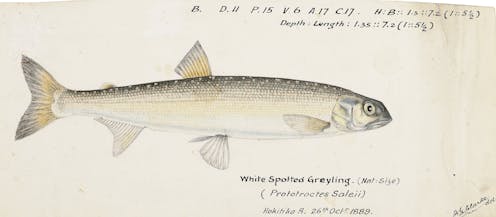
In 1923, Te Rangi Hīroa (Sir Peter Buck) documented the last confirmed capture of a special fish – the upokororo or New Zealand grayling.

More than two decades later, the upokororo received full governmental protection, but it was too late. No further sightings were ever confirmed. In 1986, the upokororo was officially listed as extinct.

The upokororo disappeared so quickly that it’s mostly unknown to Western science. But almost a century after the last living upokororo was seen, we are now using ancient DNA to finally provide some answers.

Our research reveals the upokororo’s ancient origins, going back 15 to 23 million years, and a link to its Australian cousins.

From fertiliser to phantom

Historical accounts show the upokororo was once very common in rivers across the country. In the 1800s, cartloads were caught and traded for use as fertiliser and food.

But then it disappeared, likely as a result of a combination of factors – pollution, overfishing, disease and predation by introduced trout.

A historic image showing men catching fish.
A funnel-shaped net is set to capture upokororo in the Waiapu River. Alexander Turnball Library CC BY-NC 4.0, Author provided

Despite its abundance in the past, only a small handful of preserved upokororo still exist in museums today. This is one reason we know so little about this curious fish.

A second reason is that many of these specimens have been treated with formaldehyde, a chemical that preserves the form of the fish but plays havoc with their DNA.

Fishy frontiers

The DNA in specimens “fixed” with chemicals like formaldehyde gets broken up into small pieces and stuck together. Over time, the DNA becomes more and more damaged.

This is a big challenge for researchers who want to study species like the upokororo and a major reason why extinct fish are understudied compared to other extinct species.

A formalin-fixed specimen fo a New Zealand grayling.
An example of a formalin-fixed New Zealand grayling, caught in the Clutha River (1874). Otago Museum CC BY 4.0, Author provided

Fortunately, new methods have recently been developed that help to isolate and analyse small damaged fragments of DNA. This means genetic analysis of many “wet preserved” specimens like those of the upokororo is now possible for the first time.

Such genetic information can provide new insights into the origin and identity of extinct species.

Read more: How did ancient moa survive the ice age – and what can they teach us about modern climate change?

Whakapapa of the upokororo

Based on the general appearance of the upokororo, scientists have usually considered it to be a close relative of the Australian grayling. The Australian grayling is part of a family of fish that includes Stokell’s smelt and the New Zealand smelt, which are both still found in rivers across Aotearoa.

New DNA data confirmed the Australian grayling is the closest living relative of the upokororo, but only a distant cousin at best. Genetic comparisons showed the common ancestor of the two species lived more than 15 million years ago.

An ancient origin for the upokororo agrees well with the discovery of fossil grayling ear bones in lake sediments from Saint Bathans in Central Otago.

Palaeontologists sieving for fossils in the Manuherikia River, near Saint Bathans.
Palaeontologists sieving for fossils in the Manuherikia River, near Saint Bathans. Fossils from this location are between 16 and 19 million years old. Nicrawlence/Wikipedia, CC BY-ND

Genetic and fossil data together suggest the ancestors of the upokororo arrived in Aotearoa following the birth of the Alpine Fault. Before that time, present-day Aotearoa was mostly beneath the ocean, during the height of the Oligocene “drowning” 27 to 22 million years ago.

While baby upokororo could live in salt water, adults needed brackish or fresh water. The emergence of Aotearoa from beneath the waves would have created new habitats for the upokororo.

Read more: 'I will miss them if they are gone': stingrays are underrated sharks we don't know enough about

Back from the brink?

Some scientists have previously put forward a controversial idea. Could the Australian grayling be released into rivers in New Zealand to fill the ecological gap left by the extinction of the upokororo?

That probably wouldn’t be a good plan. Millions of years of independent evolution mean the niches filled by the Australian grayling and upokororo were likely very different.

If we can’t replace the upokororo, is it possible that they’re still out there somewhere in a remote waterway, waiting to be re-discovered? It wouldn’t be unprecedented. Takahē were thought to be extinct before a small population was re-discovered in the Murchison Mountains in 1948.

An image of a river, overlain with fish.
Could the New Zealand grayling be hiding out in remote waterways, such as the West Coast’s Buller River? Peter James Quinn, Author provided

Genetic data provide a new tool in the search for survivors. Environmental DNA in water samples from remote catchments can now be compared routinely to known DNA from the upokororo. Perhaps one day this will lead to a positive match that indicates the location of survivors.

Fish populations are in sharp decline globally. Lessons learned from past extinctions, like that of the upokororo, can help us preserve fish species for future generations. Hopefully we can heed the lessons from the past.

Authors: Lachie Scarsbrook, DPhil Student, University of Oxford

Read more https://theconversation.com/from-fertiliser-to-phantom-dna-cracks-a-century-old-mystery-about-new-zealands-only-extinct-freshwater-fish-187928

Breach of Contract in Business: What Are Your Options?

Contracts are essential to business relationships. They establish expectations, allocate responsibilities and provide a framework for delivering goods...

How Pest Control Companies Can Rank for the Problems Customers Search First

Introduction SEO for Pest Control needs to start with the customer’s problem. Most people do not search for pest services in a neat or technical wa...

What Are the Benefits of Renovating an Older Home in Sydney?

Sydney has plenty of character homes, from Federation cottages to mid-century brick homes. Renovating rather than rebuilding can preserve what makes t...

Pool and Deck Design: How to Plan the Perfect Outdoor Living Space for Your Sydney Home

For many Australians, the backyard is where life happens. Summer barbecues, weekend swims and long evenings outdoors are all part of the lifestyle, ...

Is Solar Pool Heating Worth It? What Sydney Homeowners Should Know

There's nothing quite like a backyard pool on a hot Sydney day. But once autumn rolls in, many pools sit unused for months because the water is simp...

Planning a Luxury House Move: A Week-by-Week Timeline for Prestige Sydney Homes

Selling or buying a prestige home is a major milestone. Whether it's a waterfront residence in Birchgrove, a grand Federation home in Haberfield or ...

Downsizing or Upgrading Your Caravan? Here's How to Sell It Without the Hassle

Selling a caravan can feel like a major task, especially when you are unsure about its value, paperwork, or how to find a buyer. Whether you are dow...

The Best Overseas Adventure Holidays for Australians Who Love the Outdoors

Australia offers no shortage of incredible outdoor experiences, but sometimes the best way to satisfy your sense of adventure is to head overseas. A...

Cape Town Wine Shuttle: Winelands Tasting & Tours

Embark on an unforgettable journey through the picturesque Cape Winelands, where world-class wines and breathtaking scenery await. Our Cape Town Win...

Metal Fabrication: Choosing Metal Fabrication Melbourne Services for Custom Projects

What Modern Metal Fabrication Involves From individual components to complete structures, metal fabrication brings together processes such as desig...

Why Giant Rats Tail Grass Keeps Coming Back After Spraying

Giant Rats Tail Grass (GRT) is one of the most frustrating pasture weeds for farmers and lifestyle property owners. You spray an infested area, see th...

When Custom Cardboard Boxes Make Sense for Your Business

Custom cardboard boxes can be useful when a standard carton does not fit a product, packing method or presentation requirement particularly well. A ...

Full-Height vs. Pop-Top Caravan: Which Is Better for Family Travel across WA?

A pop-top caravan is an excellent choice for travellers who want the comfort of a caravan without committing to a larger, bulkier setup. With a lowe...

Bottle Label Printing: Key Factors for a Professional Finish

Why the Printing Method Matters When businesses need packaging or printed containers developed for a particular application, the right supplier can m...

Virtual Livestock Fencing and GPS Tracking: Improving Visibility Across Cattle Properties

What Virtual Livestock Fencing Means for Modern Cattle Management Managing cattle across extensive properties requires more than knowing where anim...

Sydney Pawnbrokers Explained: How Hocking Your Car Actually Works

Sometimes you need cash, and you need it soon. If you own a car, you may already have a way to get it. That's what people mean when they say they've...

Moving Interstate from the Gold Coast to Brisbane (or Back)? What Removalists Wish You Knew First

Have you talked to anyone who’s done the move? They say the same thing: the drive up the M1 is the easy part. It's everything around it that catches...

Why the Spring School Holidays Are a Great Time to Visit Coffs Harbour

The spring school holidays are a good time to spend a few days on the Coffs Coast. The weather is starting to warm up, there is plenty to do outdoor...

















