

In Iris, Fiona Kelly McGregor recreates the criminal underworld of Depression-era Sydney
- Written by Susan Sheridan, Emeritus Professor, Flinders University
It’s spring 1932 and Sydney is in the grip of the Great Depression. In the narrow terrace-lined streets and back lanes of inner Sydney, there are illegal two-up games and off-course betting. Sly grog shops are open after the official pub closing time of 6pm, offering beer, spirits and drugs. Police raids are usually pre-arranged, on these venues and others, such as Black Ada’s Academy School of Dancing, where homosexual men can meet under the guise of taking ballroom dancing lessons with the women who work there.
Most of the prostitutes in the area are “run” by one of the two notorious vice queens of the period, Tilly Devine in Darlinghurst and Kate Leigh in Surry Hills. The razor gang wars between the two are finally over and there is a period of relative quiet, punctuated by the odd shooting.
Review: Iris – Fiona Kelly McGregor (Picador).
Enter Iris Webber, a country girl from Glen Innes, more recently from Hay Women’s Prison, where she has been incarcerated for wounding her husband with a shotgun as revenge for leaving her and for owing her mother money. Arriving in “the big smoke” at Central Station, which seems to Iris “like a cathedral, light streaming in through its high vaulted roof”, she is intrigued by what she observes:
a boy selling shoelaces spread out on cardboard, two women in pencil skirts. An old man staggered past with his pants falling down, bronza on full display. Nobody seemed to care in the slightest […] All along the gangplank men held signs asking for work. A woman sat on a butterbox with a bawling baby on her lap and a toddler next to her, muttering Spare change?

 Kate Leigh, Long Bay Women’s Reformatory, NSW, 1915.
Public domain/Wikimedia commons
McGregor’s novel is a portrait of a woman who is poor and clever, angry and passionate, courageous and loyal. Above all, Iris is independent, in a milieu where even the rich and powerful women like Kate Leigh had male “protectors”.
After her disastrous marriage and an affair with a violent man when she first comes to Sydney, Iris avoids any such commitment – until her sexual attraction to her young friend Maisie comes to dominate her feelings and threatens her status with the men and women she lives among, not to mention giving the police another reason to abuse her.
Iris has no way to understand her homoerotic feelings except as “perversion”, nor to defend her choice except by reference to the violence and uselessness of men. She meets one or two other queer women, but does not feel a close affinity with them – not like the loyalty she owes her impoverished friends, both male and female. In other classes of Sydney society, or in other places, such as Paris, London or New York in the 1930s, a lesbian might have lived a relatively open life, but denial seems to be the only option for Iris.
All of this is depicted in a way that is entirely credible. The novel captures Iris’s feelings of shame and the intensity of her desire, her moments of blinding rage, and her grounding in the everyday realities of getting a meal, keeping a roof over her head, and looking out for her mates.
Read more:
Plenty of resilience, but little resistance in a new account of Australia's Great Depression
A detailed knowledge of time and place
McGregor’s novel is based on actual people. Some are famous, like Tilly Devine and Kate Leigh, and their gangster mates Guido Caletti, Frank Green, and Phil “the Jew” Jeffs. Others are obscure faces from the police files of the period, like Iris Webber herself. McGregor has created her central character out of scant police records, combined with a detailed knowledge of place and time.
Her immersion in 1930s underworld Sydney is nowhere more evident than in the novel’s language, which is replete with period argot. Some of it was familiar to me: “ridge” (or “ridgy didge”, meaning “truly”), “fenced”, “pinched”, “rozzers”, “swanky”. The meaning of other terms, such as “hoon” and “bludger”, have changed since those times. Examples of rhyming slang, like “tea leafing” for “thiefing”, were fun to figure out. Other words – like “angie” (cocaine) and “royalies” (gay men) – I had to guess from the context, or get help from slang dictionaries: “swy” for two-up, “cockatoo” for keeping a look-out, “bidgee” for a drink based on methylated spirits.
Kate Leigh, Long Bay Women’s Reformatory, NSW, 1915.
Public domain/Wikimedia commons
McGregor’s novel is a portrait of a woman who is poor and clever, angry and passionate, courageous and loyal. Above all, Iris is independent, in a milieu where even the rich and powerful women like Kate Leigh had male “protectors”.
After her disastrous marriage and an affair with a violent man when she first comes to Sydney, Iris avoids any such commitment – until her sexual attraction to her young friend Maisie comes to dominate her feelings and threatens her status with the men and women she lives among, not to mention giving the police another reason to abuse her.
Iris has no way to understand her homoerotic feelings except as “perversion”, nor to defend her choice except by reference to the violence and uselessness of men. She meets one or two other queer women, but does not feel a close affinity with them – not like the loyalty she owes her impoverished friends, both male and female. In other classes of Sydney society, or in other places, such as Paris, London or New York in the 1930s, a lesbian might have lived a relatively open life, but denial seems to be the only option for Iris.
All of this is depicted in a way that is entirely credible. The novel captures Iris’s feelings of shame and the intensity of her desire, her moments of blinding rage, and her grounding in the everyday realities of getting a meal, keeping a roof over her head, and looking out for her mates.
Read more:
Plenty of resilience, but little resistance in a new account of Australia's Great Depression
A detailed knowledge of time and place
McGregor’s novel is based on actual people. Some are famous, like Tilly Devine and Kate Leigh, and their gangster mates Guido Caletti, Frank Green, and Phil “the Jew” Jeffs. Others are obscure faces from the police files of the period, like Iris Webber herself. McGregor has created her central character out of scant police records, combined with a detailed knowledge of place and time.
Her immersion in 1930s underworld Sydney is nowhere more evident than in the novel’s language, which is replete with period argot. Some of it was familiar to me: “ridge” (or “ridgy didge”, meaning “truly”), “fenced”, “pinched”, “rozzers”, “swanky”. The meaning of other terms, such as “hoon” and “bludger”, have changed since those times. Examples of rhyming slang, like “tea leafing” for “thiefing”, were fun to figure out. Other words – like “angie” (cocaine) and “royalies” (gay men) – I had to guess from the context, or get help from slang dictionaries: “swy” for two-up, “cockatoo” for keeping a look-out, “bidgee” for a drink based on methylated spirits.
 Fiona Kelly McGregor.
Photo: Jamie James / Picador Publishing
The Author’s Note states that “almost all names, dates, places and events in the novel are based on the public record”. Indeed, there are references to contemporaneous political events and figures, such as Jack Lang, and to the easing of Depression conditions as the 1930s go on.
The range of crimes and misdemeanours depicted in the novel is also telling. At that time, women could legally operate brothels, but men could not (hence the wealth of Kate and Tilly). A busker could be arrested for “gathering alms”, as Iris is many times for playing her accordion and singing in the street. The consorting law was such that police could arrest just about anyone they pleased on that charge. Lesbianism was not illegal, unlike male homosexual behaviour – nevertheless, it was policed by patriarchal society’s citizens, whether or not they were law abiding in other respects.
Read more:
Set in a 19th century Australian leper colony, Eleanor Limprecht's The Coast depicts past cruelties, but has powerful things to say about the present
Impoverished Sydney
Iris aligns itself with a strong tradition of novels about impoverished Sydney, one that includes Caddie, A Sydney Barmaid by Catherine Edwards and Dymphna Cusack, Ruth Park’s Harp in the South trilogy, Kylie Tennant’s Foveaux and Tell Morning This, Christina Stead’s Seven Poor Men of Sydney, and, even earlier, Louis Stone’s Jonah. The latter provides McGregor with her epigraph: “Yer talk about me bein’ cruel and callous. It’s the game that’s cruel, not me.”
Some of the section titles recall this tradition: The Big Smoke is the title of a novel by D'Arcy Niland and Down in the City alludes to a novel by Elizabeth Harrower. These are stories of poor people’s Sydney, of underworld Sydney, not the city of the beautiful harbour, Kenneth Slessor’s Five Bells, or Eleanor Dark’s Waterway.
When Iris appears at the Coroner’s Court at The Rocks, she remarks that this is the first time in her five years in the “big smoke” that she has even seen Circular Quay and the newly-opened Harbour Bridge. Her experience of the city has been confined to the streets around Central Station, Surry Hills and Darlinghurst, and a brief sojourn staying with her aunt in respectable Glebe.
Her life is similarly circumscribed by poverty and struggle. Iris finds herself in a world where petty crime is the only viable mode of survival. Yet she is no victim. She is a woman of verve and spirit, who grasps the pleasures that life offers her, and lashes out when her freedom is threatened.
Iris is an in-depth character study, as well as a vivid and panoramic recreation of a place and time. McGregor has succeeded in fleshing out a full portrait of a woman from some bare bones of fact, and she dedicates the book to her subject:
In memory of Iris Eileen Mary Webber, nee Shingles (1906-1953).
McGregor has form as a performance artist as well as the author of other books, including the short story collection Suck My Toes (1994), the novel Indelible Ink (2010), and most recently the essay collection Buried Not Dead (2021). This impressive historical novel adds yet another string to her bow.
Fiona Kelly McGregor.
Photo: Jamie James / Picador Publishing
The Author’s Note states that “almost all names, dates, places and events in the novel are based on the public record”. Indeed, there are references to contemporaneous political events and figures, such as Jack Lang, and to the easing of Depression conditions as the 1930s go on.
The range of crimes and misdemeanours depicted in the novel is also telling. At that time, women could legally operate brothels, but men could not (hence the wealth of Kate and Tilly). A busker could be arrested for “gathering alms”, as Iris is many times for playing her accordion and singing in the street. The consorting law was such that police could arrest just about anyone they pleased on that charge. Lesbianism was not illegal, unlike male homosexual behaviour – nevertheless, it was policed by patriarchal society’s citizens, whether or not they were law abiding in other respects.
Read more:
Set in a 19th century Australian leper colony, Eleanor Limprecht's The Coast depicts past cruelties, but has powerful things to say about the present
Impoverished Sydney
Iris aligns itself with a strong tradition of novels about impoverished Sydney, one that includes Caddie, A Sydney Barmaid by Catherine Edwards and Dymphna Cusack, Ruth Park’s Harp in the South trilogy, Kylie Tennant’s Foveaux and Tell Morning This, Christina Stead’s Seven Poor Men of Sydney, and, even earlier, Louis Stone’s Jonah. The latter provides McGregor with her epigraph: “Yer talk about me bein’ cruel and callous. It’s the game that’s cruel, not me.”
Some of the section titles recall this tradition: The Big Smoke is the title of a novel by D'Arcy Niland and Down in the City alludes to a novel by Elizabeth Harrower. These are stories of poor people’s Sydney, of underworld Sydney, not the city of the beautiful harbour, Kenneth Slessor’s Five Bells, or Eleanor Dark’s Waterway.
When Iris appears at the Coroner’s Court at The Rocks, she remarks that this is the first time in her five years in the “big smoke” that she has even seen Circular Quay and the newly-opened Harbour Bridge. Her experience of the city has been confined to the streets around Central Station, Surry Hills and Darlinghurst, and a brief sojourn staying with her aunt in respectable Glebe.
Her life is similarly circumscribed by poverty and struggle. Iris finds herself in a world where petty crime is the only viable mode of survival. Yet she is no victim. She is a woman of verve and spirit, who grasps the pleasures that life offers her, and lashes out when her freedom is threatened.
Iris is an in-depth character study, as well as a vivid and panoramic recreation of a place and time. McGregor has succeeded in fleshing out a full portrait of a woman from some bare bones of fact, and she dedicates the book to her subject:
In memory of Iris Eileen Mary Webber, nee Shingles (1906-1953).
McGregor has form as a performance artist as well as the author of other books, including the short story collection Suck My Toes (1994), the novel Indelible Ink (2010), and most recently the essay collection Buried Not Dead (2021). This impressive historical novel adds yet another string to her bow.
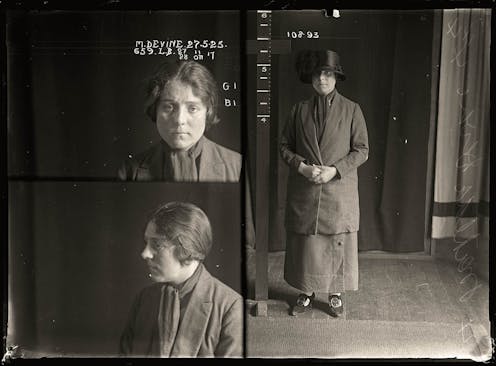
 Iris Webber, NSW State Reformatory for Women, Long Bay, 1941.
Public domain.
Authors: Susan Sheridan, Emeritus Professor, Flinders University
Iris Webber, NSW State Reformatory for Women, Long Bay, 1941.
Public domain.
Authors: Susan Sheridan, Emeritus Professor, Flinders University 
















