

how I have been observing atmospheric change through art and science
- Written by: Jessie Boylan, PhD student, RMIT University
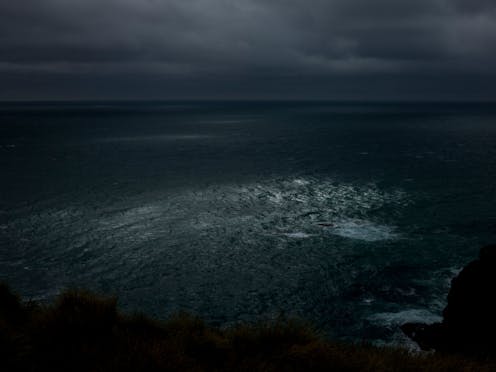
Overlooking the Bass Strait on the remote and windy northwest tip of Lutruwita/Tasmania is the Kennaook/Cape Grim Baseline Air Pollution Station.
The air that arrives at Kennaook has travelled thousands of kilometres. It hasn’t touched land for many days, weeks or even months. It is said to be some of the cleanest in the world.
The powerful westerly winds – the “roaring forties” – carry air masses across the Southern Ocean, reaching land well-mixed and uncontaminated by recent human activity.
Considered “baseline”, this air is representative of true background atmospheric conditions, and grants us insight into the driving forces behind human-driven climate change.
When I arrived at Kennaook in mid-April, it was late afternoon and a storm was brewing. The wind was blowing from the southwest at a steady 54 kilometres an hour – baseline conditions – and the carbon dioxide levels were 413.5 parts per million.
More than 40 years ago, scientists warned CO₂ levels like these would create catastrophic and irreversible environmental damage and species collapse.
I climbed the stairs to the top deck, set up my camera and tripod, and started filming.
Read more: Forty years of measuring the world's cleanest air reveals human fingerprints on the atmosphere
Making invisible visible
Much of my work has been about the ongoing human and environmental harm caused by uranium mining and atomic testing programs. The invisibility of both the harm and the substances has continued to challenge me creatively.
How do you make visible the invisible? How do you communicate imperceptible change?
Discovering there is a place that captures, archives and measures the air and these imperceptible changes presented me with an opportunity to do just that.
I have since based my creative-practice PhD on the work done at Kennaook/Cape Grim, working alongside the scientists from the Bureau of Meteorology and the CSIRO.
As an artist whose projects have a documentary basis, I use photography, video and sound to respond to place through story, and expand out from there to go beyond what is simply before me.
I believe art has the capacity to reach us in ways other forms of information cannot, revealing the imperceptible hidden in the everyday. In this case: what stories are we breathing?
Sarah Sentilles wrote in The Griffith Review that art shows us “the world is made and can be unmade and remade”.
In troubled times, we are collectively searching for ways to unmake and remake the world around us. Art is one way to unlock that capacity.
The present emergency
For this project, titled The Smallest Measure, I have taken an intentionally slow, observational approach, using “slow cinema” techniques to respond to the slow science carried out on site and to the “slow violence” of climate change.
Slow cinema, says writer Matthew Flanagan, “compels us to retreat from a culture of speed […] and physically attune to a more deliberate rhythm”.
Slow violence is described by environmental literature professor Rob Nixon as “a violence that occurs gradually and out of sight […] an attritional violence that is typically not viewed as violence at all."
This kind of violence is so embedded within daily life, connected to commonplace activities and daily rituals we don’t see it at all, let alone regard it as an emergency. In using slow aesthetic techniques, myself and the viewer use our own capacities to observe and pay attention to the damage within the everyday.
On the top deck of the station, as I watch the storm roll across the ocean, I wonder where the air has come from, who else has breathed it, what is inside of it and how long it has been on its journey.
While at Kennaook, I film and record the landscape and science working together, in constant conversation.
Inside the station, the scientists and technicians are at work. A day is spent cleaning one of the instruments, tubes are flushed and reflushed, tests are run. All the while the air is flowing in from the outside through pipes and into different machines, registering numbers and building graphs, telling us what gases are contained within it and which direction it may have come from.
If there is a sudden spike, it has come from a car outside the station. If it is a more consistent patch of dirty contaminants, the air is probably coming from the north, from Melbourne.
Meanwhile, outside the station, the landscape is working too. The ocean currents ebb and flow, the waves crash onto the rocks below, the wind keeps on blowing, making patterns across the grass, sometimes with such force it is destabilising.
My work doesn’t show dramatic scenes or spectacularly catastrophic events. Instead, through slow visual, aural and scientific processes of attention and observation it shows the emergency is already here. We are entangled within it.
If we really want to, we have the capacity to respond.
Authors: Jessie Boylan, PhD student, RMIT University


















