

in Faith, Hope and Carnage Nick Cave plumbs religion, creativity and human frailty
- Written by: Lyn McCredden, Personal Chair, Literary Studies, Deakin University
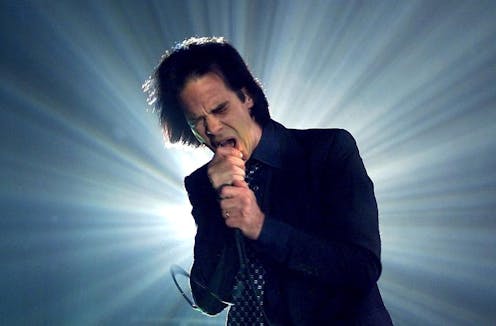
Whether you adore or despise Nick Cave, this book offers you a great deal. Far more than the stereotypes of the gothic expatriate, or the drug-loving, post-punk, underground lord, or the strutting songster with the deep, melancholy voice. All these characters appear in Faith, Hope and Carnage, but we meet full on an older, reflective, theologically-probing Cave. For many readers this might sound like challenging, even uncomfortable, territory.
Faith, Hope and Carnage – Nick Cave and Seán O’Hagan (Text Publishing)
In a long series of discussions across the pandemic period, Cave and his friend Seán O’Hagan conducted a recorded conversation that flows deep, through many sharp bends.
O’Hagan is an appropriate interlocutor. He is different to Cave in so many ways, and genuinely surprised at where Cave goes. O’Hagan is a journalist not a celebrity or a “creative”. He’s not religious, he’s not Australian, but he’s receptive and open to Cave’s challenges and, sometimes, his contradictions.
In the context of the pandemic, and after the tragic accidental death in 2015 of the Caves’ twin son Arthur at 15, a sustained and confronting strand of the conversation is, unsurprisingly, about loss, suffering, grief and death.
That will be no shock to aficionados of Cave’s music over the last 30 years, with earlier songs and albums like The Mercy Seat (1988) and The Murder Ballads (1996), his novel The Death of Bunny Munro (2009), the score for films such as The Proposition (2005) and Dahmer Monster: the Jeffrey Dahmer Story (2022), and more recent albums Ghosteen (2019) and Carnage (2022), all drenched in often violent death.
What is new about this book, though, is that Cave is weaving the threads of his life – the loss of his son, and of so many friends, his mother and father, his early musical collaborator and girlfriend Anita Lane, his heroin years and rehabs – into a different, more reflective shape.
Read more: Friday essay: reclaiming artist-musician Anita Lane from the 'despised' label of muse
And it’s not that he’s prettying things up. Not at all. In grief, Cave writes,
you become deeply acquainted with the idea of human mortality. You go to a very dark place and experience the extremities of your own pain … [and as in the pandemic] grief can have a chastening effect. It makes demands of us. It asks us to be empathetic.
One of the chastening effects of grief, for Cave, is registered in the experiences and expressions of religious faith. The conversation between Cave and O’Hagan leaves us in no doubt about Cave’s deepened religious beliefs. These have always been a part of him, through his post-punk, drug-fed years, but they are taking new turns.
To his strengthened Christian faith, Cave, often to O’Hagan’s bemusement, attaches a suite of moral human values he would now, through living with his grief and doubt and fear, like to nurture in himself: values of empathy, humility and vulnerability, mercy towards others, openness and tolerance, and acknowledgement of his need for atonement.

Forgiveness and mercy
Cave’s journey into grief and contemplation of death is personal, of course, but he does cast out a net, or spell, towards his audiences, and even broader. When O’Hagan asks about the differences between sacred and secular worldviews, Cave’s answer will be taken by many as provocative. He finds in the world:
a sort of cynicism and distrust of our very selves … a rejection of the innate wonder of our presence … to do with the increasingly secular nature of our society. There’s an attempt to find meaning in places where it is ultimately unsustainable – in politics, identity, and so on …[religion] deals with the necessity of forgiveness … and mercy, whereas I don’t think secularism has found the language to address these matters.
Religion “has a lot to answer for”, but it nurtures “a humility towards one’s place within the world – an understanding of our flawed nature”.
Such reflections do not, to this reader, come across in the spirit of hostility, but in a tested, lived, often broken human consideration of where meaning – Cave’s, his audiences’, the contemporary world’s – might be sought.
Throughout the book, Cave discusses the how and why of his Red Hand Files, an online blog fours year old and still going.
Read more: Friday essay: transcendent rage — Nick Cave and the Red Hand Files
In these Files, Cave seeks and practices openness, tolerance, empathy. Further, he consistently declares his gratefulness to his fans, and others who write in, for their care of him in his time of grief over Arthur’s death. Tragically, Cave lost a second son, Jethro Lazenby, earlier this year. (In May, Cave published a letter of condolence on the Files, thanking readers for their kind words and acknowledging their letters had been a great source of comfort.)
Radical listening
In the Files and in his recent Conversations tour, where he talked openly with his audiences about any topic they threw out, Cave demonstrates an amazing vulnerability, describing his involvement as similar to prayer or meditation, to radical listening.
In contrast, he writes that he came off Twitter and “the world suddenly improved … as far as I can see social media makes you sick”.
Another major strand of the conversation in Faith, Hope and Carnage is around creativity. We are given multiple discussions about song writing, performance, collaboration, audiences, and the artist’s divine spark. For Cave, art “does not exist in its true form unless it moves through the hearts of others as a balm.”
Music has the capacity
…to enlarge the spirit, provide solace, companionship, healing, and well, meaning.
Cave is not only talking about his own involvement with music here, he embraces his audiences, and all lovers of music. He then puts to O’Hagan that his current work is about seeking forgiveness, “making what might be called living amends, by using whatever gifts you may have in order to help rehabilitate the world.”
For some this might sound like egotism or zealotry, and there are certainly tinges of these.
Still, this is a panoramic, coruscating book. We are enabled not only to glimpse the wellsprings of Cave’s religious faith and hope, but in a vibrant landscape we are introduced to many of his friends, his literary, artistic and musical influences, his collaborations and recording locales.
 We can begin to map out the changes, and contradictions, of Cave’s lifetime in music, lived as a truly cosmopolitan artist who remains, in many wonderful ways, Australian (see his childhood memories in the book of Wangaratta and of art college in Melbourne).
It has been a rich life immersed in art, storytelling, poetic language, religious possibilities. It’s helpful to have Google and Spotify with you, just to check out the songs, historical contexts and personalities that jostle and claim attention in the pages.
There is, amongst all this, a person with regrets, self-professed sins, the felt need to make amends, and an overwhelming sense of human frailty. If this is an ego strutting its successes, it’s more so a broken, humbled, ageing, open-eyed man.
In the final pages Cave throws out one of his many bon mots:
…hope is in every little thing, as far as I can see. Hope is optimism with a broken heart.
For this reader, the unstoppable energy, as well as the reflectiveness of Cave – the musician, the religious believer, the religious doubter, the family man, the collaborator and the friend – continues to be a wonderfully tender balm.
Authors: Lyn McCredden, Personal Chair, Literary Studies, Deakin University
We can begin to map out the changes, and contradictions, of Cave’s lifetime in music, lived as a truly cosmopolitan artist who remains, in many wonderful ways, Australian (see his childhood memories in the book of Wangaratta and of art college in Melbourne).
It has been a rich life immersed in art, storytelling, poetic language, religious possibilities. It’s helpful to have Google and Spotify with you, just to check out the songs, historical contexts and personalities that jostle and claim attention in the pages.
There is, amongst all this, a person with regrets, self-professed sins, the felt need to make amends, and an overwhelming sense of human frailty. If this is an ego strutting its successes, it’s more so a broken, humbled, ageing, open-eyed man.
In the final pages Cave throws out one of his many bon mots:
…hope is in every little thing, as far as I can see. Hope is optimism with a broken heart.
For this reader, the unstoppable energy, as well as the reflectiveness of Cave – the musician, the religious believer, the religious doubter, the family man, the collaborator and the friend – continues to be a wonderfully tender balm.
Authors: Lyn McCredden, Personal Chair, Literary Studies, Deakin University 

















