Modern Australian
Men's Weekly

.

Australia needs an honest conversation about tax and budgets – and Jim Chalmers is ready to talk

  • Written by Peter Martin, Visiting Fellow, Crawford School of Public Policy, Australian National University
Australia needs an honest conversation about tax and budgets – and Jim Chalmers is ready to talk

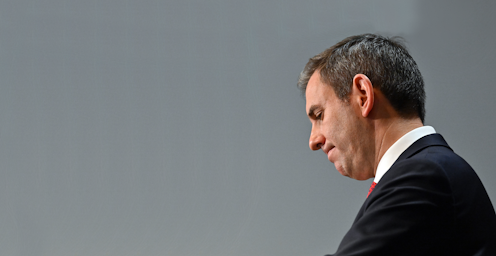
Jim Chalmers is a wily operator. Ahead of delivering his first budget next Tuesday, he has given himself room to do the things a treasurer needs to do.

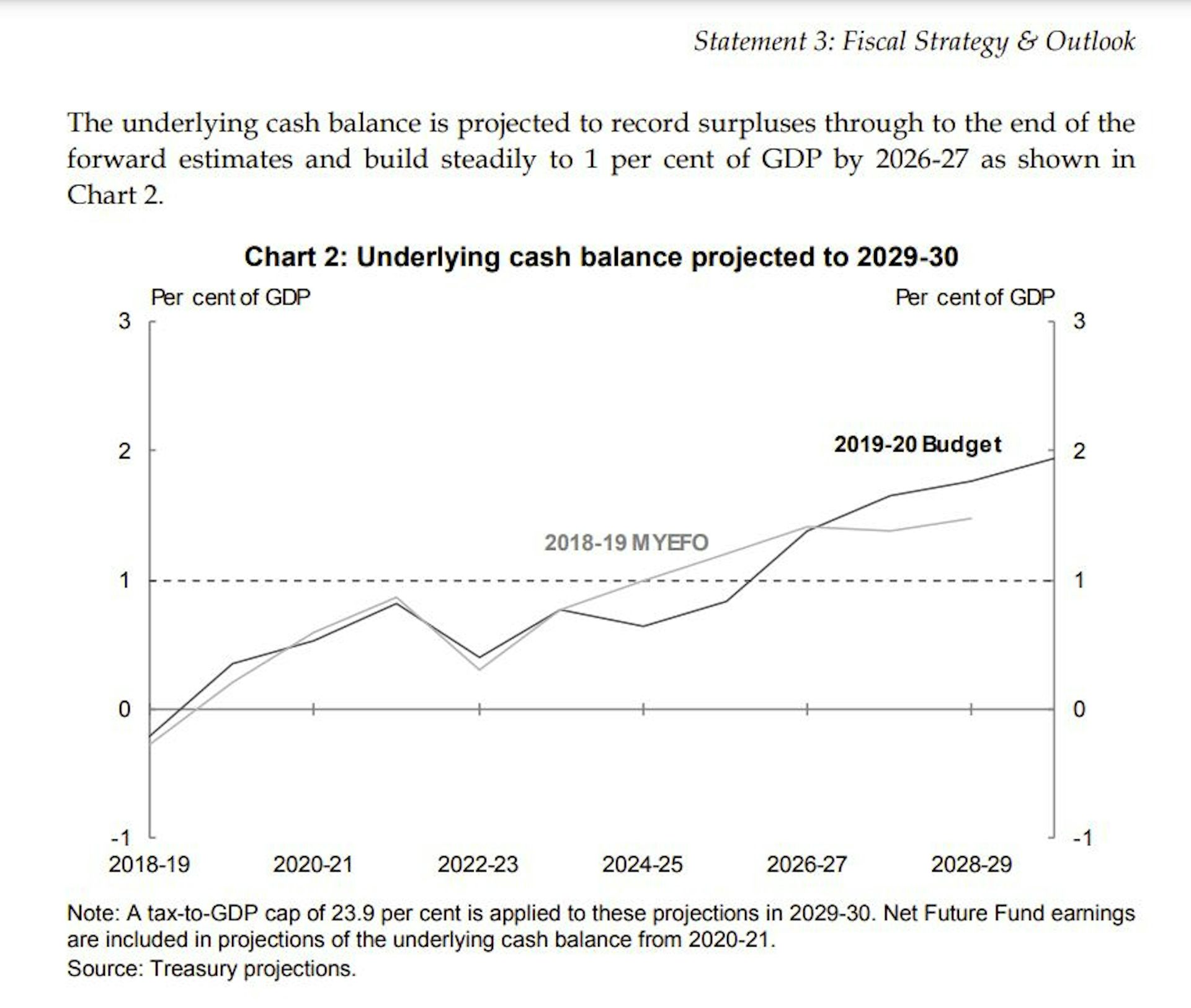
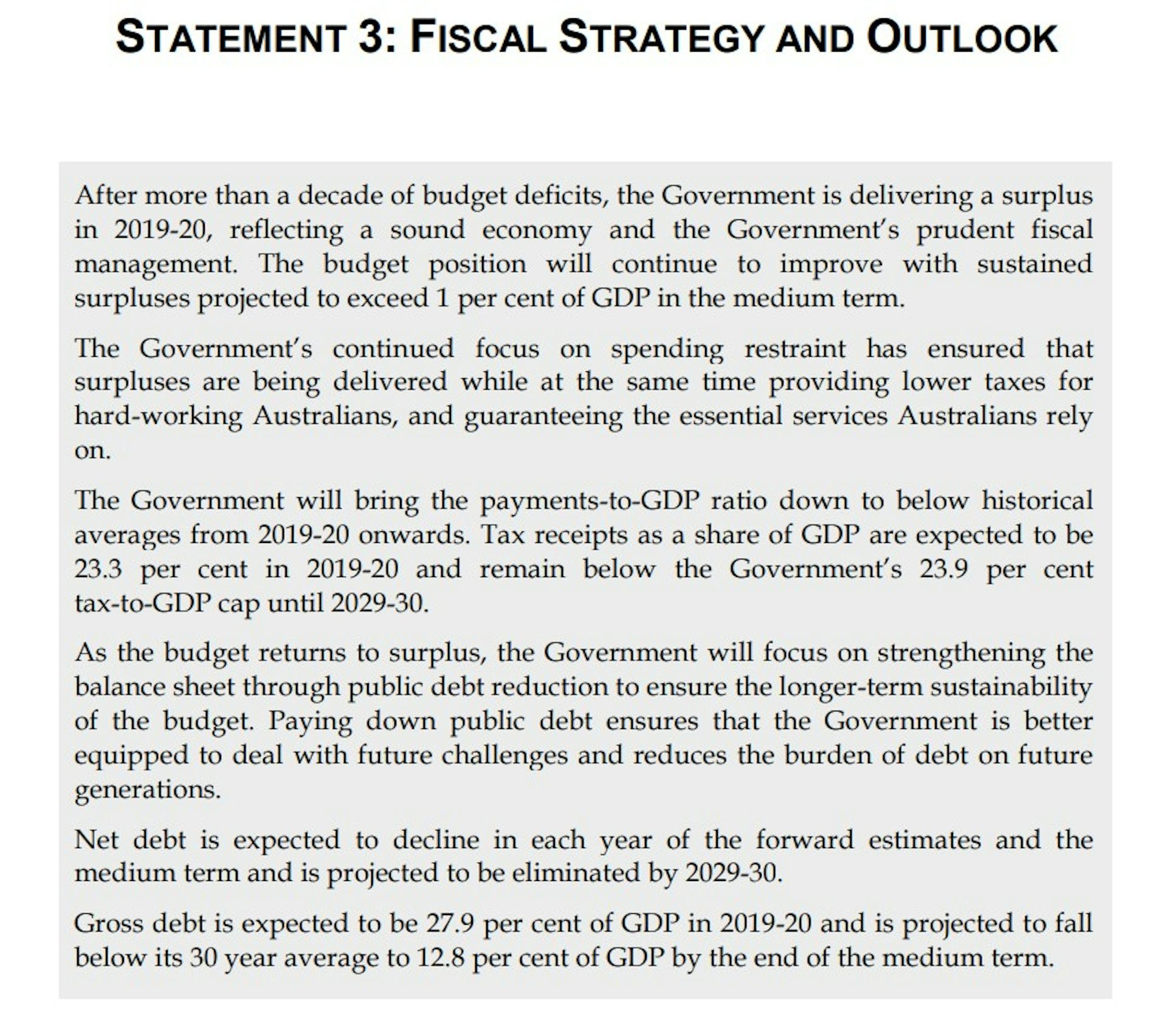
For a while, his predecessor Josh Frydenberg denied himself that room. In his first budget as treasurer under Scott Morrison ahead of the 2019 election, Frydenberg promised to get the budget “back in the black”.

That 2019 budget forecast increasing surpluses as far as the eye could see (which was ten years, the limit of the graphs presented in the budget papers). The Liberal Party began selling “back in the black” celebratory mugs at A$35 each.

Liberal Party of Australia, 2019 The trick was that from then on, government spending would grow more slowly than the rest of the economy. As a proportion of GDP, it would slide from around 25% to 23.6% by 2029-30. For that to happen, all sorts of government programs would have to become and stay less ambitious for ten years. But instead of details, Frydenberg’s department gave us gobbledegook – such as that lower payment projections had been driven by lower than expected payments across a range of programs in the forward estimates flowing through to the medium term. It made substantial extra spending near-impossible. The 2019 budget assumed that the cost of National Disability Insurance Scheme couldn’t blow out (it has), that governments couldn’t spend more in response to aged care and disability royal commissions (they’ll have to), or pay aged care workers the big rises the Fair Work Commission is about to award, and so on. COVID changed everything – except the tax cap Just about every fairly foreseeable crisis couldn’t be responded to, if the assumptions in the 2019 budget were to be believed. Not even by raising more tax. A separate “tax cap” set out in the budget said the government would never collect more than an arbitrarily chosen 23.9% of GDP. Frydenberg tied his own hands in a way a treasurer who wanted to take charge of the nation’s finances would not have. Until COVID. Within a year, Frydenberg junked the “back in the black” pledge and spent big, because he had to. But he kept in place the bizarre 23.9% tax cap. The Liberal Party campaigned on it in the election, challenging Chalmers to adopt it. No tax cap – but what comes next? But here’s how much Chalmers really wanted the job of treasurer. In an election in which Labor repeatedly presented itself as a small target, Chalmers said “no” to the tax cap, over and over again. Asked on ABC’s 7.30 last month whether next week’s and future budgets would be bound by the tax cap written into Frydenberg’s final budget, he said the cap had been more or less “plucked out of the air”. And I had the courage, if I can say that, to say that before the election as well as during the election campaign. His task was to fit the budget to the conditions Australia faced: rising inflation, falling real wages, rising interest rates, and looming recessions worldwide. The amount he would have to spend, and the amount he would have to raise, would be the result of those deliberations. Read more: Election tip: 23.9% is a meaningless figure, ignore the tax-to-GDP ratio And it would be the result of things beyond any government’s control. Unexpectedly, the Coalition almost breached its tax cap in its final year in office because of a flood of revenue flowing from higher commodity prices and a greater than expected number of Australians in jobs. It took in 23.4% of GDP. What would it have done if it had breached the cap? Given the money back? Growing demands on the budget The demands on future budgets will be enormous. Not only paying for the National Disability Insurance Scheme and aged care, but also Medicare, hospitals, defence, education, rent assistance, boosting the scandalously low rate of JobSeeker, and dealing with increasingly frequent floods and climate change. Australians expect these challenges to be taken seriously. Labor’s actual election promises aren’t that expensive. The parliamentary budget office found a net impact of $6.9 billion over four years. In Tuesday’s budget, Chalmers will find much of the money for those promises by cancelling decisions made in Frydenberg’s March budget. An upside of having budgets in both March and October this year is that a lot of the money committed in March hasn’t yet been spent. How do we pay for what we need most? But beyond that, Chalmers says he is up for a serious conversation about how we pay for the services we need and have a right to expect. A former head of the prime minister’s department, Michael Keating, wants an expert committee (“not a royal commission made up of lawyers”) to prepare a bottom-up estimate of the extra revenue we will need to guarantee the essential services we are likely to need. After the committee has developed the estimate, Keating wants a second inquiry to work out how best to raise it. Read more: Memo to Labor: you need more tax, working out how much more is urgent Economist Ross Garnaut told September’s jobs summit that as a share of GDP, total federal, state and local government tax revenue was 5.7 percentage points below the developed country average. On one calculation, that means Australia could raise an extra A$140 billion a year and still be taxed at developed country rates. It needn’t all come from income tax. Most developed countries have much bigger goods and services taxes than we do, and many have windfall profits taxes, and effective taxes on energy exporters. And it needn’t all be raised now. There’s no point in taxing more for the sake of taxing more. But we are likely to need to raise more in future, to help fix the kinds of problems we’re likely to face in the future. That’s the overdue conversation we have to have, starting next Tuesday. Authors: Peter Martin, Visiting Fellow, Crawford School of Public Policy, Australian National University

Read more https://theconversation.com/australia-needs-an-honest-conversation-about-tax-and-budgets-and-jim-chalmers-is-ready-to-talk-192603

Short Term Loans in Australia: Practical Insights for Borrowers and Finance Professionals

Short term loans play a crucial role in Australia’s personal finance landscape. They are designed to cover short-term expenses, unexpected bills, ...

Best EPD Consultants in Australia

Environmental Product Declarations (EPDs) play an increasingly important role in the Australian construction, manufacturing, and infrastructure sect...

I/O Controller And Its Role In Modern Industrial Automation

Industrial automation relies on a range of advanced technologies to ensure precision, speed, and reliability in day-to-day operations. Among these t...

Hydraulic Systems And Their Importance In Modern Industry

A hydraulic system plays a vital role in powering machinery, controlling movement, and delivering high-force performance across countless industrial...

Why Australian Businesses Are Having a Second Think About Digital Growth

Running a business these days is a whole lot different to how it was even a few short years ago. Customers are better informed, there's more competi...

Restaurants Risk Compliance Issues Amid Commercial Plumber Shortage

As demand for housing, roads and facilities increases, so does the demand for trade workers. According to Infrastructure Australia, the construction i...

The Importance Of A Professional Medical Fitout Melbourne For Modern Healthcare Facilities

Healthcare environments must operate with precision, efficiency, and a strong focus on patient comfort. A well-planned medical fitout Melbourne hel...

Top Safety and Comfort Features to Consider in Family Off Road Caravans

Exploring Australia’s coastline, bush tracks or outback locations is far more enjoyable when travelling in a caravan designed for both comfort and...

“Logistical Nightmare” – Rural and Remote Communities Supply Chain Nightmares

Australia’s road logistics need major reform to counteract the supply chain issues that are hitting rural and regional communities hard. With 80% of...

The Importance Of Quality Bait Boards For Boats To Enhance Fishing Efficiency And Comfort

Fishing enthusiasts understand that having the right equipment on board makes every trip smoother and more enjoyable. One essential accessory for an...

The Essential Safety Gear Every Tradesman Needs

Across industries like construction, electrical work, plumbing, carpentry, and welding, workers face hazards every single day. For tradesmen, having...

Best POS System Features That Boost Customer Experience

Source: Unsplash Starting and scaling a retail business is unlikely possible without an effective Point of Sale (POS) system. It is the tech heartbe...

Understanding SMSF Setup Online and Why More Australians Are Choosing Digital Fund Establishment

liManaging your own superannuation gives you greater control over investments, retirement planning, and long-term financial decision-making. As inte...

Double Carport: Complete Guide to Design, Cost, and Installation

A double carport provides practical, cost-effective protection for two vehicles whilst adding value and functionality to your property. Whether you're...

How External Blinds and Awnings Improve Comfort, Privacy, and Energy Efficiency

Outdoor comfort and protection are essential for homes and commercial properties, especially in regions with strong sunlight, high UV exposure, and ...

Worksite Comfort Upgrades That Boost Team Productivity

Jobsite productivity doesn’t depend solely on tools, training, or scheduling. It also hinges on something often overlooked: worker comfort. When e...

NDIS Occupational Therapy: Your Complete Guide to Accessing Support and Services

Occupational therapy plays a crucial role in helping NDIS participants achieve their goals and improve their daily living skills. For people with disa...

How to Start Trading Futures in Australia: Markets, Margin and Regulation

Futures trading has become increasingly popular among Australian traders seeking opportunities across global commodities, indices, currencies and ener...