

An entirely new illicit drug has been discovered by Australian chemists. Here's how they did it
- Written by: David Caldicott, Senior lecturer, Australian National University
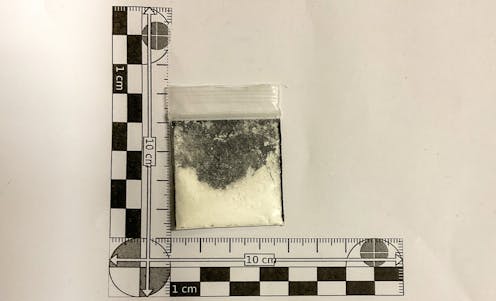
Imagine, if you will, a small plastic baggy containing a mixture of crystals and powder.
The person presenting it thinks “it might be ketamine?”, but admits the subjective effects are different to what they’re used to. How do we find out if it’s what they think it is? And what are the consequences if it isn’t?
This is a typical scenario for the people working at CanTEST – Australia’s first and only fixed-site, face-to-face drug checking service, located in Canberra.
And in this case, it led chemists to discover a drug never before seen in Australia, and with no associated clinical information from anywhere in the world.
Identifying ‘chemical X’
The identification of new psychoactive substances – drugs made to resemble established illicit drugs – presents a major challenge when pill-testing. Testing a chemical provides us with its “fingerprint” that will hopefully match one of the thousands stored in databases available to analysts.
But what happens when a fingerprint doesn’t provide a match and we have come across “chemical X”?
That brings us back to the original baggy of powder.
Patrick Yates, a PhD candidate from the Australian National University’s Research School of Chemistry, ran the sample through the first piece of equipment, the Fourier transform infrared (FTIR) spectrometer – a workhorse of many drug-checking programs around the world.
Read more: Pill testing really does reduce the risk of harm for drug users
FTIR works quickly and reliably – even at a bush doof – as long as an electricity supply is available. It shines a laser on the sample, and the “reflection” (a measure of how the drug shakes and wiggles) is captured and compared to a database of more than 30,000 chemicals.
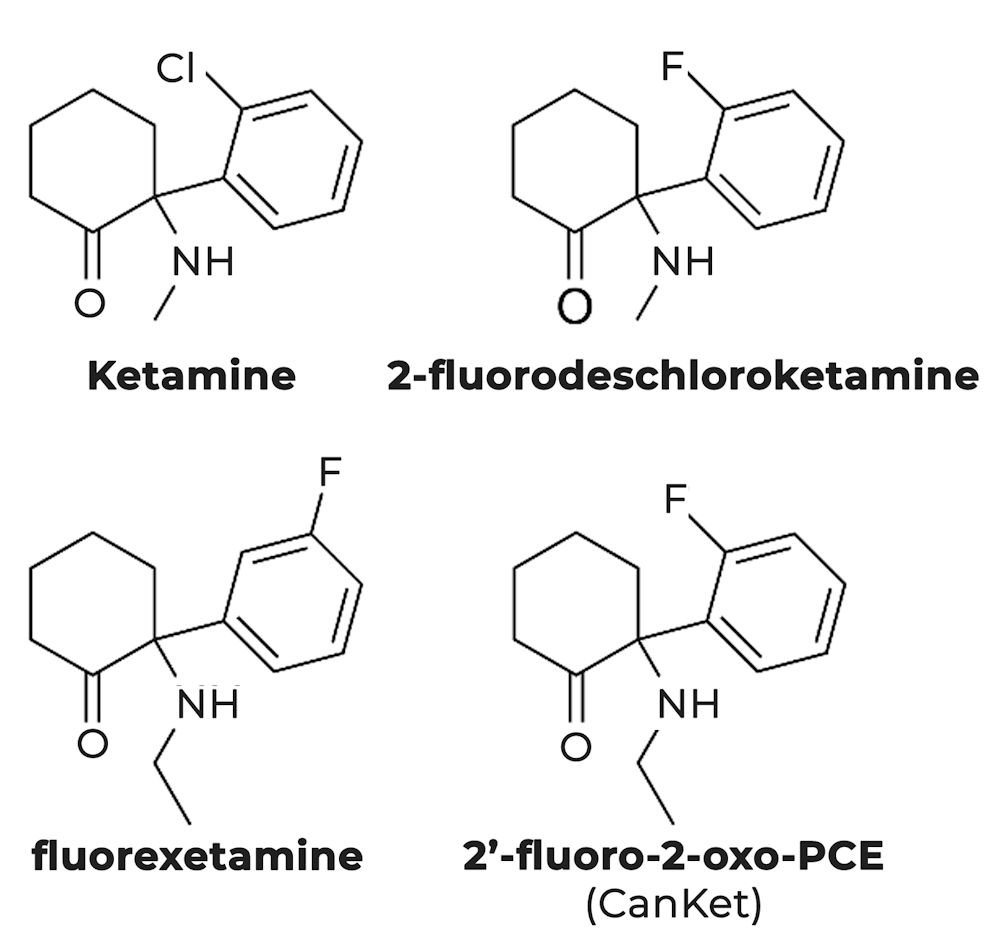
Patrick’s analysis didn’t confirm a ketamine match, but suggested it might be a relatively new ketamine analogue called 2-fluorodeschloroketamine (2-FDCK). However, Patrick’s trained intuition left him doubtful.
PhD student Cassidy Whitefield then turned to an instrument known as ultra-high performance liquid chromatography with photodiode array (UPLC-PDA), humming away in the corner at CanTEST. She ran lab-based standards through it, calibrating the machine to the ten most common drugs we see, including ketamine.
Chemical X had to “run a race” against a known sample, comparing it to already known compounds. The UPLC-PDA test takes about four minutes to run.
While the sample appeared similar to the ketamine standard, Cassie’s trained eye saw something was off. The rate at which chemical X ran its race (known as the retention time) was similar, but its absorption of ultraviolet radiation was off.
Whatever was there was real, quite pure, and neither ketamine nor 2-FDCK.
When in doubt, run more tests
Ketamine is both an invaluable agent in the emergency and pre-hospital environment, and part of an emerging group of illicit drugs known as arylcyclohexamines.
In consultation with ANU chemistry professor Mal McLeod, the CanTEST team arrived at chemical X being “ketamine-like”.
The person who brought it in was advised the substance was not ketamine, and its identity could not be ascertained – our band of peer workers advised extreme caution in using it.
Read more: Forgotten how to party? Safety tips from a drug and alcohol expert
But that was not the end of the story for analytical chemists – the full inquisition was just beginning.
Next up, chemical X was subjected to a method called gas chromatography–mass spectrometry (GC-MS), meaning the sample was made to “run another race”, and was then smashed into pieces to further fingerprint it.
The GC-MS data correlated closely with a ketamine derivative known as fluorexetamine, but the presence of an isomer – two compounds with the same molecular formula but arranged differently – could not be ruled out.
It was time to bring out the big guns: a nuclear magnetic resonance spectrometer is a chemist’s Book of Runes. Answers can be found, but only by those few who can speak the language well.
Eventually, after a series of multi-dimensional tests, the team figured out there were four hydrogens next to each other around the aromatic ring, meaning it could not be fluorexetamine.
Chemical X could only be something called 2’-fluoro-2-oxo-phenylcyclohexylethylamine. And they had never seen this compound before.
From chemical X to ‘CanKet’
It’s hard to emphasise what a phenomenal piece of work this was. We contacted our offsiders at the UN Office of Drug Control, the European Monitoring Centre for Drugs and Drug Addiction, as well as several well-positioned researchers in this space from around the world. None had seen the compound before.
Our colleagues at the ACT Government Analytical Laboratory wrote to their international peers; a global forum of forensic and analytical chemists reviewed their locally acquired data and provided information that supported our findings.
We have since found a single further report out of China from a forensically obtained analytical sample, where it was described by another name (2F-NENDCK). As 2’-fluoro-2-oxo-phenylcyclohexylethylamine is a bit of a mouthful, our team has taken to calling it CanKet, as in “Canberra ketamine”.
After this feat of chemical analysis, we are now able to identify CanKet with impunity. We still don’t know its full effects, but thanks to understanding its chemical composition, we have a better idea of what we’re dealing with.
Read more: Yes, we can do on-the-spot drug testing quickly and safely
Authors: David Caldicott, Senior lecturer, Australian National University


















