

Victoria signals end of coal by announcing a new 95% renewable target. It's a risky but vital move
- Written by: Tony Wood, Program Director, Energy, Grattan Institute
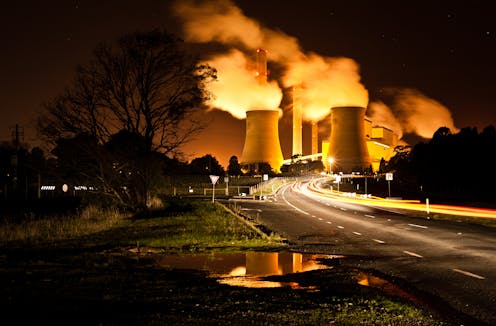
It’s the end the line for coal in Victoria, after Victorian Premier Dan Andrews today announced plans for 95% renewables within 13 years. Until now, the industrialised state has been aiming for 50% by 2030.
But it’s also the end of the line for our ailing, mostly privatised, energy market. Public ownership is back in vogue – in a recognition the energy market cannot deliver the transformation required. The Andrews Labor government would bring back the State Electricity Commission (SEC) if re-elected next month and use this to build new renewable energy projects.
At a national level, Labor is aiming for 82% renewables by 2030. So is Victoria’s target even possible? Yes – if the state government can overcome the major stumbling block of transmission. Building solar and wind isn’t the bottleneck – it’s the grid that isn’t fit for purpose.
Still, it’s an encouraging sign that the clean energy floodgates are opening in our eastern coal states. Queensland is now aiming for 70% renewables in a decade. New South Wales is forging ahead with renewable energy zones.
Dizzying pace of change
Why are governments boosting renewable ambitions so dramatically? Several reasons. In Victoria, there’s an election campaign under way. Labor is widely expected to win a fourth term – and infrastructure is one of its strengths. This offers an exciting vision of the future – and any political blowback from cost overruns will come later on.
But other changes are afoot. Operators of ailing and ageing coal plants are looking for the exit. The huge Loy Yang A power plant – responsible for 13% of the state’s emissions – will close in 2035, a decade ahead of schedule.
Climate change is intensifying, with unprecedented floods in Australia and Pakistan, unprecedented droughts in America’s west and China, and marine heatwaves devastating fisheries. Solar is now the cheapest form of newly built power.
Elsewhere around the world, offshore wind turbine technology has matured into 16 megawatt giant turbines, stretching hundreds of metres into the sky. And the Russian war on Ukraine has driven fossil fuel prices skyward, causing hip pocket pain to consumers around the world.
This move will also give Victoria’s emissions reduction target a shot in the arm. Nationally, a third of our emissions come from electricity. In brown-coal capital Victoria, it’s traditionally been 50%. Clean power will get the state about halfway to its emissions targets. The announcement today made no mention of other emissions sources – manufacturing, agriculture and transport.
But is it possible?
Close your eyes tightly and squeeze. Can you see it? Yes, it’s physically possible – just. But I raise two serious caveats.
First, it means coal fired power will have to end. Second, we have to find ways of building the unsexy but crucial part of the clean energy system: transmission and storage. There’s a lot to build in a short time and the cost will tend to offset the low cost on the renewable generation.
When the coal power stations were built in the Latrobe Valley east of Melbourne – where the coal is mined – state governments footed the bill for the huge transmission towers needed to take the electricity to where people live and work.
Now we need to do that again but on a much larger scale. This poses serious risks. Rural communities are almost guaranteed to push back on large new transmission lines. They may well be in favour of clean energy, but they don’t want big new power lines.
Some might say Australia can’t build like this any more. But we can, as our recent fossil fuel infrastructure builds show. Only a decade or so ago, Queensland built huge new gas export terminals at Gladstone. The cost blew out, but it was done.
We can do it, but it will cost us. The conversion of Snowy Hydro to a pumped hydro plant is way over budget and time. Current transmission projects like EnergyConnect, which will link NSW and South Australia, have seen budgets double.
We’ve done the easy part – solar on rooftops, wind and solar farms in places with good existing grid connections. That got Victoria’s renewables over 20%. Now comes the hard part – transmission, and storage.
Victoria has already announced a renewable storage target equal to half the state’s household use. But it will get harder and more expensive the closer we get to the 95% figure.
Read more: What is the electricity transmission system, and why does it need fixing?
What does this mean for energy markets?
Some old-timers will shed a tear of joy at the news the SEC is coming back. But why the reversal, after the state government privatised the electricity market in the 1990s?
The reason is the market is not delivering the clean energy transition. For years, we’ve pretended the market can make the shift by itself, but it hasn’t. Continuous government intervention and policy changes certainly didn’t help. Working through the government-appointed Energy Security Board to reform the market market didn’t work either.
We’ve needed these new transmission links for years and the existing regulatory model hasn’t delivered.
The announcement today represents a fundamental change. The energy market is set to change completely. Yes, there are risks in having the state government do it. But governments like Victoria’s have been emboldened by the pandemic, which saw all of us look to them – not the market – to steer us through.
What happens to the workers on coal plants? Victoria is quite well placed already. The closure of the highly polluting Hazelwood plant in 2017 caught the state government by surprise. In response, it created the LaTrobe Valley Authority to help people transition to other work.
Five years later, the authority is still there. That’s good – it’s well placed to help ex-coal workers find jobs in other industries such as wind turbine manufacture or construction.
Read more: The end of coal-fired power is in sight, even with private interests holding out
It may surprise you, but we’re a role model
When I’m asked which countries Australia should look to on the energy transition, I can’t help but laugh. In reality, we’re at the forefront. Many other countries are looking at us for ideas. Last year, South Australia made history by becoming the first gigawatt scale grid to (briefly) run on 100% renewables.
While we’ve historically been highly dependent on fossil fuels, we have also had a competitive advantage in shifting. After all, we have rather a lot of sun, wind and land.
So, the verdict on Victoria’s upgraded ambition? 10/10 for vision. But there’s a lot of heavy lifting involved in making it a reality. And the issues we often think of – where to build renewables – are no longer the issue. Now we need old-fashioned transmission towers and high voltage powerlines – and fast.
Authors: Tony Wood, Program Director, Energy, Grattan Institute


















