

Politics of future budgets likely to get harder for Albanese government
- Written by: Michelle Grattan, Professorial Fellow, University of Canberra
When Kevin Rudd made Bill Shorten parliamentary secretary for disabilities in 2007, the post was a good deal less than the high-profile new MP’s ambition for a ministry.
But Shorten took to the job, becoming an effective advocate for the disability sector. Most notably, he promoted the idea of a national disability insurance scheme, which was subsequently legislated by the Gillard government.
Back then, Shorten would never have imagined that, as minister for the NDIS in another Labor government, he’d have the task of driving reform of this scheme, recognised as a landmark achievement but now running on an unsustainable cost trajectory.
Announcing a review of the NDIS this week, Shorten revealed that its estimated cost over the next four years had risen by $8.8 billion just since the March budget. The scheme is estimated to escalate to a staggering $50 billion annually by 2025-26.
Shorten, who wants to make the NDIS more client-friendly as well as financially sustainable, faces a politically painful task. A necessarily tighter scheme must mean potential losers.
But getting the NDIS costs under control will be an important test of how well the Albanese government handles, over the longer term, budget challenges.
Labor is committed to generous spending on areas such as disability. As it should be. But it needs to make sure dollars aren’t squandered in these money guzzlers.
That’s why the government also has to get to the bottom of the Medicare fraud and waste by doctors exposed by an ABC/Sydney Morning Herald/Age investigation this week.
There is some dispute about the amount of funds involved (the reporting suggested $8 billion is being lost annually), but it’s apparent Medicare needs some close scrutiny, especially in the wake of the pandemic, which brought an expansion of the services provided (notably telehealth).
On the savings front, Tuesday’s budget is the easy part. Sort of. There will be some sizeable cuts. But in the firing line will be mainly Coalition priorities, including from the March budget and the inducements thrown at the Nationals to persuade them to sign up to the target of net zero emissions by 2050.
The government will sell many or most of these cuts as hitting waste, rorts and projects without proper business cases. It calculates, or hopes, these arguments will offset the political impact of the objections from those who are affected.
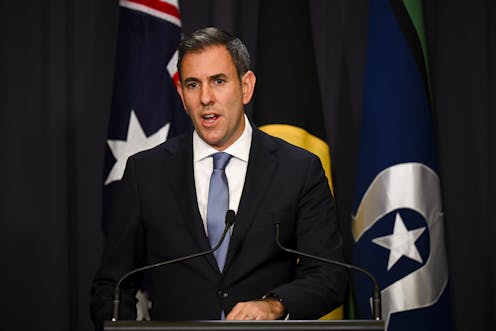
Treasurer Jim Chalmers is sparing no effort in tilling the ground in which to plant his first budget.
For weeks, indeed months, he has been warning how difficult are the circumstances in which this budget is being framed. Even as the numbers have shown a much improved bottom line from what was expected in March, Chalmers has insisted this is only temporary.
He told the ABC on Thursday: “What people can expect to see on Tuesday night is an improved budget position over the next couple of years”. But after that the budget assumes “more normal” commodity prices, and the spending pressures will “make a big impact over the latter years of the forward estimates and into the medium term”.
Economists and commentators will pore over the many forecasts in the budget and the assumptions on which they are based. This year, there’s more reason than usual to take them cautiously – which is no reflection on the expertise or integrity of those officials who have put them together.
With international economies going into down-spins, the course of Ukraine conflict and its consequences unpredictable and China in a worse-than-usual economic space, forecasting beyond a few months can be extraordinarily problematic. Treasury is full of clever people, but unexpected events keep blowing their numbers off course. And Nostradamus doesn’t work there.
Amid an ever-worsening cost-of-living crisis, Chalmers has flattened expectations of what extra the budget can do in offering relief (beyond the election promises of child-care reform, cheaper medicines and the like).
Many people’s food costs will rise further as a result of the latest extensive flooding. The impact of the floods will find its way into inflation; it will also be a cost for the budget, with officials working this week to put some estimate into Tuesday’s figures.
This budget will see innovations reflecting Labor’s priorities and values.
It will have a discussion of the risks to the economy and to the budget itself posed by climate change. Chalmers says this will focus on “the costs of doing nothing” – why it’s important to engage in climate change action “in ways that strengthen the economy and strengthen the budget”.
Behind the scenes, several ministers, including Chalmers, are still wrestling with one of the knottiest current issues of the move to clean energy – how to lower the domestic price of gas, which is a transition fuel. Outspoken Australian Workers’ Union secretary Daniel Walton wrote to the prime minister this week, claiming “if the current position on gas policy is maintained, thousands of Australian manufacturing jobs will be lost during this term of the Albanese government”. Among other measures, he wants a gas price cap.
Tuesday’s documents will also contain an inaugural “wellbeing” budget statement. A number of other countries, including New Zealand, have “wellbeing budgets”.
Chalmers wants the “wellbeing” statement to start another of those “conversations” he’s keen on. “The budget’s primary focus is this inflation challenge, but it’s also about how do we make our economy stronger and broader and more inclusive and more sustainable. And so to do that, I think we can find better ways to measure what that means for people, so that we can have a stronger economy and a stronger society at the same time.”
Chalmers has repeatedly stressed that Tuesday’s budget should be seen just as the first of a suite of budgets, and he’s setting up a narrative for what he wants to do subsequently.
He obviously still has his eyes on trying to recalibrate the stage 3 tax cuts, the latest costing of which, he said on Thursday, has risen to $254 billion over a decade. But the future of those tax cuts, like the savings that need to be made in the NDIS, is a matter for later.
Authors: Michelle Grattan, Professorial Fellow, University of Canberra


















