

Modern Australian
Men's Weekly

.

Australia is dragging its feet on healthy eating. In 5 years we've made woeful progress

  • Written by Gary Sacks, Associate Professor, Deakin University

Australia is dragging its feet on healthy eating. In 5 years we've made woeful progress

Australia is falling behind other countries in addressing the unhealthy state of our diets.

Several other countries, including the United Kingdom, Canada and Mexico, have recently taken major steps to help improve population nutrition and prevent obesity.

But our latest assessment, released as part of the International Congress on Obesity, has found major holes in Australian government policy relative to international best practice, with limited policy progress in the past five years.

What we assessed?

Our assessment of the federal government included a scorecard of how Australia is going in 50 policy areas for addressing unhealthy diets. These policy areas include key influences on what we buy and what we eat, including policies that affect the price and affordability of different foods, the types of food available, how food is labelled, and the way food is promoted.

We worked closely with government officials to document current action in each policy area. We then assessed how existing policies compared to international benchmarks.

Finally, we made recommendations to address the gaps, prioritising them based on their relative importance and feasibility. Eighty-four experts from 37 organisations participated in the assessment and prioritisation process.

Read more: No, it’s not just a lack of control that makes Australians overweight. Here’s what’s driving our unhealthy food habits

How does Australia compare to other countries?

We found implementation of globally recommended policies for improving population diets and addressing obesity in Australia falls far short of international best practice.

There has been only limited policy progress in Australia in the past five years.
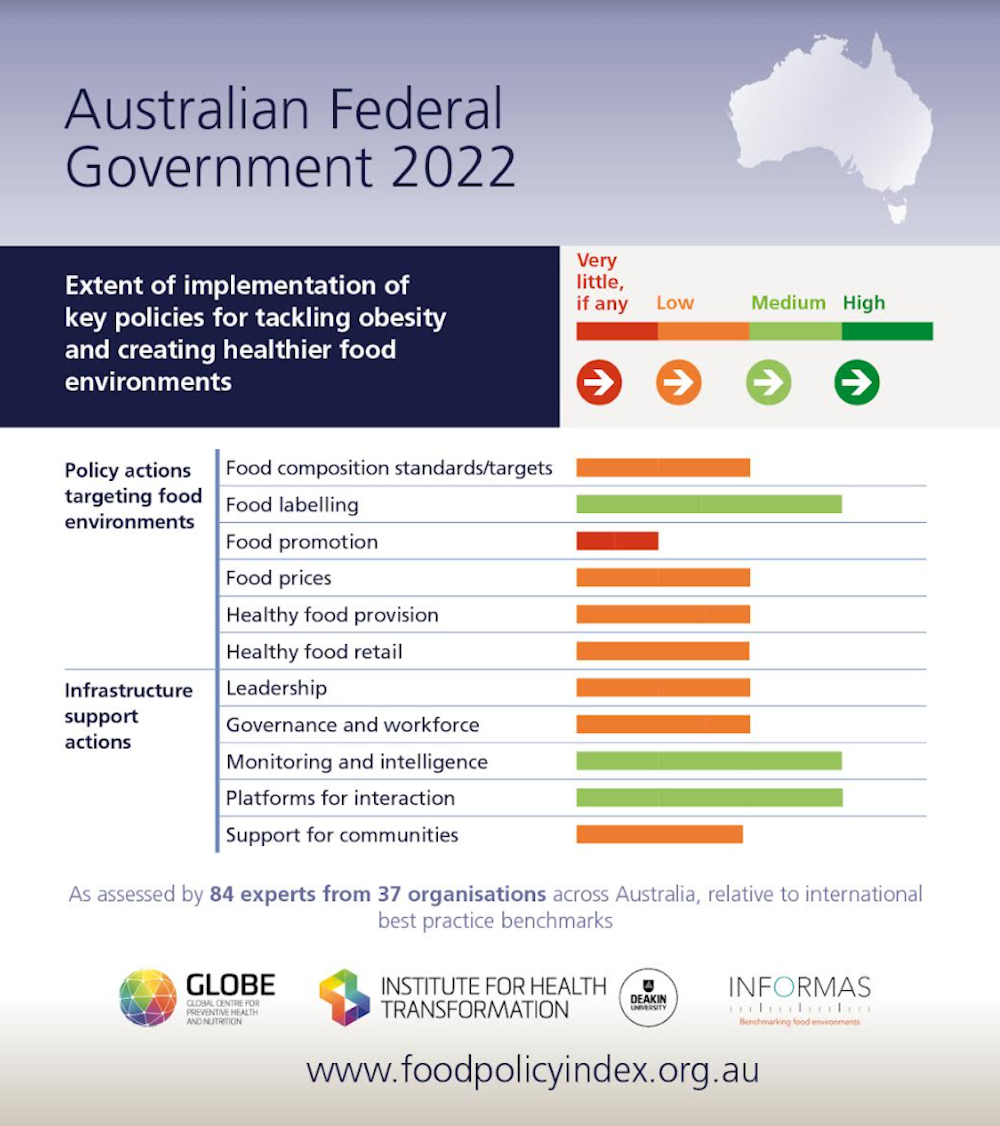
Areas where Australia is doing well One of the only areas where Australia fared well was in the area of food labelling, where some of the regulations regarding ingredient lists, nutrition information panels and health claims was rated among the best in the world. The other area that scored Australia top marks is that the GST does not apply to fresh fruit and vegetables, which helps lower their prices relative to other less healthy products. What are other countries doing better? Several other countries have implemented policies to limit the marketing of unhealthy foods and make it easier for people to choose healthier options. Countries in Latin America are leading the way globally. Chile has put in place comprehensive restrictions on TV advertising for unhealthy food, conspicuous warning labels on the packaging of unhealthy products, as well as taxes on sugary drinks. Mexico has similar policies. Food warning label for Oreos The warning labels on this product sold in Chile indicate it is high in energy (calories), sugar, saturated fats and sodium (salt). Shutterstock Elsewhere in the world, more than 50 countries now have taxes on sugary drinks. There is clear evidence these taxes have decreased consumption of the taxed products, while also incentivising soft drink manufacturers to reduce the sugar content of their drinks. Several other governments are taking strong action to protect children from exposure to marketing of unhealthy food. As an example, the United Kingdom is set to ban ads for unhealthy food online, and on TV before 9pm from 2024. Canada has similar laws before their parliament. The UK also just introduced major changes to how supermarkets operate. Laws that came into effect this month mean unhealthy products can no longer be displayed in prominent in-store locations, such as shop entrances and checkout areas. In addition, the UK has proposed a ban on price discounts on unhealthy food, although implementation remains uncertain with the recent change in government leadership. Several other innovative policies are in place internationally. For example, in some parts of Mexico, retailers cannot sell unhealthy food to children. And in Argentina, there are laws dictating maximum sodium (salt) content in a range of products. Read more: Sugary drinks tax is working – now it's time to target cakes, biscuits and snacks How bad are Australian diets? Unhealthy diets and obesity are the leading contributors to poor health in Australia. Less than 7% of people in Australia consume a healthy diet consistent with the Australian Dietary Guidelines. Nearly 65% of Australian adults, and 25% of Australian children are overweight or obese. While there isn’t good data on how these statistics have changed in the past few years, things have likely got worse since the start of the COVID pandemic. Unless we see comprehensive government action to improve population diets, there will be enormous health and financial costs to individuals, communities and the economy overall. Read more: BMI is underestimating obesity in Australia, waist circumference needs to be measured too What actions should Australia take? Federal government policy action is needed to improve population diets and address obesity. This includes: protecting children from exposure to the marketing of unhealthy food and beverages through comprehensive and consistent national legislation implementing a health levy on sugar-sweetened beverages (a sugar tax) and other unhealthy food, while addressing the affordability of healthy food improving food labelling by mandating the Health Star Rating scheme and requiring warning labels on products high in added sugar, sodium (salt) and/or saturated fat. What’s holding us back? In the past 12 months, the former federal government released key strategies in this area, including the National Preventive Health Strategy (2021-2030) and the National Obesity Strategy (2022-2032). But this has yet to result in any changes on the ground. Critically, there is strong support from the Australian community for governments to impose higher standards on marketing to support children’s health and wellbeing. More than 75% of Australians also back warning labels on unhealthy foods. It is promising to see momentum building around a legislative ban on the marketing of unhealthy food and beverages to children. But it’s now time for the federal government to catch up to the rest of the world and implement meaningful policy change to help Australians improve their diets. Authors: Gary Sacks, Associate Professor, Deakin University

Read more https://theconversation.com/australia-is-dragging-its-feet-on-healthy-eating-in-5-years-weve-made-woeful-progress-192393

Why Doctors in Bundoora Play an Important Role in Community Health

Access to quality healthcare is essential for maintaining a healthy lifestyle and managing medical conditions effectively. Visiting experienced doctor...

Backyard Aesthetics Decoded: Mediterranean, Coastal, Retro, Rustic, and Beyond

Backyard design has come a long way from a patch of lawn, a barbecue in the corner, and a few chairs chosen purely for practicality. Today, outdoor ...

What Stops a Home From Feeling Flat-Pack Generic

There is nothing wrong with convenience. Flat-pack furniture, fast styling decisions, and online checkouts have made it easier than ever to furnish ...

5 Best Dental Clinics in Beecroft, NSW

The best dental clinics in Beecroft, NSW are Beecroft Smiles Dental Surgery, Beecroft Elegant Dental Clinic, McConnell Dental, Dentistry for Life, a...

Executive Recruitment: Finding Leadership Talent That Drives Organisational Success

Hiring the right leadership team can significantly influence the direction and performance of any organisation. Strong executives bring strategic thin...

Understanding the Importance of Abrasive Blasting in Industrial Surface Preparation

Surface preparation is an essential step in many industrial processes. Whether preparing metal structures, removing old coatings, or cleaning equipmen...

Farm Machinery Costs Set to Rise

With steep rises in fuel prices and the need for specialised maintenance, farm machinery costs are set to rise across Australia. The need for transpor...

Why an Employer Recruitment Agency Helps Businesses Build Stronger Teams

Finding the right employees is one of the most important responsibilities for any organisation. Businesses rely on skilled professionals who can con...

Why Quality Trailers Are Essential for Transport and Trade Businesses

Transportation plays a major role in industries ranging from construction and landscaping to logistics and agriculture. Businesses that frequently m...

Why Professional Car Removal Services Are The Best Way To Dispose Of Unwanted Vehicles

When a vehicle reaches the end of its useful life, owners often face the challenge of deciding how to remove it safely and responsibly. Old vehicles...

Why Professional Commercial Carpet Cleaning Matters for Modern Workspaces

Clean office environments influence how employees work, how clients perceive a business, and how long workplace interiors last. Carpets in commercia...

Why Hiring Removalists Makes Moving Easier And More Efficient

Relocating to a new home or office can be an exciting yet demanding experience. Packing belongings, organising transport, and ensuring that items ar...

The Importance of Hiring Local Lawyers in Melbourne for Business Protection

When it comes to protecting a business, the legal support you choose matters just as much as the decisions you make day to day. Working with lawyers...

Why Packaging Boxes Are Important for Product Protection and Logistics

Packaging plays a crucial role in modern commerce, ensuring that products are transported safely from manufacturers to consumers. One of the most wide...

Best Practices for Promoting Crypto Payment Options to Your Customers

Promoting crypto payment options is no longer a futuristic concept but a present-day strategy for venues aiming to reduce transaction costs, attract a...

What Is Allocated vs Unallocated Gold?

Gold has been a trusted store of value for thousands of years, prized for its rarity, durability, and universal recognition. Even in the modern financ...

Physiotherapy Strategies for Improving Independence in Daily Living

For many individuals living with permanent and significant disabilities, the concept of "independence" is not about a total absence of support, but ra...

Mobile Patrol Security vs Static Guards: What’s Best for Brisbane Businesses?

Business security is very nuanced; a cookie-cutter approach doesn’t necessarily always work in a city like Brisbane. The bigger the city, the more...

















