

The most horrifying part of Halloween is the useless piles of waste it creates. Why not do it differently?
- Written by: Olav Muurlink, Associate Professor, Social Innovation, CQUniversity Australia
Thousands of young people roaming the streets at night in scary costumes, knocking on strangers’ doors and threatening pranks if their demands for treats are not met. What could possibly go wrong?
Well, for starters, there’s the frightening amount of waste produced by those few hours of Halloween fun.
In recent years, Halloween has joined Christmas and other consumption rituals to become an entrenched celebration on the Australian calendar – especially for young kids (and their parents).
But afterwards we’re left with mountains of discarded lolly wrappers, pumpkins, costumes and decorations. How did we end up here – and how can we create a more sustainable Halloween?
A horrible history
Halloween is celebrated each year on October 31. About one in four Australians intends to take part this year. That’s a lot of people – but still far behind participation rates in the United States and United Kingdom.
Halloween began as an ancient Celtic harvest celebration. Known as Samhain, the festival included storytelling, bonfires and costumes to ward off ghosts.
In the eighth century, Pope Gregory III declared November 1 as a time to honour all saints. Those festivities included some Samhain activities, and the evening of October 31 became All Hallows’ Eve, then later, Halloween.
Halloween was brought to the US in the 1840s by Irish immigrants. It has since transformed into a heavily marketed staple of the retail calendar, and spread to many other countries, including Australia.
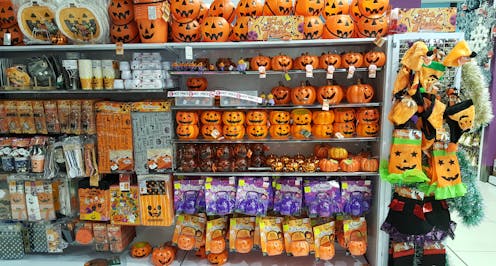
Each year, mass-produced Halloween-related treats, costumes and spooky paraphernalia fill the shelves of supermarkets and department stores in the lead-up to October 31.
A spine-chilling tale of waste
All those consumables lead to a huge amount of waste. First, let’s start with food.
Most data on Halloween food waste relates to the US, but we can assume the problem extends proportionally to Australia.
About one million kilograms of pumpkins are grown in the US each year. Many are carved into jack-o’-lanterns and end up in landfill rather than on the plate. US authorities have warned all these decomposing pumpkins produce methane, which contributes to climate change.
Similarly, research released in 2020 found half of the 24 million pumpkins carved for Halloween in the UK would become food waste. What’s more, 42% of survey respondents didn’t even know pumpkin flesh was edible.
And what about all those treats? Days out from Halloween last year, the US National Retail Federation said overall Halloween-related spending would hit US$10.14 billion, including about $3 billion in candy sales.
Some 70% of UK shoppers expect to buy sweets, chocolates and other treats on Halloween, and the celebration is now the UK’s third biggest commercial celebration after Christmas and Easter.
Individually wrapped lollies are popular fare in modern Halloween celebrations - especially in the pandemic era. But it wasn’t always that way. In decades past, cookies, candied apples and home-made toffee were the common Halloween currency.
Wrapping and packaging does reduce food waste, but it creates plastic waste that litters our roadsides, fills our bins, and pollutes the environment.
Research on Halloween consumption in Australia is in its infancy. But research this month by the Australian Retailers Association found Australians planned to spend about A$430 million on Halloween this year, up on previous years.
Items to be purchased included costumes, sweets, themed food and drinks, and party decorations.
If you plan to decorate your house, beware of buying fake cobwebs – wildlife experts this week warned that animals, particularly birds, could get caught in them and die.
Have a sustainable Halloween
Australia is a largely blank slate when it comes to Halloween culture and tradition. We have a chance to make the tradition our own.
Why not carve a real pumpkin, rather than buying a plastic one, and turn the innards into pumpkin soup or scones? Or try hitting your local op-shop and reworking a fashion nightmare from yesteryear into a spooky Halloween costume?
The World Wildlife Fund offers these other tips for a “green” Halloween:
Reuse decorations from previous years instead of buying new ones. Better still, make your own
Keep old clothes that can be used as costumes, such as worn-out t-shirts
Reduce party waste by avoiding disposable cups, plates and cutlery
Buy locally produced lollies and treats. Look for those with minimal packaging or packaged in recycled materials
Don’t buy a special trick-or-treat bag. Use and decorate household items such as a bucket, pillowcase or old bag, and re-use it each year
When trick-or-treating, walk around your neighborhood instead of driving to do it elsewhere
compost and recycle as much party food, treats, pumpkins and other items as possible.
Read more: Not spooked by Halloween ghost stories? You may have aphantasia
Authors: Olav Muurlink, Associate Professor, Social Innovation, CQUniversity Australia


















